How Long Is The MPB Process? – Hair Loss Information by Dr. William Rassman

How long can MPB take?

My hair kind of leapt into a widow’s peak during 2003/04 and is now considerably thinner than it has ever been in my life. So this is about 5 years maximum – i thought MPB took on average 15 years or more?

What happened?

Once you know you have male pattern baldness (MPB), it remains a progressive process until the day you die, but in reality most people slow down the loss in their late 30s or 40s. There are always exceptions to the rule, but most people are destined to develop a pattern and that pattern is not always a class 6 or 7 pattern (see Norwood Chart below). They may stop at a class 3… but of course, each person is different.

Norwood Chart


Heavy Metal Music and Hair Loss – Balding Blog

My question is in regards to the hairlines of many rock musicians which I have noticed over the years. I’ve been big into heavy music for many years and i’ve notived many of them seem to have slightly receded hairlines which have never gotten worse. Some examples are

Dez Fafara from the band Coal Chamber (now Devildriver), Bass guitarist Oliver Reidel from german heavy metal band Rammstein, And in particular Pogo, once keyboardist for Marilyn Manson who has retained i’d say what’s inbetween a 2 and 3 on the scale for many years.

All of these artists seem to have retained around a 2 and 3 class pattern and has never gotten any worse. I guess it’s possible they all have gotten hair transplants at one point. Any knowlege on this? Is it possible for someone to have they’re hairline recede like that and just stop? I mean it happened to both my uncles who had they’re hairlines recede a bit around my age (19) and now in they’re late 30’s hasn’t gotten much worse. Thanks and hope to hear from you!
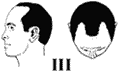
Norwood Class 3You are correct to look at the genetics of your family for the answers. Many people stop at Norwood Class 2 or 3 levels. I actually believe that the Norwood Class 2 pattern of balding is not real balding, but just the appearance of the mature hairline. That being said, I am not Dr. O’Tar Norwood and do not know if he recognized the mature male hairline as a normal transition for a maturing man when updating and devising the Norwood classification system that we use today.

As I’m sure you could likely assume, I’m not a big heavy metal music fan, and didn’t have the foggiest idea who the people you specifically mentioned are. I asked someone on my staff to hunt down these folks, and their photos are presented below:


I don’t see any hair loss in the gentleman on the left, Dez Fafara, as the photos I’ve seen have his long hair covering any pattern that may be present. The other two guys, Oliver Reidel and Pogo aka Madonna Wayne Gacy (thanks Internet!), each appear to be Norwood Class 3. It is completely possible that they stopped at their current levels and did not require any hair restoration, but I have no first hand knowledge about that (and if I did, I couldn’t say).




Related Posts Plugin for WordPress, Blogger...

Balding Forum - Hair Loss Discussion

Applying Rogaine Foam Directly After Showering – Balding Blog

Does applying Rogaine Foam directly after showering with the hair somewhat wet, but not soaked, bring down the effectiveness of the foam? I read through the directions, but it does not specify unlike the old Rogaine solution.

Thanks!

I believe that it should be applied after a shower and after you mostly dry your hair. Circulation in the scalp is high at that time.


Related Posts Plugin for WordPress, Blogger...

Balding Forum - Hair Loss Discussion

48 Year Old Woman with Hair Loss and Thyroid Problems – Hair Loss Information by Dr. William Rassman

Dear Dr. Rassman,
I am writing to you because I would greatly appreciate your opinion as I have read much about you in the past and know you have a wonderful reputation when it comes to hair loss. I am a 48 year old female who has been around the block for several years dealing with AGA since my twenties. I know I carry a predisposition to it, (Dad, brother, Grand dad all went bald early) but assume it was aggravated by the high androgen birth control pills I took for several years as well.

I have tried everything under the sun including avodart for the past two years (which did not work for me, and therefore I went off a month ago) and since December have been using rogaine 5% foam twice a day on most days, the hair max laser comb 3 times a week, taking a hair vitamin containing saw palmetto and other hair friendly vitamins, and trying to eat a well balanced diet. I also was diagnosed with hypothyroid and am currently taking “synthroid” for the past couple years for an underactive thryroid, which I can’t tell if it is making the hair loss worse or not, even though it is suppose to help treat hair loss. I have been taking yasmin now for at least 5 years which is suppose to be a more hair friendly bcp.

(my questions are as follows: Is it worth it for me to see an endocronologist to conduct more tests other than thyroid, and iron levels (normal) at this point in my life? I went to a supposed expert dermatologist here in Boston several years ago who basically took a quick look and said genetic, and dismissed me telling me to try minoxidil..( I never did at that point). I would like to know if you think I have all the basis covered since at 48 I will be entering menopause soon, and can’t afford any more hair loss!

I was told I was not a good candidate for hair transplant, too much hair, and too thin all over and the results would not be any better than what I already have.
I really would appreciate your feed back.. Thank you so much.

You have a double combination of low thyroid and genetic hair loss. In women I have seen, when genetic hair loss is present and low thyroid precipitates more, even correcting the thyroid does not often help. Seeing another doctor may have value, but I am not hopeful. The appearance of menopause adds the third negative, which may or may not make you worse. The use of Rogaine Foam is a good choice and you will have to wait 1-2 years to see the benefits of this treatment. Sorry I can’t be more helpful. I am waiting for some drugs to be introduced or better research which may show us better what is happening to folks like you.

Balding Forum - Hair Loss Discussion

Paid advertisements (not an endorsement):


Hair Loss InformationRemoving vs Camouflaging Old Plugs – Hair Loss Information – Balding Blog

In correcting an old pluggy hair transplant,is it feasible or possible to transplant behind the old plugs first, let this mature, then remove the old plugs so the initial transplants (from the donor area) can camoflage the surgical sites of the excised plugs(this is assuming the old plugs cannot be camoflaged via a transitional zones of fue transplants). I have seen the reverse procedure on your website often when corrective procedures such as this are done. Also, if old plugs need to be excised can you use a flesh colored suture material to minimize post surgical incision lines of the excised plugs? And final question, in determining whether to excise old plugs or place a zone of camoflaging units in front, if the existing hairline is on the borderline (low or high) what is your criteria in your choice.Thanks.

Block Quote

The decision to remove the hairline is a joint arrangement between patient and doctor. Sometimes the social limitations of removing the frontal hairline is just not a good choice for the patient. One should outline the number of surgeries with the various approaches. The decision for FUE, or excision of single plugs and building a hairline in front of the old plugs at the time of the FUE, or individual plug excision, seems to be the choice most patients are making despite a hairline excision which may, in the long term, be a better decision. The location of the old pugs is important. If the old plugs are at least 1 1/4 inches above where the natural juvenile hairline was located originally, then just camouflage may work fine. The lower the hairline, the better is the excision of the hairline, but still many people today are opting for the FUE/selective plug excision and frontal camouflage, because it does not limit their ability to go out in public within days of this surgery.

If My Libido is Better than Ever with Dutasteride, Will It Cause More Hair Loss? – Hair Loss Information – Balding Blog

I have heard on almost every website that Propecia/Avodart decreases your libido and they find it hard to get an erection, however my libido is working better than it ever did. Since taking Avodart, i feel as though it has raised my testosterone and increased my sexual desire. My question is, if Avodart increased my testosterone which it can, will it increase my hairloss. If it has increased my testosterone, does that mean it will continually stay at the same level, what i mean is that will my testosterone always be higher because im taking Avodart or will it slowy decrease over the months. If it will not should i stop taking it as it will increase my hair loss.

Block Quote

I know that men who take Propecia (finasteride) sometimes get an increased sex drive because testosterone levels rise by about 15% on this drug. I don’t have direct experience, but I would expect that Avodart (dutasteride) should have similar effects, because there is a feedback loop which tells your body just how much male hormone it needs. That feedback loop is what causes the rise in testosterone on finasteride.

The value for treating hair loss has nothing to do with your libido, and you should get benefits for hair growth.

Will My Urologist Tell Me to Stop Finasteride? – Hair Loss Information – Balding Blog

Going to see a Urologist next week, will he tell me to stop finasteride?

Hi Doctor. I have been on 1/4 proscar for over a year now with great success, no side effects, and great reqrowth and maintenance. I’m a 26 year old male and went to my hair loss doctor for my yearly check up a few weeks back and he and I were very happy with the way things are going. In the last 3 months however i have had 3 cases of hematospermia, passing blood in the semen accompanied with some minor pelvic pain. I however, have no other problems urinating so it’s clearly something to do with the prostate. My family GP gave me some antibiotics, which seemed to clear one episode and he referred me a urologist to get it checked out further. He mentioned that the fact i was on finasteride would have to be seriously looked at when I visit the urologist. I mentioned all of this to my hair loss doctor during my yearly consultation, now this guy is very ethical and has over 20 years in micro surgery and over 2000 patients my age on the drug. He told me that the finasteride had nothing to do with it.

In fairness to finasteride, I was on it for 10 months without a hitch before I started getting episodes of hematospermia. I’m just worried that the urologist may ask me to stop it as he clearly will not be concerned about male pattern baldness…and effectively lose the wonderful gains the drug has provided me.

In your experience have you ever encountered cases of hematospermia any more in patients on finasteride in my age group? Do you think it may have anything to do with it, what about prostate shrinkage?

Thank you so much and i hope you can help me on this, i really hold your opinion i this area in high regard.

Regards

Block Quote

People who are not on finasteride do develop hematospermia, so I would expect that people on the drug will be at the same risks. I doubt that the drug is contributing to the problem and would agree that finasteride should be continued. I would doubt that a urologist would ask you to stop this, considering the benefit you have achieved.

Months After My Transplant, There’s Dead Hairs In My Scalp – Hair Loss Information by Dr. William Rassman

I received a 3100 graft procedure a little over 5 months ago in the 1/3 frontal area. I see a lot of growth, but also noticed that there are areas that still have the short, blunt hairs that were originally in the follicle when it was transplanted. They never grew, nor ever fell out. If I take a tweezer to them, the hair just slips right out, and has a bent area where it’s in the scalp. Also there are black bumps at the scalp that if pulled with a tweezer, keeps getting longer and longer until it comes out of the scalp. No pain, just seems like dead hairs. Can you “shed” some light on any of this?

I am sure that when you pluck these short hairs, you will not see any bulb with them. These reflect remnants of the old hairs and they are not growth from new hair follicles. I see this in a few patients and they usually fall out with good washing.

Balding Forum - Hair Loss Discussion

Paid advertisements (not an endorsement):


I Had Poor Results After a Transplant 11 Months Ago — What Can I Suggest to My Doctor? – Hair Loss Information by Dr. William Rassman

Hello Dr Rassman,
i had a hair transplant surgery,(strip method of 2400grafts approx)from a well reputable doctor about 11 months ago with relatively poor results in the crown area. what can i do in my case, what can i suggest to my doctor? my doctor would make the final assets at the 12th-14th month he told me. (what usaualy happens in cases like mine?)
Thank you

Failure to grow can happen, even if everything is done right. Assuming that your doctor and his/her team did it all right and you did not grow the hair, you should sit down with your doctor for a frank discussion of the problem. His/her experience should produce a good interchange with the risks of failure amongst the possible outcomes. In the hands of an inexperienced team, failure rates might be much higher. On the rare occasions that I have seen failures of the transplants to grow, I have offered to repeat them at my cost. Sometimes it grows just fine the second time, yet sometimes it does not grow even on the second round. I generally wait a year to determine what the results will probably be.

The profession has called the failure of a hair transplant to grow, the “X” (unknown) factor. This distinguishes the cause from the “H” (human) factor, which reflects defects in either the surgeon’s control or the transplant surgeon’s team. Some of the causes of “H” factor include trauma to the grafts caused by drying (leaving the grafts exposed to air for more than 30 seconds at a time), or rough handling, or a switch of the solutions used in error from saline or Ringer’s solution to distilled water (slop in protocols and process of the team).

Failures in follicular unit extraction (FUE), in particular, reflect many elements of damage caused by the extraction process which have been defined by me and some other experts at various medical meetings. Lack of required skills in FUE is the most common cause of graft growth failures. Some of the causes of failure to grow may reflect autoimmune diseases such as diffuse alopecia areata, which has no real physical presentation for an easy diagnosis other than a series of biopsies to look at the scalp under the microscope.

Balding Forum - Hair Loss Discussion

Paid advertisements (not an endorsement):


Body Hair or Scalp Hair — Which Grows Faster? – Hair Loss Information by Dr. William Rassman

which grows faster body hair or scalp hair?

The cycle of hair growth is shorter with body hair than scalp hair.

If what you are actually wondering is whether or not body hair or scalp hair will grow faster after a hair transplant, that would require some experience with body hair for an answer. I frankly do not have the answer for that, other than to say that hair growth after a hair transplant ranges from immediate to about 5 months on average.

Balding Forum - Hair Loss Discussion

Paid advertisements (not an endorsement):