
In the News – DigniCap Cleared for Final Clinical Trials – Hair Loss Information – Balding Blog

Snippet from the article:

Hair loss is often a depressing signature of chemotherapy, particularly disturbing for women who have to undergo treatment. One way to help prevent hair loss during chemo sessions is to cool the scalp, narrowing blood vessels around hair follicles and slowing the uptake of the poison in the area.

A system called DigniCap from Dignitana (Lund, Sweden) has just been FDA cleared for final clinical trials and may soon become available in the U.S. to help prevent chemo related hair loss. DigniCap consists of a touch screen equipped refrigeration and control unit that monitors scalp temperature and delivers cooling liquid to the inner cap.

Block Quote

Read the rest — DigniCap to Help Prevent Chemo Caused Hair Loss Cleared for FDA Trial

We have discussed the concept in a series of previous posts about a device called the Cold Cap. It seems that the technology has gotten better since we wrote about it.
Hair Loss InformationApplying Betadine After a Hair Transplant – Hair Loss Information – Balding Blog

after hair transplant about 15 days, I have been infected with pimple not sure it is folliculitis or not. My doctor let me take doxycycline and use betadine leave it for 5 minutes and wash. If I use betadine 2 or 3 times a days can it affect graft survival?

Block Quote

Betadine is a strong antiseptic containing an iodine solution that will significantly reduce the presence of skin bacteria. Infections 15 days after a hair transplant rarely are caused by skin bacteria. Many times the cause is as simple as scratching the scalp, thereby breaking the skin and introducing a source for skin bacteria to invade into and through the skin. When applied topically, Betadine will not hurt the grafts at this stage.

I am not sure what the problem is that you’re experiencing, so it is impossible for me to comment on a treatment. At the least, a picture may help. But since you’re under the care of your doctor, I’d go with his/her treatment plan.

Would a Norwood 6 Patient That Had 7000+ Grafts Still Need Propecia or Rogaine? – Hair Loss Information – Balding Blog

Thanks for the great effort here.

I just want to know, why minoxidil or finasteride are required after a hair transplant?

Let’s say a male, 45, with great donor area, Norwood class 6, had 3 sessions over 2 years, and was given 7000 – 8000 grafts covering his hairline, front, vertex and crown. Since most of his balding areas are covered, and the transplanted hair is genetically programmed not to fall off, why would this patient still require the minoxidil and/ or finasteride?

Thanks for your answer to this small query!

Block Quote

Most patients in that situation do not stay on these drugs. It is worth noting that if there is residual hair still present or the fringe area has not been impacted and shows signs of miniaturization, then these drugs have value.

If you were a Norwood 3, for example, then finasteride would help minimize shock loss following surgery and help to maintain the existing hair around the transplanted areas.

In the News – Chinese Men Using Western Hair Loss Treatments Instead of Snake Oils – Hair Loss Information – Balding Blog

Snippet from the article:

After raw-ginger scalp rubs and walnut snacks failed to counter Shi Yang’s receding hairline, the 26-year-old Shanghai engineer says he’s ready to ditch his mother’s advice and give Western drugs a go.

Traditional herbal remedies for male pattern baldness are losing ground to treatments such as Merck & Co.’s Propecia and Johnson & Johnson’s Rogaine in China, where a full head of black hair on a man is a sign of health and virility. Shi, a slim, bespectacled college graduate, has a better chance of landing a girlfriend with a thick thatch of hair like President Xi Jinping or Premier Li Keqiang, both of whom are in their 50s, he said.

Sales of Western hair-loss treatments doubled in China the past five years, growing almost twice as fast as the broader hair-product segment, according to Euromonitor International. The hair-loss market is still small because baldness is only now being seen as a problem requiring pharmaceutical help, and Western companies have only recently begun to seize on the concern.

Block Quote

Read the rest — Snake Gall Bladders Ditched for Drugs by Balding Chinese

Hair Loss InformationAccelerated Follicular Restoration to Speed Up Growth After a Hair Transplant? – Hair Loss Information – Balding Blog

Any thoughts on this Help Hair product that claims to accelerate the growth process after a transplant, so that it only takes 6 months to see the full results after surgery? It claims to reduce or eliminate the telogen phase after a hair transplant!

Press release from 2011 – link
Product page (with link to a study of 115 hair transplant patients) – link

Block Quote

I have been following the Help Hair product for some time, but I have been reluctant to hop on board because of the lack of clinical evidence that it works. On a positive note, it is logical, and the theory that “increased anabolic metabolism can affect regeneration of the hair follicle” makes sense (after all, we are what we eat). The change in diet brought on by this product may have no effect on a person who is healthy and eats healthy foods, but there may be a fine line between those with a good diet and those who might benefit from a better diet.

If I saw a good scientific study, I might want to endorse this product’s use in our practice, but as this increases the costs for our patients, I really want to see better evidence.

In our practice and in the years I have been doing hair transplants, most of the grafts routinely have started to grow within 6 months, and once hair starts to grow, it grows at 1/2 inch per month. So for example, for the transplanted hairs that grow out by the 5th month, we will see 1/2 inch length at the 6th month. I would be interested to see reports of when the hair actually starts to grow, and then use the 1/2 inch rule to determine when the “full results” are actually achieved.

Not Hair Loss News – Doctor Claims to Cure Cancer, Is Possibly a Quack – Hair Loss Information – Balding Blog

Snippet from the article:

Hundreds of thousands of pounds have been raised to send British patients to a doctor in America who claims he can “cure cancer”. But Dr Stanislaw Burzynski’s treatment has been dismissed by practitioners of mainstream medicine.

It looked like something out of Willy Wonka’s factory. A room full of pipes and noise; a production process that flowed through steel tubes, steaming boilers and glass tanks of bubbling liquid. But there was one striking difference from a chocolate factory – the whole room smelled of urine. This is an industrial facility in Texas which produces the drug at the heart of Dr Stanislaw Burzynski’s treatment. He thinks the cure to cancer can be found inside our bodies, substances in blood and urine that switch off cancer cells.

Dr Burzynski calls them antineoplastons. He used to extract them from human urine, but he now uses chemicals. Up to 300 litres of the drug, which has never been licensed, are produced in this factory every day.

Block Quote

Read the rest — Curing cancer or ‘selling hope’ to the vulnerable?

We look for heroes who break the rules imposed by traditional medicine, working with diseases impossible to cure. Hope is a strong drive and many times regular channels in medicine do not give the hope to those who feel abandoned.

I have seen reports on this doctor and although there is little evidence that what treatments he offers has value, he offers optimism for people with terminal diseases who do not otherwise have much to hope for.

Would Finasteride Treat Hair Loss While I’m Taking an SSRI? – Hair Loss Information – Balding Blog

I’m 18 years old and have been on an SSRI, which has caused a diffuse hair loss. This has also seemed to kick off MPB. Obviously my mental health takes priority however is there any chance of finasteride being successful in treating the MPB side while i am still taking the SSRI which causes a telogen effluvium?

thanks.

Block Quote

If your SSRI (e.g. some antidepressants) kicked off the genetic balding process, then the use of finasteride may have value for the treatment of the genetic component of your hair loss. If the hair loss isn’t related to your genetics, the finasteride is unnecessary.

I Quickly Saw Great Improvement from Propecia, Then It All Started Shedding Just as Fast – Hair Loss Information – Balding Blog

I am 23 and have been experiencing MPB since age 16. I decided to try Propecia 6 months ago. After 2 months, I started getting fantastic results (hair looked WAY thicker, nothing was falling out). However, a month or so later, Propecia seemed to stop working. I am now in month six, and for the last 3 months my hair has been shedding and falling out like it was before I started the drug and it seems it has completely stopped working. I even called Merck and they told me they had NEVER heard of anyone responding positively so quickly and then stopping. Is it possible for a “shed” to last over three months and then revert back to positive results?

Interestingly, I had the SAME reaction when I tried Saw Palmetto a year ago. It worked great for a month or so and then completely stopped. Does my MPB overpower the DHT inhibitors and create some sort of immunity? I did not stick with Saw Palmetto for more than a few weeks after it stopped “working,” but I have stuck with Propecia so far.

Please let me know if you have any advice as I am desperate for some guidance. (I am no longer with my prescribing doctor and have nowhere to turn)

Block Quote

An uncommon report from some people starting on the drug is that they experience shedding. When this occurs, it generally disappears after one or two months. You’re asking about three to four months of shedding caused by the drug, and I frankly have not seen that report. The real effects of Propecia take a year or so, in some people up to two years. Patience is a virtue.

It is unusual to see fantastic results in just a couple months, so I’m not really sure what you saw. Since it is a prescription medication and you’re no longer with your prescribing doctor, the best thing I can recommend is to find another doctor and have him/her handle your care. Hopefully you can get some metrics to compare your hair today to your hair a year from now to see if you’re experiencing any benefits from the medication.

You could have accelerated hair loss from the genetic impact. The hair loss cycle with those that have genetic hair loss can come in spurts and slow periods, and the only way to know is to watch it over time while you are on Propecia.

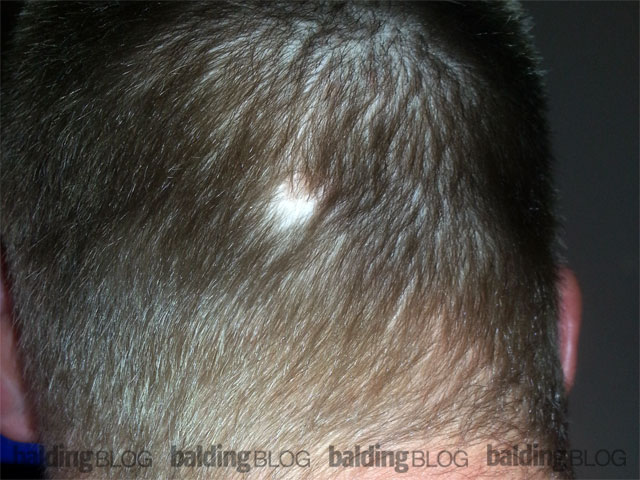
I Found a Bald Spot in the Back of My Head (with Photo) – Hair Loss Information – Balding Blog

I am 24, male. And found this bald spot a few days ago and getting really worried and dont know why or how it’s there. I would like help and advice if possible please thanks.

Block Quote

Click the photo to enlarge:


You should see a dermatologist. There are many conditions that can cause such a bald spot, including alopecia areata, fungal infection, allergy, injury, stress, etc. Is the spot growing in size since you first noticed it?

In the News – Growth Factor for Follicle Generation During Wound Healing Identified – Hair Loss Information – Balding Blog

Snippet from the article:

Researchers in the Perelman School of Medicine at the University of Pennsylvania have determined the role of a key growth factor, found in skin cells of limited quantities in humans, which helps hair follicles form and regenerate during the wound healing process. When this growth factor, called Fgf9, was overexpressed in a mouse model, there was a two- to three-fold increase in the number of new hair follicles produced. Researchers believe that this growth factor could be used therapeutically for people with various hair and scalp disorders. The study appears in an advance online publication of Nature Medicine.

“The findings help explain why humans don’t regenerate their hair after wounding,” said senior author George Cotsarelis, MD, professor and chair of Dermatology. “The study also points us to a way to treat wounds and grow hair.”

Block Quote

Read the rest — Growth factor responsible for triggering hair follicle generation during wound healing identified

Exciting stuff from a world renowned researcher!