Hair Loss InformationHair Transplant Candidate Couldn’t Believe SMP Patient Had Pigmentation Done – Hair Loss Information – Balding Blog

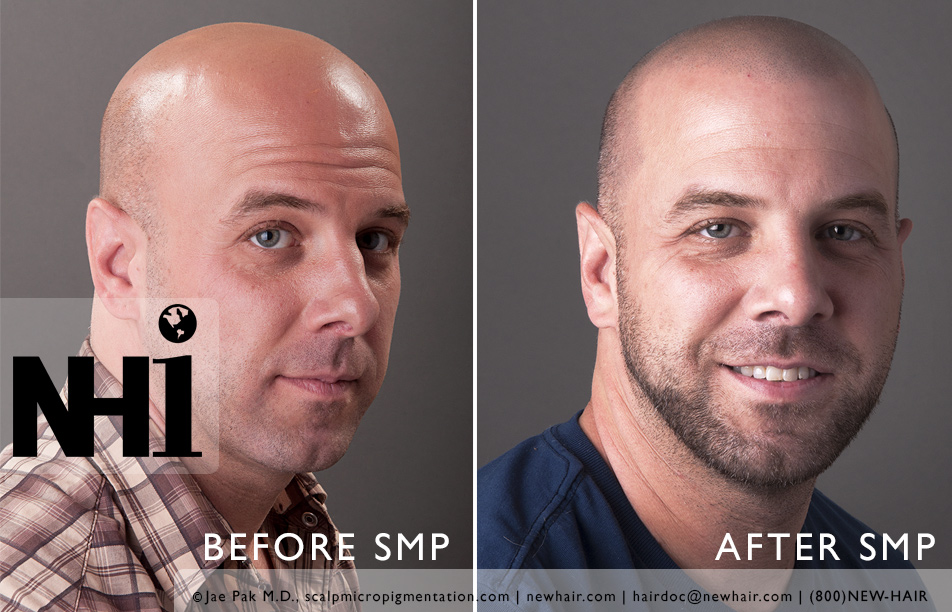
At our most recent open house event, we had three of our Scalp MicroPigmentation (SMP) patients show up along with numerous other people exploring the hair transplant option. As the guests interacted with each other, I overheard a conversation between one of our SMP patients (Alex) and another man at the event (let’s call him Bruce).

Bruce had sarcastically asked Alex if he came to the event just to make balding people like him feel bad about themselves, and the two began a seemingly heated debate about hair loss. Alex told Bruce that he was actually very bald and that he had SMP done. Bruce did not believe him, so as the conversation frustrated Alex, he was invited to feel the front and top of Alex’s head, which was very smooth. Alex then told him to feel the hair stubble on the back of his head, which looked just like the front and top of his head. That was Bruce’s introduction to SMP, and the two of them laughed loudly enough for others to curiously join the conversation.

Bruce actually signed up for an SMP procedure before he left our open house, as he became a believer. Seeing is believing.

SMP before and after

Since You See Many Patients Taking Finasteride, Can You Know My Chances of Keeping My Hair? – Hair Loss Information – Balding Blog

Hi,
You must see lots of patients taking finasteride. My question is, how many of these patients have seen no progression of their hairloss during a long period of time?

I am a Norwood 2 at 21 years old and I have been taking finasteride since 6 months. It’s been a longtime since I have a receding hairline. However, it’s hard to know how many hairs I’ve lost because I’ve always had a haircut who hided quite well my receding hairline.

My father and the father of my father have lost a lot of their hairs but they are still far from being bald and their hairloss started in their early 40s. The father of my mother is not bald either but he’s quite close. But he lost lot of hairs during the last 20 years.

With your experience, do you think I have great chances to keep all my hair during at least 10 more years? Thanks!

Block Quote

At 21 years old, one can not generally predict if balding will happen unless there is physical evidence of balding present. Early balding to the naked eye is easy when it is there, but often the process does not start for a few years (at least for you). Most balding men show a balding pattern by age 26, but that is not a certainty.

The best way to follow your balding process, if you have it, is to come into our office with your hair at least 2 inches long and get us to measure your hair bulk throughout your scalp. Even if there is no visible balding pattern yet, everyone will show hair bulk reductions with this measurement tool if there is hair loss. We then may recommend the use of finasteride in an attempt to slow, stop, or reverse the hair loss. This hair bulk measurement is also terrific for following the progression of hair loss from not visible hair loss to patterned hair loss, over time.

Hair Loss InformationIn the News – Reality TV Dance Contestant Uses Alopecia to Her Advantage – Hair Loss Information – Balding Blog

Snippet from the article:

Franchesca BassSo You Think You Can Dance has done it again in Season 11 with another unforgettable dancer and audition courtesy of Franchesca Bass.

The 18-year-old dancer from Indiana was born with Alopecia Areata which made her stand out automatically in appearance but even more with her dancing. She took her condition and used it to her advantage by creating a character for her performance. She called herself an alien who was afraid to be around others. And holy crap, did she deliver. Her alien side came alive and got her a ticket straight through to Vegas.

Block Quote

Read the rest — ‘SYTYCD’s Stunning Franchesca Bass Doesn’t Let Her Condition Weigh Her Down

Check out the video of her dancing on YouTube or at the link above. This teen was empowered by her alopecia totalis or alopecia universalis, and used it in her dance routine to make it to the next round of this reality TV show.

The Hair Transplant of Pakistan’s Prime Minister? – Hair Loss Information – Balding Blog

Pakistan’s prime minister has gotten a hair transplant a few years ago. His results are amazing. However, even with the hair transplant sometimes he looks like he has no hair in the frontal zone and sometimes he looks like he has a lot of hair in the frontal zone.

Here is a picture under the sunlight where his front zone looks empty. Photo

If Nawaz went for another procedure, is there any possibility he can get a result where even if he stood under the sun, his hair transplant results would show a fuller appearance in the frontal zone? Please give your advise.

Block Quote

Nawaz SharifNawaz Sharif could fill up the frontal area with another procedure and get some more hair on the top of his head, but as has a Norwood class 7 balding pattern with what appears to be fine hair, I doubt that he will ever look completely full.

In our practice, we have performed hair transplants on people with fine and average weight hair. Those with fine hair, never really look full although I have done upwards of 9000 grafts on these people; however, with an average weight hair we have succeed in getting good coverage with a good styling technique to enhance the distribution of the transplants with about 9,000+ grafts. Many Asian class 7 pattern patients will not have the density to move that high number of grafts, so even with a better hair thickness, the ability to extract and move 9000 grafts may not be possible if the density is typical of most Asians.

Of course, one other way you can give the appearance of fullness would be through the use of Scalp MicroPigmentation (SMP).

Started Taking Finasteride When I Had No Hair Loss – Now I’m Scared to Quit! – Hair Loss Information – Balding Blog

First of all I would like to thank you doctors for allowing time out of your days to answer questions. I began shedding more hair than normal 3 years ago at age 22. I received the opinion of two dermatologists that I was not experiencing male pattern baldness. Even with these opinions I became paranoid based on the increased shed and my maternal grandfather and uncles baldness so I began using finasteride.

I showed no visible signs of hair loss then and do not now at the age of twenty-five. I am scared to stop using finasteride because if I am genetically predisposed I know I will lose what I have prevented the past three years. My question is, based on my age and beginning the treatment early do I have a good chance of keeping my hair well into older age and is it worth suspending the treatment just to see if I need to be taking the drug or not?

Block Quote

Paranoia is clearly not a good reason to take a prescription drug meant for treating something you might not even have.

At 25 years old, you still might see hair loss if you have the genes for it, but I have no way to know if finasteride is protecting your hair or if it is an unnecessary daily medication. I would see a doctor first and foremost, so that you can have an exam and any hair loss that is observed can be noted. Your doctor may decide to discontinue your medication and just have you keep your fingers crossed that there’s no loss that finasteride was delaying.

Hair Loss InformationOur SMP Photos Are Being Copied by So-Called SMP Experts – Hair Loss Information – Balding Blog

Hey docs, I swear I think these are your SMP photos on this other site: [link removed]

If this isn’t your website I’m not sure what you can do, but I just wanted to let you know. I didn’t know if maybe you were going under a different name for different markets or something.

Block Quote

Those are our photos, but that is not our site. We have become aware that many of our photographs on our Scalp MicroPigmentation (SMP) site have been copied by some people, tattooists, doctors, etc.. who want the public to believe that they have extensive experience with SMP. I am personally affronted and taking the proper legal action; however, the great crime is that many people who see our photos on these sites where these representations are made, may be tricked into a procedure with one of these criminal groups.

These groups clearly don’t know what they are doing or they would show their own work. If you are not careful on selecting a proven provider, you could become a victim. As we have always said on this site, “Let the Buyer Beware,” and here you must do your diligence to avoid becoming a victim.

When a doctor from overseas stole one of my books and published it under his name, he could not understand why I was so upset. He felt that this was the greatest form of flattery (i.e. he felt so strongly that my book was the best on the market so he did the natural thing and republished it under his name as if it was an ‘endorsement’).

Hair Loss InformationGerman Football Player Marco Reus’ Hairline? – Hair Loss Information – Balding Blog

Marco ReusWhat sort of hairline does German football player Marco Reus look like he has?

Block Quote

I’ll admit that I don’t have the foggiest idea who this is, but Google Image Search was able to show me some photos. Photo 1, Photo 2, Photo 3

From the photos I saw (links to a random 3 above), it appears to be a solid hairline with possibly a slight bit of corner recession. It is difficult to be sure if there is really balding present, but I suspect there is some maturing of his hairline, as seen in photo 2 (some photos appear that he styles the hairline corners to mask this). In any case, this young man has the hairline that many men would be envious of.

Does FUE Change Donor Area Planning? – Hair Loss Information – Balding Blog

Dr. Russell Knudsen (from Australia) wrote in informative article in this months “Hair Transplant Forum International”. Clearly, the ability to harvest the donor area with FUE will be more restrictive in individuals who have more extensive balding patterns (Class 5, 6 and 7 patterns of balding). The donor area around the sides and back of the head reflect 25% of the original total hair count on the head (I call it my 25% rule). If one targets somewhere between half or 2/3rds of the follicular units found in the donor area, as the maximum safe yield for FUE over time, then for Caucasians with average hair density (100,000 hairs on their head or 50,000 follicular units in the permanent zone) might be able to safely harvest as much as between 6,250 (half) or 8,250 (2/3rds) from the 12,500 follicular units in the permanent zone (25% rule).

In those individuals with higher densities than 100,000 hairs on their head, the harvestable follicular unit numbers may safely go higher, while in the typical Asian, for example with lower hair densities (80,000 hairs on their head or 40,000 follicular units), the donor area would contain only 10,000 follicular units. With half of the Asian’s 10,000 follicular units harvested, that leaves 5,000 follicular units behind (this reflects a calculation of 25% of the birth hair follicular unit numbers which are permanent). I believe that extracting between one out of every two follicular units from the permanent zone may be pushing the limit on people with low density hair.

There may be reasonable limits for a typical Asian based upon hair density (we calculate hair density on every patient undergoing hair transplant surgery). To complicate matters, Asian follicular unit hair counts average less than two hairs per follicular unit, so to get out an average of two hair FUE grafts, it takes more follicular units to yield an average of two hair FUE grafts. Asians (or Caucasians with low hair density) who have a high number of FUEs will, in my opinion, be thin looking around the back and sides of the head. I have seen some Asians with significant track marks from the punch scars created by FUE, particularly when the harvesting numbers are high and the remaining donor hair is significantly lessened.

Many doctors are taking hair from the non-permanent area to give the patient the benefits of more hair in the transplant; however, this may spell disaster for the patient who develops more extensive balding (suggested by Dr. Knudsen). Hair taken from the non-permanent area will be lost with aging and/or advancement of the balding patterns. Over zealous FUE beyond the permanent zone, has long term consequences for some patients and they must be warned. I have seen some patients who’s balding had accelerated from multiple FUE procedures and have loss hair in areas where FUE grafts were taken while leaving visible scars.

I want to raise blood supply issues here as I have seen one patient already who had received 6700 FUE grafts in two sessions and lost more hair in the permanent zone than was removed by the surgeon during the FUE. I actually counted the grafts and the hairs on the head and had done density studies on him before another surgeon did surgery on him. When FUE numbers are pushed, this patient’s findings suggested vascular compromise may have occurred impacting the remaining hair in the donor area. I have heard, second hand, that at the last ISHRS meeting some cases of necrosis have appeared in the donor area when too many FUEs were done, possibly too close together. I don’t believe we really understanding the complications of large FUE sessions, or that doctors are not reporting their complications out of fear of professional ridicule and/or malpractice risks, all of which may become a factor in the long term future of this surgery. As we do many FUE cases in our practice, we are not anti-FUE; however, aggressive FUE megasessions in the wrong hands could be a problem.

In conclusion, “do FUE surgeries change donor area planning”, the answer is YES. FUE will impact long term planning and may impact strip surgery in future surgeries. Low density donor areas, resulting from FUE, make for less donor hair for a strip surgery, which will only make any scarring more visible as the hair is cut short.

Around the Web – Does Chemotherapy Always Cause Hair Loss? – Hair Loss Information – Balding Blog

Snippet:

Question: I may have to have chemotherapy. Will I go bald?

Answer: Hair loss is not certain with chemotherapy. Whether you lose hair depends upon the medication and dose your doctor prescribes.

Chemotherapy is a systemic treatment that uses drugs to kill malignant cells, bacteria, viruses and fungi. Chemotherapy drugs are used to treat cancer, bone marrow diseases, rheumatoid arthritis and lupus. The drugs can be given by injection or taken orally. There are also topical creams.

Chemotherapy drugs attack rapidly growing cancer cells. They also attack other rapidly growing cells in your body such as those in your hair roots. Each patient reacts differently to these drugs. Some newer chemotherapy drugs may cause fewer side effects.

Block Quote

Read the rest — Does Chemotherapy Always Cause Hair Loss?

This is a pretty good write-up about chemo and hair loss.

Hair Loss InformationWhy is SMP Better on Some Scars than Others? – Hair Loss Information – Balding Blog

I’m really interested in the scalp micro pigments / SMP and I’ve reviewed the results of SMP on your sites along with some of your competitors. There’s clear differences in the results, even on your site alone. How do you explain these differences?

How do you deal with scarring from previous surgeries of the transplant variety and can SMP do a good job covering it up for everyone with such scars?

Block Quote

I’m going to reference a couple patients found on our SMP Photo Gallery and explain why the results are so different and so obvious…

Patient 20 is the ideal patient result with a scar from a previous hair transplant. The scar was flat and uniform and was the result of a single surgical procedure with bad healing which caused the scar to stretch. The surgeon who did this patient did nothing wrong. When we did the SMP, we worked on a uniform scar surface, there were no divots or elevated areas on the scar, so the process worked perfectly. Contrary to what you see, the scar is still there and just as big as before, and if you ran you finger over it you would feel what you can not see.

Patient 51 had great results as well with the old drilled holes in his scalp from the old fashioned (now abandoned) surgical procedure called Open Donor Technique. He also had a strip surgery which accounted for the horizontal scar. The skin on the Open Donor Wounds turned out to be relatively flat, so the pigment was taken up well and uniformly, providing great results; however, the horizontal scar from the strip procedure was elevated and even though the skin took the pigment very well, the elevated scar could be soon.

These patients shaved their head for the procedure. They may have intended to grow out their hair and if they did, Patient 51 would have no obvious scar seen; however, Patient 20 would have to be careful, because the invisible scar would not grow any hair while the scalp above and below the scar would grow hair. This would be seen in the transition of early growth of the hair above and below the scar. When the hair is long enough, it will not be a problem because his hair stylist will account for the absence of hair from the scar.

We don’t always shave the head. As a matter of fact, we don’t shave the entire scalp in the area we work much of the time. That becomes a choice of the patient.

Finally, SMP is not real hair. SMP is applied under the skin, like a tattoo. It cannot possibly remove, erase, or make scars completely invisible. We do our best to blend in the scar and make it look less obvious, but the scar will always be there and will be noticed in certain lighting and at certain viewing angles. The goal is for the casual observer to not notice the scar.