Patients from India often write asking about hair loss and recommendation of number of grafts he needs. – Hair Loss Information – Balding Blog

I am loosing hair from my crown portion of my head. I am in New Delhi (India) and one of the doctors at New Delhi advised me 1000 hair not grafts. How much area will 1000 hair cover?
howmany

Block Quote

There is a tendency for doctors in some geographic areas to prey on people losing hair. Your question supplies little information, but I will take liberties and assume that you’re a young man desperate over his hair loss. Based on the many, many emails I receive daily it seems that in India hair loss implies some lack of manliness and if you’re balding will not be able to find a bride. These young men will try anything offered and if they have the money, there are doctors who will offer hair transplants to anyone because they make money doing it. We see the same phenomenon in western societies.

If a balding person is ignorant, naive, has money to burn, and wants a quick fix, then the first solution for some doctors is to push for a hair transplant. That is not right, not moral, and makes the unfortunate individual into a victim, many times leaving him deformed in some way. Simply put, not everyone is a candidate for surgery.

While I have written posts like this from time to time over the years, I felt that it needed to be restated. This blog is written as our attempt to educate the public so that when anyone searches Google, low and behold, we come up. We try to make this blog easy to read and direct. I hope that we accomplish this.

To answer the question posed, yes 1000 grafts would produce detectable hair but the degree of cosmetic benefit or how much it would cover is highly variable with the type of hair loss, hair to skin contrast, hair length, etc. You need a second opinion from someone who can examine you. A one line question with a number will not address your problem.

Not Hair loss News – Technology Changes The lives of The Handicap – Hair Loss Information – Balding Blog

point-and-read-for-the-blind
(Photo : MIT Fluid Interfaces Research Group)

A ‘wearable ring helps the blind read’ shown here is a great advance. I am amazed how much technology can help the handicap person. It makes me feel real good to see such advances in technology that helps such people. The advances keep coming with artificial limbs that work more naturally, artificial pancreas for diabetics

Anxiety, Testicular Pain on Propecia – Finateride, and Half-Life of Biochemistry – Hair Loss Information – Balding Blog

I had been experiencing hair loss the last year and now my hairline has started receding.

I am now 24 and i was in denial but now that it’s visible i started propecia although i didn’t want to because of the horror stories i read. After i started i had testicular pain and i felt a lot of anxiety and stress so i decided to stop. It’s been a week since i stopped the 1 mg per day. How long do the effects of it need until they are gone?

From a study i read the byproduct ([3H]dihydrofinasteride) has a half life of 1 month and the intermediate adduct of it (NADP-dihydrofinasteride) still effects DHT production. Will i need that long to be sure that it doesn’t creates me the stress i feel? The fact that finasteride is an irreversible 5AR2 inhibitor means that i will have to wait for new 5AR2 enzyme to be reproduced, and can this be downregulated in any way? Is my anxiety caused by the the inhibition of allopregnanolone maybe?

Thanks for your time, your input and knowledge based on your experience will be very helpful.
anxiety

Block Quote

For all practical purposes, the half life of Propecia (finasteride 1mg) in your blood stream is about 4-6 hours. This means the drug should be out of your blood stream in one day. This is why you need to take the medication everyday. Some believe there is a component of tissue fixation where some residual drug linger on for about one week. This is why we often write that if you experience a side effect you should see it reverse in about one week.

It is quite a remarkable coincidence that as someone who was apprehensive about taking Propecia from reading the “horror” stories of on the Internet also happen to get the rare side effects. Testicular pain and anxiety as a side effect in it of itself individually is probably less than one percent but having BOTH would be even rare. Also note that these symptoms are not even reported in the actual drug insert. Please note that I am not trying to ignore what you are experiencing but rather you should also speak to your doctor as testicular pain is a very serious medical issue that may not be related to the medication itself.

With respect to all the biochemistry questions of the breakdown of Propecia, I do not believe it has anything to do with your issues. I am also not a biochemistry expert to state all the importance and functions of the enzymes or hormones you are trying to correlate with your issues. I have said many times before, our body and its function/dysfunction is not so simple to define with single biochemistry pathways.

With all due respect your “anxiety” may just be more of a psychological issue rather than these enzymes and by products of Propecia. Because if you really want to really get in to all the biochemical process behind your “anxiety”, you must think of all the other medications you may be taking (for example: anti-depressant drugs can cause sexual dysfunction, anxiety, suicidal feelings, etc), recreational drugs you may be using or have used (for example: effects of marijuana, cocaine etc can cause long lasting mood related side effects), your social life (for example: dating in your 20’s while losing hair in it of it self can be filled with anxiety), the sun exposure you have (for example: not having enough sun light can cause psychological effects), your childhood experiences (for example: you can fill in the blank and blame x y z from your childhood), the friends you have, etc etc etc. This list is endless and Bladingblog and a short paragraph cannot begin to understand the big picture nor solve your issues. I will say again, biochemistry alone does not explain your mood.

My final point: TALK WITH YOUR DOCTOR for your anxiety issues and your testicular pain.

Experimental ACell Injections? – Hair Loss Information – Balding Blog

I was just curious if you planned on experimenting with acell injections along with your other acell trials.
If you are I would love to pay to test the effectiveness of the product, as I can not use finasteride due to side effects.

thank you for your time,

Block Quote

There is no rational nor are there valid research studies for ACell injections into a bald scalp. We do not do things that do not have the potential to work. Thanks for asking.

Hair Loss InformationApproaches To Treat Hair Transplant Plugs And Costs – Hair Loss Information – Balding Blog

Do you have a cost to remove hair plugs and what will the scalp look like after removing them?

I’m in Kansas City?

Block Quote
The cost to repair this type of problem can range from $3000 to over $10,000. Most doctors have developed strategies for the treatment of hair plugs that include:

(a) This problem is created when the doctor tries to thicken the frontal hair where balding or thinning occurs. Over time, the hair is lost from continuation of the balding process and only the plugs remain. This patients hairline was easily 1-2 inches lower than the lowest of the hair plugs in this picture. Direct removal, possibly using a punch like instrument, depending upon the size of the plug works, but this often leaves whitish scars where the plugs were originally located. This may turn out to be expensive and with the scarring it is not satisfactory. The larger the plugs, the worse the scarring. Many doctors charge a per plug cost with a minimum fee. If you had this problem, I would recommend the approach shown in (b) below.

Some example are HERE

(b) Partial removal: This has gained popularity over the past decade where a punch is used to remove some of the plug (between 30-80% of it) and then re-transplant what was removed around the original plugs to produce either more fullness in the vacant areas, or create camouflage around the areas where the plugs are detectable using more hair transplanted grafts to fill the area up. This technique has been pioneered by us and is a standard around the world.

(c) Camouflage with small grafts: This is effective, providing that the plugs are not in the frontal hairline and there is enough donor hair. The patient should understand that he often must keep his hair long (at least 1 1/2 inches). We often do some partial plug removal for plugs that are in the area of the hairline. For plugs in the frontal hairline in addition to thinning these plugs out, we often recreate a new hairline at least 1/2 inch in front of what was originally the pluggy hairline. If the above patient were to take this route, the pluggy hairline is so high, that a new hairline in a normal location would create a very normal look. When such patients comb their hair back, the old hair transplants are hidden behind the new hairline. Creation of a new hairline may be expensive both on hair and money as it often takes approximately 1000+ grafts for a good job depending on how far forward the new hairline is made. Many people with the old pluggy look have depleted donor areas so that the choice of creating a new hairline may become impractical. This technique has been pioneered by us and is now standard around the world. This would be our preferred approach to this problem for most patients.

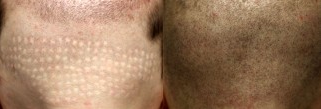
(d) Scalp Micropigmentation (SMP): This is a new approach and is now used more and more in our practice. SMP which is truly an artistic process, accomplishes three objectives. (1) The presence of the pigmented ‘dots’ obscures the large plugs. This can not be performed at the hairline level, only behind the hairline, and if the man in the photos wanted this, he would have to maintain a shaved scalp with the newly created pigmented hairline in front of the plugs, (2) it works by filling in the areas between the plugs so that the plugs will not easily be seen, and (3) it can be used on scars in the donor area where greater than 90% of the scars can be successfully camouflaged with this technique. See Scalpmicropigement.com
smp_plug_repair

Hair Loss InformationPropecia – finasteride, DHT, libido, erectile dysfunction and male sexual function – Hair Loss Information – Balding Blog

Sexual dysfunction prevalence vary widely, but is much higher in the general population than most people are willing to accept.
Füße eines Paares im Bett. Trennung und Scheidung
Causes include: smoking sedentary lifestyle, poor general health, endocrine, cardiac, circulatory, structural, psychological, social, marital and other idiopathic causes. Because of this complexity it is difficult to make the correct diagnosis as to its cause, even when Propecia (finasteride) is not in the mix as shown in a recent survey of patients in a Canadian primary care setting where there was reported a 49.9% prevalence of erectile dysfunction in 3921 men 40-88 years of age (ave. = 56.7) and 30% prevalence in men in their 40’s. Although there is a statistically small relationship between finasteride and erectile dysfunction, the connection is far less significant than the reports in the general population (* see reference below).

Ref: Grover S, Lowensteyn I. The prevalence of erectile dysfunction in the primary care setting: Importance of risk factors for diabetes and vascular disease. Arch Intern Med 2006: 166; 213-219.

Hair Transplant Patients That Keep Their Hair Cut Short? – Hair Loss Information – Balding Blog

Hey! I realize that the whole idea of a hair transplant is to make less hair look like more as there is only a limited donor supply. This seems to work great for those who grow their hair out but I have never seen a transplant patient keep their hair short. I know there are scars that need covering, but just out of curiosity, do you have any examples of shorter hair post transplant? I just can’t imagine it working with less than 50% density.

Block Quote

I generally do not recommend keeping the hair short (crew cut length) after a hair transplant because the hair transplant does not create enough density. For a hair transplant, we generally target about 15 to 25% of the original density. If the transplants is limited to a specific small area, that number will be increased to possibly 35% of the original density. A second or third procedure can bring the density up to ~50% (maybe), but although that density often looks good with longer hair, it does not look very full when cut short. Some of our patients have tried to cut their hair short, and all of them eventually let the hair grow out unless they had Scalp Micropigmentation to diminish the contrast between the dark hair and fair skin. We target fullness, not density. Fullness is a reflection of the (a) thickness of each hair shaft and (b) density. The thicker the hair (e.g Coarse hair) the less density is needed. Fine hair produces a real fullness issue in some patients. If the hair is fine and dark against a light skin, even a 50% density may not look full enough with longer hair. In conclusion, we generally recommend that our patient exploit length to maximize fullness and minimize the number of procedures that are needed to obtain the results that they desire. One must understand the limitation of a hair transplant surgery which is where you are basically rearranging your hair from one location (back of the head) to another location (front of the head). If you move too much, the original area will be bald.

Hair Loss InformationHow Do You Know if Your Hair Transplant Doctor Has a Good Track Record or Review? – Hair Loss Information – Balding Blog

How Do You Know if Your Hair Transplant Doctor Has a Good Track Record or Review?

Block Quote

That is the big question and you should know how to manage the hair transplant doctor selection process.

These are the things you should do before selecting a hair transplant doctor. There is uncertainty in the field as some doctors do not get the results that they should and you don’t want to be on the receiving side of that statement so research the doctors and the medical group you should be interviewing.

Our medical group (the New Hair Institute) has pioneered most of the new technologies of the past 20 years. These technologies included (a) The use of small grafts in large quantities instead of the large grafts which gave the appearance of ‘dolls’ hair in 1992, (b) follicular unit transplant first introduced in 1995 which used the natural growing units of 1-4 hairs each found in the human scalp (follicular units), published 1995, (c) Follicular Unit Extraction pioneered between 1996-201 and first published by use in a peer reviewed medical journal in 2001, (d) Scalp Micropigmentation introduced by us in 2010 and published in various medical journals and text books since. What we do to help you, the buyer, is we hold Open House Events every month where patients can come and (a) meet with the doctor, (b) meet with other patients who had their work completed, (c) see a procedure as it is being done. We believe that seeing is believing and that a good buyer will know if they are being ‘led down the garden path’ to disaster or if it what we represent is real. Our patients have been coming to these open house events for over 20 years and what you will see here is what you will be getting with the results that are shown.

There are ‘for profit’ networks or forums that promote doctors under the “guide” that their list of doctors are the good doctors inferring that if the doctor is not on their list, they may be ‘bad’ doctors. Unfortunately, these “networks” or “organizations” or “forums” or “coalitions” have their own issues and flaws. For starters, these organizations are there to make money! To put it bluntly, the doctors have to pay for being on these lists and the fees amount to thousands of dollars per year. It’s actually a clever way for these forums (networks) to make millions of dollars as they endorse a doctor and post the doctor in the recommended list of doctors. The doctors’ results are never evaluated, but feedback from dissatisfied patients get posted to alert prospective patients that there may be problems with those doctors posted by unhappy patients. They create an image of being an “independent” source for endorsements. It is a Faustian bargain for the doctors.

I generally advise prospective patients to go to the internet and look up the doctor on the official licensing agency. In California is is the California Medical Board. If the doctor has been charged for any reason and found guilty of any infraction, they will be listed on this website.

The buyer has the burden to check out the doctors in their area by asking a lot of questions, researching the internet, Yelp and other such sites, the Chamber of Commerce in the area and go to the Board of Medicine which controls the license for doctor (for California it is the California Medical Board). These boards will make public, complaints about the doctor and disciplinary actions taken against the doctor, a worthy effort in your due diligence process.

The International Society of Hair Restoration Surgery (ISHRS) is a non-profit medical association of over 750 physicians specializing in hair loss with defined skills in the hair transplant and hair restoration field. To be a member you need a medical degree and the annual dues. You do NOT need special training in hair transplant surgery. The ISHRS is the most well known and respected organization for physicians with the most members and its focus is on medical education and we participate every year in their educational programs. There is no discipline or authority to oversee the practices of its members. To the consumer (patient) the doctor’s membership to the ISHRS just means the doctor is paying his dues annually and keeping abreast with the science of hair loss and therapies to treat hair loss. At the annual and regional meetings, the ISHRS enables doctors to keep up to date with the rest of the specialists in the field. Despite the lack of accreditation or oversight, the ISHRS is considered “the” main organization for hair transplant surgery.

The ISHRS has no disciplinary powers as it depends upon its members to promote medical education. It has the most membership of hair transplant surgeons in practice. It’s an outlet for sharing and presenting new information and research among surgeons with its yearly meetings..

There is a group called the American Board of Hair Restoration Surgery (ABHRS). There were 154 members as of 2010. To become certified by this society, there is a $400 application fee and $1900 testing fee. The doctors in this group must present two reference letters, have 100 cases logged and pass the written examination. The ABMS does not recognize ABHRS.


Hair Loss InformationGrafts and an Insufficient Donor Supply For A Class 7 Patient – Hair Loss Information – Balding Blog

This week I saw a man who had a transplant of 3000 grafts… and did not look normal. His examination showed a very low donor density and very fine hair, yet the doctor who did the surgery had placed these 3000 grafts uniformly around his entire, very large Class 7 balding area. The patient regretted his decision to do this surgery. Unfortunately, his options were limited and his doctor should have given him the information to avoid this terrible mistake.

Had I seen him before his surgery, I wouldn’t have been able to help him; however; today because of Scalp MicroPigmentation (SMP) there is an obvious solution. To help him make his decision, we decided to first address his large wide scar with SMP. Then with his scar taken care of, he can shave his head very closely and see what he would look like if he decided to have SMP all over his head. This would be an incremental decision for him, giving him the time to judge this last step.

What failed him was his previous doctor who never told him that he did not have enough hair to reconstruct his extreme balding pattern, nor was he told about scarring risks. The doctor painted a good picture and like most patients who believe in their doctors, he wanted to believe that his doctor was addressing his best interests. As there is no going back now, the solution of SMP to the entire head would give him the look of a buzz cut (see scalpmicropigment.com)