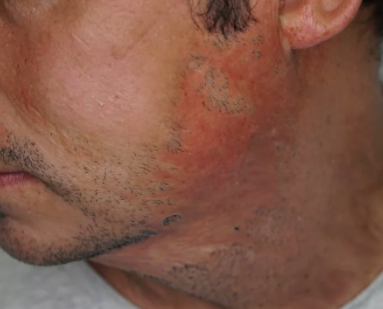
Scars from Strip Harvesting Surgery

I have a terrible scar from a previous hair transplant in the donor area. What can be done about it?

If you find that you have a scar from your donor harvest that you find is unacceptable, these options need to be discussed with a competent doctor. The scar often has ridging from the nature of the closure and that will be determined by the doctor who evaluates you. Scars from the donor area are not uncommon and when the surgery is done by a competent surgeon doing standard of care work, scars may still form and be the result of the way your body heals. The treatment of scars are as follows:

  1. Do nothing
  2. Perform a scar revision with a surgeon who can do trichophytic repairs and use ACell in the wound to give you the best opportunity to heal it.
  3. Have FUE into the scar. This can fill in the scar, but hair direction may not be controlled by the surgeon, making the results often disappointing. Two sessions into the scar may be needed.
  4. The use of Scalp Pigmentation has been a significant breakthrough in our hands. Risks include change of color (unusual for the back of the head where hair covers the pigmented area protecting it from the sun). This will not address any ridging in the scar area.
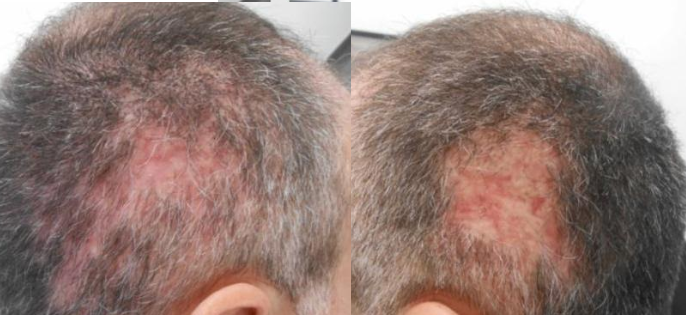
Scars from hair transplant

I got an FUT 3 years ago. My scar unfortunately is “raised” and wider than expected. I’m not sure if it just healed wrong, or surgeon error. I was originally told my hair would need to be cut to a “5” for it to be unnoticeable, but it takes more like an “8” or “9”. I use dermatch or fibers to cover it with shorter hair.

A few months ago, I decided to get SMP on it. I had 5 sessions, and the ink just didn’t stick at all. The practitioner said it was due to the scar being “raised”. This was a couple thousand dollars, so I’m not feeling great about it.

Should I have something done to the scar before attempting something like SMP again? What about grafting some hairs into the scar? I’m not sure if my scar is hypertrophic, a keloid, or what. I just don’t want to spend more money on something that won’t work.

We treat raised scars with Kenalog injections which flatten then out (sometimes it takes a few months and more than one injection). Then I do the SMP into normal scars. See here: https://scalpmicropigmentation.com/gallery/scar-covering/


2020-09-04 12:34:15Scars from hair transplant

Scars from FUE

I may have heredity loss or loss as the result of medication. I just wanted to confirm that the Fox procedure does leave tiny scars at the donor area (where the hair is taken from)? Also, does the fox procedure also leave tiny scars where the hair is implanted. Please review and let me know of your thoughts.
Thanks in advance

1 Year After FUE – Parted 1 Year After FUE – Shaved


At the point where the follicular units are removed, there may be small punctate scars, but not at the recipient site, as the skin is trimmed once the grafts are outside the body. The skin disc that was removed in the FUE from the above photo were created by a 1mm punch, today the punch size measures 0.9mm. Trimming of the excised FUE grafts are critical to minimizing the transplantation of skin for the recipient area, which is clearly not the objective. When these FUE grafts are trimmed, the skin disc is reduced to 0.1-0.2mm in size, thereby minimizing scars at the recipient site.

For more on FUE / FOX Procedure, please see:


2006-10-04 16:26:47Scars from FUE

Scarring from necrosis in the donor area secondary to poor FUE (photo)

This patient had too many FUEs performed too close and possibly with instruments that were too large for the process. Necrosis (skin death) is a complication seen in the inexperienced, over ambitious hands of inexperienced doctors or technicians who should not be doing FUE. I expect this complication to be more and more common in the coming years and more and more providers enter the FUE business without adequate training. The only tre)atment for this is Scalp Micropigmentation, which will work well provided that the patient keeps his hair very short (see: https://scalpmicropigmentation.com/scar-covering/

scarring from necrosis

Scarring from FUE – Why Does It Happen and What Can I Do About It?

The scarring is related to the size of the instrument used by your doctor. When the punch is 0.9mm or less, the scars are less prominent. If you have scars as some people do, regardless of the surgical technique, then Scalp Micropigmentation is a solution to “wipe” them out visually. We do this all of the time for people who had an FUE procedure.

Hair transplant FUE scarring from tressless


2018-08-15 08:58:58Scarring from FUE – Why Does It Happen and What Can I Do About It?

Scarring alopecia following a hair transplant

I was just told (from another doctor) that one of his patients who had two hair transplants surgeries totaling 5500 grafts, got a third hair transplant and then lost all of the previous hair transplants. The third hair transplant did not grow. A biopsy was done and the diagnosis of Scarring Alopecia was made which clearly caused the loss of the hair. This is an autoimmune process. Of course, the patient was concerned that the scarring alopecia risk was risk he was told about and the patient was angry. This is the very first time I heard about the appearance of a Scarring Alopecia after a hair transplant. I am not certain that there is a one-to-one- correlation between the last hair transplant and the appearance of the scarring alopecia, although the incidence is highly suggestive of it.

Scarless Healing from New Drug Called Juvista?

Hello Again Mr.& Dr.Rassman

We’re all in here thanking you for your salvation blog as am now going thru it on a daily basis.

I’ve this Revolutionary News for you which might be the long awaited Deliverence to many of us who have had Traditional Strip HT & left with a linear thin scar(hopefully) in the back making us feel so confined. Have you ever heard of a new innovative drug being developed by ”Renovo plc.” so called ”Juvista”, as mentioned it’s now in the PhaseII clinical trial & might see the light in the few coming years. It’s basically used during the surgery by being injected to the wound edges while suturing(i think) which will later lead to an almost scareless healing (GOD I HOPE THIS GONNA HAPPEN), please comment.

Juvista consists of recombinant TGFβ3. TGFβ3 is present at high levels in developing embryonic skin and in embryonic wounds that heal with no scar, but by contrast, is present at low levels in adult wounds that scar. Since the FDA has not approved of this drug yet and it still is in clinical trials, I will not comment much until further studies have been published. To get this drug to be approved by the FDA may take many years. In the mean time, please take a look at Techniques to Minimize Donor Area Scarring, which shows the modern techniques employed today (deep fascia closure and trichophytic incisions).

You can read more about Juvista here.


2006-04-17 15:02:25Scarless Healing from New Drug Called Juvista?

Scared to Lose My Hair with Chemotherapy

I’m a 22 year old girl who will be starting chemo the first week of November ’07. While the thought of treatment is really scary, what’s scaring me the most is knowing that I’ll be losing my hair outwardly looking ill. I’ve been doing a huge amount of research on any ways to retain my hair during treatment. I keep ending up hitting a product called Thymu-Skin. I can’t find any sites that discuss if there are any side effects to using this product while on chemo.

Can you please help me out with this? I’d really appreciate it!!

thanks

Chemotherapy does not necessarily mean you will lose hair. Hair loss depends on the specific drug used in chemotherapy. Your doctor who will be overseeing your chemotherapy treatment should be able to answer all of your questions and tell you how chemotherapy will affect your health and hair. The good news is that if you lose your hair, it will probably come back strong after the growth cycle is invoked.

To my knowledge, there is no FDA approved product to prevent hair loss from chemotherapy. With respect to ThymuSkin, I have heard of this product from patients and readers like you. Most accounts of its success/failure are based on anecdotal accounts. Despite the claim of ‘research’ and publications, they are rarely in peer reviewed mainstream journals and even if it is, the design of the study needs to be scrutinized for biases in the research. A theme that often echoes here on BaldingBlog is that it is a “buyer beware” market.

Of note, the ThymuSkin website seems to account the expertise of Dr. Morton Walker. Dr Walker is a doctor of podiatry medicine (D.P.M.) I am confused how a foot doctor came to be an expert in hair loss and the thymus.


2006-10-19 13:28:13Scared to Lose My Hair with Chemotherapy

Scared Hairless

I am 26 years and experiencing hair loss. I haven’t done anything different. This has been going on since Aug 04. Then it was not so bad but i noticed a difference. In November I went to my doctor & told them that it’s getting worse. She had my thyroid checked & it came back normal. She recommended a dermatologist. The derm said there’s nothing wrong. It’s getting WORSE. I wear hair pieces now so it doesn’t show. I’m to the point now that in every stroke of a comb/brush through, a quarter to half of my hair is in the comb just from that one stroke. I know this is not normal for me, this has NEVER been a problem before. can you please suggest where I can go or what my next step should be?

Sincerely, Scared Hairless

Your questions are very appropriate for hair loss in a young person. Now that we know you are healthy, then the most probable cause of the hair loss will be genetic balding if you are a male. The physical examination will determine if you have genetic balding as a female. This is a crisis for a 26 year old. Hair that is lost now from the genetic process (in men), will probably never return. For women, it will be a slow process over time with incomplete loss if the cause is genetic. The next step is for you to see a doctor who will consider putting you on Propecia as this is the only drug that can slow down, stop, or in some cases reverse hair loss in men. The use of a hair pieces/systems (wigs) will only make the problem worse as the glues, tapes and weaves will pull on the existing hair producing a condition we call traction alopecia. If you want to put the lost hair back, you should consider a hair transplant.