Scalp Stitches from Sports Injury — Will My Hair Regrow There?

I recently had a sports injury on right above the hair line in the center of my scalp. Six stitches were put in and later removed. it has been over a 2 months now and very little hair growth has occured since the injury. The scar is about an inch long vertically and about 1/4 inch wide. I was wondering if there were any ointments or other treatments other than a hair transplant that I could use to encourage hair growth. Thank you in advance for your timely response.

Based on what you describe, I doubt hair will grow on the 1″ x 0.25″ scar, and while there are no medications or products that will cause hair growth on this tissue, hair transplanted into the scar will work in most cases. A small scar like what you are describing should not cost a lot to get it fixed. First, I would wait out a period of 6 months before concluding that it is a permanent problem. Without examining you, I can not tell.


2008-01-09 13:32:08Scalp Stitches from Sports Injury — Will My Hair Regrow There?

Scalp and Skull Injury After a Fall 2 Years Ago, Since Had Neurosurgery. How to Fix This!

The man above researched our practice and found Scalp Micropigmentation. He wanted to know if this would work for him since scars from accidents and brain surgery are very difficult to treat. He seems to have an elevated scar in the middle of other scars, which could be flattened with steroid injections prior to having Scalp Micropigmentation.

Alternative solutions would include a series of balloon expanders, but this would be expensive and take considerable time.


2018-08-24 06:55:36Scalp and Skull Injury After a Fall 2 Years Ago, Since Had Neurosurgery. How to Fix This!

Scalp Severely Tender 11 Days After Hair Transplant

Hi! Thank you for providing so much helpful information! I had a hair transplant eleven days ago with a very reputable surgeon. I had 3700 grafts placed in my temples and frontal hairline via strip method. I have been having severe scalp tenderness in my crown where no hair was transplanted. The tenderness does not seem to be improving at all. The crown is much more tender than my donor sites. I don’t have any tenderness in the recipient areas. I contacted my doctor who said this was normal and should improve over the next few weeks. However, I have not read about any other patients having a similar experience. So I would greatly appreciate your thoughts. Do you think this is a typical problem after surgery? Do you think that it will completely resolve? If so, about how long do you think it will take to improve? Thanks in advance!

I do not know how to answer your question without examining you. At 11 days post-operative, the differential diagnosis could be infection, too tight a closure with ischemia to the scalp (restriction in blood supply), nerve injury, and on and on. Your doctor needs to examine you and let you know.

Scalp scar from forehead lift

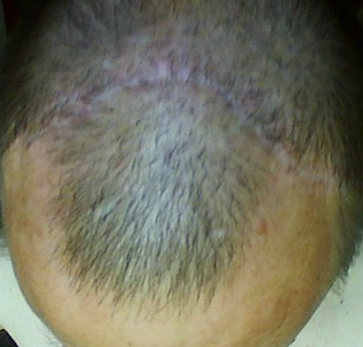
This man had a forehead lift and was left with a scar that runs ear-to-ear.

His scar can be concealed with Scalp MicroPigmentation. A hair transplant would work well to address the frontal recession of his hairline.


forehead lift scar

Scalp Scar After Motorcycle Accident — Will Hair Regrow There?

I recently had a motorcycle accident about a month and a half ago. unfortunately i was stupid and wasnt wearing a helmet causing a minor injury on my head. i went to the hospital and was told by the doctor that i would need plastic surgery to make sure my wound closed. however throughout the whole process of taking care of paper work and insurance to cover the plastic surgery my wound closed out perfectly fine. even the doctor told me i didnt need the surgery anymore.

however i have a scar about the size of a quarter, a little bigger id say, and i have no hair there. but people say i am gonna grow hair being that everything closed out normal no stitches or anything. i just wanted to clarify that. thanks

I would wait about 6 to 12 months to see if hair will regrow. If not, you can have that scar dealt with, either by having the scar revised or perhaps hair transplanted into the scar. At this point, you’re going to have to wait and see, and if the hair doesn’t return you can meet with your doctor to determine the next step.

Scalp Reductions

I met with a doctor last week who suggested that I take out the bald area. I am very bald so the bald area is very big. Is this a good idea?

Removing the bald area (scalp reductions) were very popular surgeries 10+ years ago. Thousands of men have had it done. You might even see them at airports, where they have a scar down the middle of their head, like they had brain surgery. Starting with that as my answer, I think that you will see (from everything else I am about to write here) that I am not open minded about this surgery. First, I should state that I am a victim of this surgery, having had three such surgical procedures to remove my bald spot (much smaller than yours, I suspect). I was scarred, but I got lucky in that I did not pursue more than the three surgeries, for had I done so, I would have been really deformed.

These surgeries have many, many problems associated with them and they have been largely abandoned over the past 10 years, largely because of the efforts of myself and a small handful of other doctors who have brought the complication of this surgery to the public. The most important issue to remember here is that when you are considering a hair restoration procedure, you want low risk and high certainty in the outcome. These scalp reductions produced many, many risks and the outcome was only occasionally successful. This is not a good procedure to do. For more information, please see Scalp Reductions on the NHI website.

Scalp Reduction Slot Deformity

I had scalp reductions many years ago, about 7 such surgeries. I have this long narrow straight defect in my head that looks crazy from the back. Many people think that I had brain surgery and ask me about my brain operation. Can this be fixed?

Thousands of men have had the bald spots of the scalp removed in a procedure called a scalp reduction. There was a naïve view by many doctors that bald areas could simply be excised surgically. When this was attempted, the surgeon might be able to remove about 1 inch per procedure and therefore some patients would have many procedures done to tackle extensive balding of the ‘Top and Crown’ that might be as much as 7 inches wide. What the patient found out, however, was that after 7 surgical procedures, they might have only reduced the bald area by 3 inches or so. The match did not add up.

That meant that the bald areas came back by stretching (“stretch-back” was the term used), and the patient was subjected to a never ending battle to remove all of the bald spot. Rarely was this ever successful for any large bald spot, but what was successful was the appearance of a slot in the back of the excision area which joined the two sides of hair that normally was on the side of the head, growing towards the ears. It was like a aprt in the middle of the head with a bald slot in the center of this slot that often measured 1/2 inch wide or so. This abnormal hair direction moved to the top of the head accentuating the slot deformity that appeared.

There have been many attempts to get this fixed, but only one surgery really works well. It is a triple flap procedure where scalp is moved around on the two sides of the slot. The hair direction is changed. The scalp reductions themselves are well exemplified in this article by Dr. Patrick Frechet, where the slot deformity as well as Dr. Frechet’s newer methods to remove the bald areas are shown.

You might want to go to France and consider having him do the surgery, as he is one of the few doctors world-wide that can achieve consistent results from this surgery with minimal risk of scalp necrosis (a common problem in inexperienced hands).

For more information, please see:

Scalp Psoriasis in Women

I have been diagnosed with scalp psoriasis. I use a variety of topical ointments to keep it under control and it seems to be doing much better. However, I have lost a lot of hair because of this condition and now have a very thin area on the side of my head near my part. My question is, will using a hair growth product like rogain for women help “jump start” new growth in this area? And I also wonder about what I have read that once you start using Rogain, you have to use it forever or the hair will just fall out agian? Thank you so much for any advice you can give me

First, a doctor should determine if you have other causes of hair loss since psoriasis, by itself, rarely causes it. Most people with hair loss and psoriasis either scratch the skin constantly, pulling out hair and that can cause traction alopecia or they may have another condition that may be the cause of hair loss.

For women, you need an accurate run down on your hormones to rule out other diseases such as thyroid disease, etc. Make sure that you are not on a bizarre diet, as weight loss is a cause of hair loss. Both men and women need to have their scalp and hair checked out for miniaturization, looking for genetic hair loss causes. Other autoimmune and inherited conditions can contribute to this as well. Never assume the obvious, for the price is too costly in non-reversible hair loss.

For information about using Rogaine with psoriasis, please see: Psoriasis and Rogaine.


2006-01-20 11:50:54Scalp Psoriasis in Women

Scalp Psoriasis and Transplants

Does a history of scalp psoriasis (assuming it is under control with treatment) rule out using minoxidil or transplants to offset hair loss?

Psoriasis is an autoimmune disease that has a genetic preference in its victim selection. It comes in all degrees of activity. Simple dandruff may be a very low active state of psoriasis and as it becomes more severe, it takes on more of the characteristics of the disease state, where scaling of the skin and red areas in the affected area can become painful. Flaking of the skin can be easily seen when psoriasis affects the scalp. Baldness is also a genetic process but it is unrelated to psoriasis. Both processes can co-exist in the same person and both can be treated independently at the same time.

People with psoriasis often ask about transplanting the disease from one area of the scalp to another. Can, for example, skin taken from the area where psoriasis is active, move the disease to areas in the recipient area that are not showing signs of the disease? The answer here is no, as the disease seems to be localized in the area where the scaling exist and moving the hair from the scaling area does not impact the normal recipient area, assuming the recipient area is normal. Psoriasis can be aggravated in the area where the disease is active by any trauma and surgery is a trauma. Some people who tend to pick at their skin and hair can develop traction alopecia (hair loss) if they persist on picking over a prolonged period of time.

I generally tell my patients to use a topical treatment (steroids) on any active area of psoriasis prior to a hair transplant so that the scaling that occurs will be less bothersome during the transplant process. I try to get good control of any scalp psoriasis prior to a hair transplant.

With regard to minoxidil, if this medication does not produce skin side-effects, then one can use it with psoriasis. If side effects should appear or the psoriasis should become worse with minoxidil, then the medication may not be a good choice.

My scalp is pink now 2 weeks after surgery. Why is it that way? (photo)

Some people have skin that easily turns pink when it is traumatized. I can detect these patients in advance by having them scratch their forehead with their fingernails. If the scratch mark turns pink within 5 miniutes, it means that the skin is histamine positive and these patients will often retain some pink coloration for a longer time than the non-histamine positive patients


2017-12-27 17:32:11My scalp is pink now 2 weeks after surgery. Why is it that way? (photo)