Propecia Success Rates

Hello Dr. Rassman,

Just wanted to start out by thanking you for this site. It seems like every time I get concerned about hairs falling out in the shower or sink, I check out your responses. LOL! Anyway, I am a 20 year old male who started taking Propecia 23 days ago (yes, I know, very precise). I noticed that the success rates of the medication are about 80% for preventing further loss and about 60% for actually growing back missing hair. Would these percentages increase for me since I am so young and just recently starting losing hair (1-2 years)? I am just so worried all the time that I might be in that 20% who gets the rotten end of the deal. I don’t want to be that 21 year old with a ring of hair around the sides and back. Just me worrying the weeks before Propecia is supposed to “kick in”…

Thanks!

Without seeing you or at least your photos, it would be impossible to address your concerns. It is true that young men (your age) will more likely get a reversal of some or most of the miniaturization, but that depends upon your balding pattern. You should get your hair mapped and from that, we can make the types of judgments you are asking about. What I can tell you is that in someone of your age, the success rate for reducing the rate of hair loss (or reducing miniaturization) is very high.

I don’t know if your numbers are correct, and though I’m sure I’ve seen actual percentages before, I can’t seem to find them at the moment. Where did your statistics come from? If anyone has a link, I’d love to see it.

Propecia Success Rates, Follow-Up

The writer of the piece below researched the value of Propecia for our review. If you choose not to go to the source, at least read what is written here.

Dr Rassman

Brilliant site. In response to a post dated April 16 (Propecia Success Rates), you asked your readers for a link related to the success rate of Propecia use. While the clinical studies supporting drug approval (links below) involved many endpoints and durations of observation (from 12 months to 5 years), the most dramatic evidence is at the 5-year assessment for men with vertex baldness:

“ An independent analysis of photographs (of the entire head)….. showed that at 5 years, 48% of men using Propecia had increased hair growth, 42% of men had no change (from pre-Propecia baseline photos), and 10% were rated as having lost hair. For placebo, 6% of men had increased hair growth, 19% of men had no change (from baseline photos), and 75% were rated as having lost hair.”

For your readers, the best link to summarize the clinical studies supporting regulatory approval in the US for any drug is at the FDA’s web site and will contain both the “Product Label” or “Summary Basis of Approval”. The Product Label is a brief summary similar to what is found in the package insert that comes with the medication, and the “Summary Basis of Approval” (also termed “Review”) is a detailed submission often involving thousands of pages. However, the “Medical Review” in the Summary Basis of Approval is a document that is well indexed and usually contains the clinical studies supporting safety and efficacy.

This information can be accessed without charge. For any drug, the link is Drugs@FDA. One can then choose the drug as listings are by alphabetical order and trade (brand) name. Once the drug is chosen, then choose the link with “Label Information.” For Propecia, therefore, the link that takes the reader to the “Review” from 1997 Drug Approval Package #020788.

For Propecia, three double-blind, placebo-controlled randomized studies of 12 months duration were conducted with 1879 men. The two main endpoints were hair count by photography of selected areas and patient self-assessment. Secondary endpoints were investigator ratings and ratings of photographs (by independent counters). Main results were as follows:

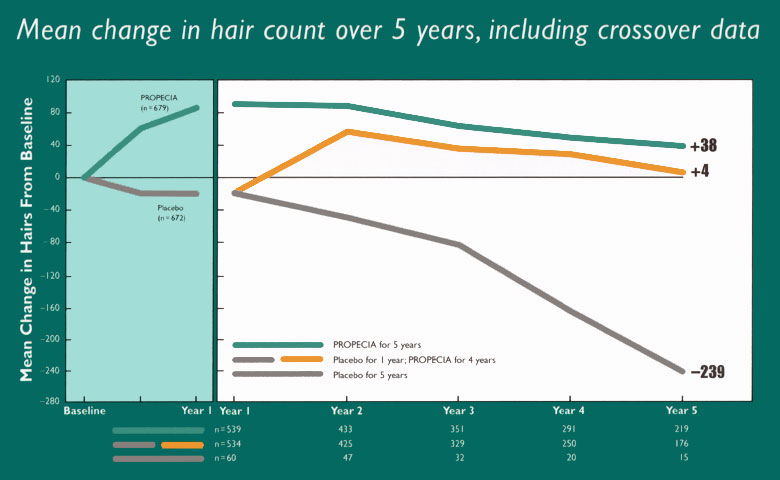
Combined data from Study 1 and 2 in men with vertex baldness (number of men = 1533): At 12 months, there was a 107-hair difference within a 1-inch diameter circle compared with those in the placebo group. An extension study showed that the hair count was maintained for up to 2 years in men taking Propecia, compared with the placebo group (38-hair placebo-adjusted difference at 2 years). Related to the figures your poster of April 17 noted, at 12 months, the investigators rated 65% of men treated with Propecia as having increase growth compared with 37% in the placebo group. At 2 years, the same investigators rated 80% of men using Propecia (compared with 47% of men using placebo) as having increased growth. These figures were 77% (Propecia) and 15% (placebo) at 5 years.

An independent analysis of photographs of the entire head (without reader knowledge of treatment assignment of person is photo) showed that at 12 months approximately 50% of men treated with Propecia (compared with 7% using placebo) had increased growth. At 5 years, 48% of men using Propecia had increased hair growth, 42% of men had no change (from pre-Propecia baseline photos), and 10% were rated as having lost hair. For placebo, 6% of men had increased hair growth, 19% of men had no change (from baseline photos), and 75% were rated as having lost hair.

Additional data including info on Study 3 (hair loss in anterior mid-scalp with or without vertex baldness) can also be evaluated.

This is a scholar’s view of the long term studies on Propecia, as published. This writer’s review from a practical view shows that the drug Propecia works for hair retention. I have never understood the focus on unproven alternatives by much of the balding male population who read this blog and write to me. Rather than get predictable hair retention, men seem to be willing to take ‘things’ that have not been shown to have hair retention value and during the period that they take these compounds, they are losing hair that will never grow back.

So where Propecia seems to hold the ‘status quo’ for years, too many men seem to be willing to accept progressive balding when psychologically, they obsess over their hair loss. And far too many men believe what they see on television or the Internet and don’t think that pictures of hair growth they’re shown may be fraudulent.

Propecia Stopped Working, So I Added Rogaine

I have been on Propecia for 2 1/2 years but about 6 months ago I noticed that the Propecia was no longer doing its job so I started on Rogaine as well and have been using that for 6 months along with the Propecia. The crown of my head has not gotten worse however the thinning area has spreaded throughout the scalp and I fear it is only getting worse. What do you recommend I do?

There is no cure for androgenic (male pattern) hair loss. Drugs such as Propecia slow it down and at best sometimes grows some hair. Just because you notice more hair falling out does not necessarily mean Propecia has stopped working. Instead it is not able to keep up with your ultimate fate. Adding Rogaine may be of benefit, but again there is no cure or 100% stop to the hair loss. Even surgery (hair transplant) cannot cure balding. At best, it redistributes the hair so that you can maintain a look for maximum cosmetic benefit.

If you are noticing a rapid rate of hair loss, you can consider seeing a doctor for a miniaturization study to document the rate of hair loss and review any medical or surgical option for a complete master plan.


2007-03-02 11:34:24Propecia Stopped Working, So I Added Rogaine

Propecia Stopped Working After Years — Time for Avodart?

I have wrote to you before about Propecia losing it’s effectiveness for me after 6+/- years.

I have had just about every blood test done which were all in a normal range. Thyrioid is OK.
The only thing that appeared high was my Estrogen/Estradiol levels.

Last stop was an Endrocinologist who thought the level was a bit high but not horribly high.

The problem is my hair is just coming out daily. I can pull on it and get a shed. Wash it and get a shed. Nothing is slowing down the loss.

My question is, should I try Avodart since nothing else seems to be working.

I am 40 and basically a healthy guy.
But I am desperate as well.

Is it normal for all of the top to just go in such a short amount of time (6+/- months)?

Hair loss is an ongoing process with or without using Propecia. However, hair loss may slow down or temporarily stop once on Propecia. Avodart appears to be a longer acting drug in the same class as Propecia. I am not certain if it will be better than Propecia. I need to see more data before recommending you to try it, but without the FDA’s approval, I am not willing to recommend it yet. Despite the theory behind Avodart, there is no concrete study out there to prove that this drug is better than Propecia.


2006-04-21 08:42:01Propecia Stopped Working After Years — Time for Avodart?

Propecia Stopped Working After 3 Years

I have been on propecia for 3 years, now I am 24 and the effects seem to be wearing off. It has worked well to stop loss up until now. What would cause it to stop working and how can I combat this? Is there something else I can take? What about avodart?

Thanks a million!

Unfortunately, Propecia (and probably Avodart) will eventually stop working in men with an aggressive genetic hair loss predisposition. In these men, you need to have a Master Plan to determine what you might do when the drugs stop working. In many young men taking Propecia, the effects over time will decrease, but when it does, you should not stop taking it because then you will experience what I call ‘catch-up hair loss’, which means that you will lose all of the benefits of the drug over the previous years within months upon stopping it.

Some doctors who prescribe Avodart are reporting better results in men like you, but this is still no miracle cure. Even if the Avodart works where Propecia fails, the Avodart will eventually fail as well.


2006-02-20 08:52:35Propecia Stopped Working After 3 Years

Propecia Stopped Working After 3 Years.

Hi. I have been taking propecia for about 3 years now. After the end of first year, the results were significant and I could see 20% regrowth. But then it started receeding by month 13-14. then I got on to propecia and Minoxidil. About 7-8 months of this combination, I had gained significant hair back. And it was easily my peak. But now I have not changed anything and it is receeding and i am shedding like crazy for the past 2-3 months. Also, my sex drive has increased and I have morning wood all the time. Is it that I have stopped responding to propecia and my body is used to the medication and producing lots of DHT? I am worried as hell. Please help.

propecia chart

If you look at the Propecia chart, you will see that your experience is in accordance with most men. Your doctor who prescribed you the medication should have explained this to you as well. It isn’t that the drug stopped working but rather your genetic predisposition is catching up. Propecia is still likely working in slowing down the hair loss (not reversing it). You should follow up with your doctor.

Propecia Stopped My Hair Loss Immediately, Then Started It Again Months Later

Hi Doc. Thanks for a great website.

37 year old male, been on Propecia for three months now. Prior to Propecia, hair was falling out of vertex at a steady rate. Started Propecia and loss stopped immediately and completely within three days. One month later after continued Propecia use, hair begins falling out at same rate as before Propecia and continues falling out now.

I know that I can’t “build up a tolerance” to Propecia, so am I in a shedding phase? If so, how long will that last approximately? And is it a good sign that my loss stopped so dramatically at the outset of my treatment? Is that a sign of things to come after this shedding?

Any information would be appreciated. Thanks!

If this is not a short term shedding process, you could be in for trouble. I don’t have any idea if it’s a temporary thing or how long it’ll even last. Stick to the treatment and then work with your prescribing doctor. You might start to ask yourself if its time to consider adding minoxidil to the treatment plan.

Propecia Stopped My Hair Loss and I Have Less Body Hair!

Hi.. I’ve seen a lot of people talking about propecia contributing to loss of body hair, yet it’s not really listed as a side effect. I’ve been taking fin for about 5 months now, and the hair on my legs is now patchy and thin, and very short. The hair on my back also seems much thinner, and I think there is less of it in general. I don’t care about either (I guess it’s kind of nice? that may sound weird). I have noticed my hair loss stopped pretty much at the 2 month mark.

Now my question is: Do you think this could be any indication of future regrowth or thickening?

Also is hair thickening considered regrowth (I’ve always wondered this)?

I love your blog by the way!

I have heard from a small number of patients who describe what you are going though with the less body hair growth, but after a few years of Propecia use. At least your scalp hair loss has subsided… and who could be upset about less back hair, right? Regardless, it doesn’t indicate any future regrowth or thickening, but may be one of those rare side effects.

Finally, hair thickening is not considered regrowth. Hair thickening is… hair thickening.


2010-08-03 10:04:10Propecia Stopped My Hair Loss and I Have Less Body Hair!

Propecia Side Effects

I am 28 years old, and I have had the unfortunate expierence of losing my hair for the past 2 years.
I had a consult with a Bosley representative, and reccomended that I go on Propecia for about 9 months in order to retain my hair to be a good risk for hair transplantation. I would like to know, if this is a good reccomendation, and is the risk of side affects worth the effort? I have been on propecia now for almost 3 weeks, and I have had some side effects. In fact, I feel like I’m losing more hair due to propecia…Is that possible? With all this drama and money involved with going bald, I am about to resort to just shaving my head. It seems all the effort is in vain. It’s hard to beat genetics with a natuaral look.

It is almost always a good idea to try Propecia if you have genetic hair loss, especially at your age, BEFORE you go through a surgical hair transplant. You may decide that after 9 to 12 months, you are happy with the results and do not need surgery.

I suspect that in the past three weeks, you have spent more time looking at your hair, watching for growth or hair loss, than you have in the past two years. It may take up to 12 months to see results from Propecia, and by watching your hair very closely and very often, you may miss some of the subtle growth that will hopefully be taking place. As far as side effects, erectile dysfunction, decreased libido and ejaculation disorders were reported about by .5% more men taking Propecia, than those taking the placebo- according to Merck. If the side effects are greatly impacting your life you will have to make the decision if you want to continue Propecia.

You sound like you are conflicted about your hair loss and solutions that are open to you. My suggestion is to take your time and research all of your options before you make the committment to surgery.

Propecia Side Effects and the Placebo Effect

Hey Dr.Rassman,

What do you think of the placebo effect in regards to side effects associated with taking Propecia? This snippet from Wikipedia on the placebo effect got me thinking about alot of individuals that have expectations/concerns on getting potential side effects from the medication.

Snippet:
Expectancy and conditioning

In 1985, Irving Kirsch hypothesized that placebo effects are produced by the self-fulfilling effects of response expectancies, in which the belief that one will feel different leads a person to actually feel different. According to this theory, the belief that one has received an active treatment can produce the subjective changes thought to be produced by the real treatment. Placebos can act similarly through classical conditioning, wherein a placebo and an actual stimulus are used simultaneously until the placebo is associated with the effect from the actual stimulus. Both conditioning and expectations play a role in placebo effect, and make different kinds of contribution. Conditioning has a longer-lasting effect, and can affect earlier stages of information processing. The expectancy effect can be enhanced through factors such as the enthusiasm of the doctor, differences in size and color of placebo pills, or the use of other interventions such as injections. In one study, the response to a placebo increased from 44% to 62% when the doctor treated them with “warmth, attention, and confidence”. Expectancy effects have been found to occur with a range of substances. Those that think that a treatment will work display a stronger placebo effect than those that do not, as evidenced by a study of acupuncture.”

Sometimes I feel like alot of us convince ourselves we have these side effects when in reality they are non existent.

I have no doubt that many of the problems with sexual side effects reported while taking finasteride, are impacted by the power of suggestion. Also, some men have erectile dysfunction prior to ever starting the drug finasteride, so it is easy to blame the drug for that problem if they exercised denial. Thanks for sharing this with us.