
Uncertainty In Hair Loss Pattern and Testosterone Levels

Part 1:

I really enjoy the website and find it very informative. I have read on this website many times, that many individuals who are destined to be a norwood 6 or 7 and eventually do become either of those stages, are typically men under the age of 30. Moreover, the final balding pattern is established or completely stops typically between the ages of 40-50.

So, how come there is so much uncertainty regarding hair loss between the ages of 30-40 and what will happen and if further progression of hair loss will occur? I would think if an individual has reached their 30’s with a significant amount of hair, then balding should stop.

Part 2:

My situation is like this, I started balding at 19 and am currently 33. I have been on finasteride for the past the 14 years and have remained a norwood 2-2A. I don’t have much body hair or facial hair and have always felt I have low testosterone. What am I a destined to become then, any ideas?

testosterone

Thank you for following BaldingBlog!

There is no firm rule on what age you will lose your hair. For most men, genetic male pattern hair loss occurs in their 20s and30s. But it can also happen in their 30s, 40s, and 50s. Hair loss does not completely stop. We don’t necessarily fit neatly into a box. This is why patients go to doctors for an examination.

If your hair loss is a Norwood 2 there would be questions of why you would have needed to be on Propecia in the first place. A Norwood 2 hair loss pattern do not progress to a Norwood 6. Norwood classification is not a chart for “progression” of hair loss. It is merely a pictorial description of your genetic hair loss trait. In the end only your doctor can tell you about your treatment plan. If you suspect a low testosterone level you should discuss your concerns with your doctor and have a test to confirm this (…if it is an issue). Testosterone levels have nothing to do with genetic male pattern balding. You can have a very high testosterone level and have no balding and no beard. You can have a very low testosterone level and be completely bald with a full beard. There is no correlation with facial hair and testosterone levels.
Umbilical Cord Blood, Is It the Future?

Umbilical cord blood is stored by more and more people today at great expense. It is used to treat rare blood cancer and bone marrow disorders. They can be used to form beating heart cells, treat heart disease, form neurons, and treat neurodegenerative diseases, like Alzheimer’s, with almost endless possibilities (including brain injuries, stroke, spinal cord injuries, and even multiple sclerosis). A recent study treated cerebral palsy successfully in experiential trials. This is very exciting stuff! Maybe in 10 years, we will see cures never imagined.


2018-09-13 14:00:14Umbilical Cord Blood, Is It the Future?

UK Newspaper Reviews Hair Loss “Cures”

Dear Dr Rassman,

I thought your readers may be interested in this article. The Daily Mail, here in the UK, reviewed some common hair loss “cures” including your favorite product the laser comb :). Not surprisingly, they were all found to have little or no effect apart from regaine.

Here is the link: From a laser comb to rubbing coffee on your head, the His and Hers guide to hair loss cures

Best regards

Aside from the fact that there is no real hair loss cure, this is a decent round-up of some of the over-the-counter hair loss treatments. It doesn’t surprise me that that highest marks for the products they reviewed went to Rogaine (Regaine as it is known in the UK), and treatments like fish extracts and saw palmetto lotions got low scores.

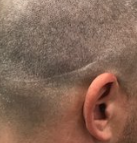
Typical strip surgery scar

I am often asked about what a typical strip scar would look like. Not everyone heals this well. This scar can be hidden even with a #2 cut or any reasonable long hair.

Two Years on Finasteride (Photos)

There seems to be some corner fill and stabilization of your frontal hairline with probably little or no recession


2020-06-02 09:43:40Two Years on Finasteride (Photos)

Two studies on ketoconazole in balding men

At the recent ISHRS meeting last week in Bangkok, the value of ketoconazole shampoo was also echoed by one of the guest experts in the field of hair loss.

https://www.tandfonline.com/doi/abs/10.1080/09546634.2019.1573309?scroll=top&needAccess=true&journalCode=ijdt20

In a 21-month study for 39 male patients aged 21 to 33 years with Hamilton Grade III AGA, treatment with 2% KTZ shampoo two to four times weekly resulted in progressive increase in pilary index (defined as hair shaft diameter in µm 1.5 cm from bulb obtained from computerized MOP Videoplan Kontron image multiplied by percentage of hairs in anagen phase obtained from trichogram) while unmedicated shampoo demonstrated slow linear pilary index decrease. 61 In another sixmonth study on 150 patients aged 18 to 65 years, 1% KTZ shampoo two to three times weekly increased hair shaft diameter significantly, but did not significantly modify mean hair density.45 A final study described the Accepted Manuscript Page 9 of 33 comparison of oral finasteride 1 mg/day only and 2% topical minoxidil only to combination therapies of oral finasteride with 2% topical minoxidil and oral finasteride with 2% KTZ shampoo for a year in 100 male patients with Hamilton Grades II to IV AGA. Oral finasteride with topical KTZ demonstrated significant clinical improvement compared to oral finasteride or topical minoxidil alone (p<0.01) and was comparable combining oral finasteride and topical minoxidil (p=0.3).

http://libgen.lc/scimag/ads.php?doi=10.1080/09546634.2019.1573309

So 20 years after the 1998 study, and we only got 2 more studies. Not super duper definitive, but very promising. I’m basically convinced to ad it to my routine.


2019-11-21 10:21:01Two studies on ketoconazole in balding men

Two Previous Hair Transplants and Wants to Understand His Remaining Donor Supply

I am in my 40s and have had FUT twice, both times with very high yield and good cosmetic results. I have had a bit over 3,000 total grafts total. My FUT scar in the back of my head also came out well. The scar itself is thin and is pretty hard to detect, even if I cut my hair short. Sometimes I think about having a third FUT. I have a decent amount of donor hair left. How risky is it for me to have a 3rd FUT surgery if the first two went well? Am I risking ruining my good results to date? What are the chances I could get a good FUT scar on the third surgery if the first two went well? Does my chance of a bad FUT scar increase with each subsequent procedure? Should I quit while I am ahead or push for another procedure if I want more hair on top? Thanks for your help, and many thanks for baldingblog. It is very well done and helpful.

3,000 grafts is most likely less than half of your donor supply, assuming that you are a typical Caucasian. I had three strip surgeries myself and have no scar as you don’t with two surgeries. The general rule of thumb for normal healers (not good ones like me) is that the scar risks increase with additional procedures. Considering your history, you might discuss other options with your surgeon such as another strip surgery with a trichophytic closure to minimize the scar. Alternatively, you can have the harvest done with FUE (Follicular Unit Excision) and not worry about a linear scar. The FUE is becoming more and more popular in the past few year and now reflects more than half of all hair transplant harvesting technologies done worldwide.


2018-06-22 05:43:29Two Previous Hair Transplants and Wants to Understand His Remaining Donor Supply