Trichophytic Closure Photos

I read your article about the Trichophytic incision. Do you have photos of what this looks like?

The pictures shown below are of a patient who had a trichophytic incision on half of his wound and on the other side had a non-trichophytic closure. The side with the trichophytic closure has hair growing in the actual wound, making it less obvious. These pictures were taken 5 months after surgery, so the scars have not fully matured and a slight pink color still remains. The photos below are both from the same patient (right and left are exactly the same image), except the two on the left are unedited and the two on the right has a yellow highlight showing where the actual scar is, so that you can see clearly that hair is growing through it. I apologize because some of the hair from below the scar is obscuring the trichophytic set of photographs, but I believe if you look through the line of hair that is combed upward from below you will see the hair growing directly from the wound. I will replace these with better photographs from the next patient that comes in to the office. Click the images to enlarge.

The below photos show the non-trichophytic side.

For more information about Trichophytic closures, please see Techniques to Minimize Donor Area Scarring

Trichodynia

My question is with regards to Trichodynia. I’m not sure if I have it or not. But I’ve been having some minor pain off and on in the crown region of my head for 3 months. I have not lost any hair in that region (I’m a NW2) and have been on Propecia for 4 1/2 years. But I’m afraid of what might be causing this sensation, I hope it isn’t associated with hair loss in that area. Are there any treatments for this pain sensation??

The pain hasn’t progressively gotten worse or anything, but it did start overnight, it wasn’t gradual at all. Could it be an allergy of some sort?

In all fairness, how do you expect me to diagnose your condition this way? You need to see your doctor (perhaps a dermatologist) and get a good physical exam.

The minor pain you’re describing can be anything from normal male pattern baldness to a neurological disease. See what I mean? It’s such a broad spectrum of possibilities that I don’t want to get into discussions about treatments for a condition you might not even have. You can learn a little more about it at Wikipedia.


2009-05-08 09:11:06Trichodynia

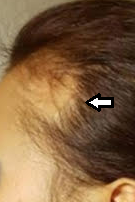
Triangular Alopecia (photo)

This woman presented with this bald spot characteristic of a genetic abnormality called Triangular Alopeica. It is often on both sides of the head and is best treated with a limited hair transplant, which cures the problem.

Triangular Alopecia (hoto)

I’ve had a bald spot on the side of my head for like 10 years and I’m only 16. How can I grow hair here? Please help

You have an inherited condition called Triangular Alopecia. A small hair transplant procedure will solve this permanently. Some people have it on both sides.

Triangle of Hair Missing in Middle of the Hairline

hi,what is it called when the hairline is kind of an inverse widow’s peak – when there’s a little spot (maybe triangle-ish) of hair missing right at the top?

i’ve been googling to no avail and it is rather worrying me as i am only 16 years of age ,male. i have very thin hair aswell but only because i have straightened it for the past 2 years so i am not sure as if that has somthing to do with it

Assuming that you have not damaged the hair from straightening it, some people have irregularities in the frontal hairline that is normal and genetic. These irregularities can be fixed with a transplant into them to reshape the hairline. At 16 years old, I am not sure that you are a candidate, but you should be examined by an expert if this is something that you want to do.

Treatments Available for Female Hair Loss

Over the over again, women from all over the world are writing to me asking, “What can be done for me?” I will list alternative options below, but I want to warn those of you who are reading this material to recognize that none of this is proven to solve the hair loss problems of most women. If it works, it may work in selective women, those that have a more clear androgenic (male-like) component of their hair loss. In addition, some women with combined genetic hair loss and Polycystic Ovaries (PCO) develop male-like patterned hair loss and could be candidates for the hormone treatments discussed below. I am loathe to recommend these treatments, because I do not personally feel comfortable with recommending hormone altering therapies, as some of them may impact ovarian, breast, and uterine cancer risks — so with that warning, please read on.

Finasteride use in women:
There have been articles on the failure of 1mg of finasteride to impact women’s hair loss. Now, for the use of higher dose finasteride than normally prescribed in men, the Iorizzo article (see references below) concludes, Sixty-two percent of the patients demonstrated some improvement of their hair loss with the use of finasteride, 2.5 mg/d, while taking the oral contraceptive. It is unclear whether the success was due to a higher dosage of finasteride (2.5 mg instead of 1 mg) or to its association with the oral contraceptive containing drospirenone, which has an antiandrogenic effect. These two drugs may complement each other and to get the effect, they both may be needed. Further studies are necessary to understand which patterns of female pattern hair loss respond better to this treatment, for I am sure that all women will not respond the same way. The article leaves us confused. It is not clear which are those who can be treated and there are no statistics on safety and side effects (this was not the focus of the article, however). The entire article is based upon conjecture, something that the authors recognize is the problem that the limited study creates. What concerns me is that with the promise that 62% of women may be helped by Propecia, desperate women with the help of inexperienced doctors will start taking finasteride without understanding the long term impact of these drugs on women. Maybe downstream, we may see a Vioxx type side effect with regard to cancer. With that said, there is a suggestion in this article that finasteride may have value for women and if this can be seen with better, more controlled studies, then this may be a breakthrough. I suspect that women with a ‘male pattern’ to their hair loss may experience more benefit over those without it. This is conjecture (an educated guess) on my part.

Antiandrogen treatment for hair loss in women:
The second article (see references below) starts off, “It has not been conclusively established that female pattern hair loss (FPHL) is either due to androgens or responsive to oral antiandrogen therapy.” This opening correctly set the tone of the article. Two different medications were used: spironolactone and cyproterone acetate. Neither was clearly better than the other. Discussion of the authors said, “The treatment under a doctor’s care went for 16 months. 44% had improvement, 44% had no improvement and 10% had further hair loss“. Many dermatologist are presently using spironolactone and cyproterone acetate and there is selective enthusiasm for these drugs, but it is not universally accepted as the mainstay for treating women’s hair loss. Doctors come under a great deal of pressure to do something. The question here is will spironolactone and cyproterone acetate treatment provide enough benefit for the costs and the pain of the injections that are required with repetitive treatments over a prolonged period of time?

References:

  1. ARCH DERMATOL/VOL 142, MAR 2006: Matilde Iorizzo, MD; Colombina Vincenzi, MD; Stylianos Voudouris, MD; Bianca Maria Piraccini, MD, PhD; Antonella Tosti, MD, Titled Finasteride Treatment of Female Pattern Hair Loss
  2. British Journal of Dermatologist 2005, Article by R. Sinclair, M/ Weweromle amd D. Jolley from Australia titled: Treatment of female patterned hair loss with oral antiandrogens

Treatment with finasteride? (photo)

You reported one year of treatment. The photo shows a perfectly normal hairline. The presence of the widow’s peak and the flat hairline to the sides suggests that you have a left-over component of your juvenile hairline still showing. I have seen or treated many men like you. If you want a consultation with me, my email address is williamrassman33@gmail.com. Please send me your post before you started treatment so I can understand what was reversed after a year of treatment.

Treatment of Pubertal Gynecomastia Report

Reader responds: RALOXIFEN, is a SERUM. It is a medication that has ANTI-estrogenic effect on breast tissue and esteogenic effects on bone, liver, etc ..
It is used by many bodybuilders and also doctors to prevent and treat gynecomastia.

https://www.ncbi.nlm.nih.gov/pubmed/15238910


2018-10-10 11:48:22Treatment of Pubertal Gynecomastia Report

Treatment for Dermatitis in Eyebrows?

Hi,
Not only I have dermatitis on my eyebrows but my eyebrows are getting thinner. A dermatologist gave me a treatment for my dermatitis (carefully rubbing the treatment on my eyebrows) but I am too afraid to touch my eyebrows now. I rather to have an oral treatment for my dermatitis, and an oral treatment to regrow my eyebrow hairs (if there is any). Also I am planning on getting my eyebrows transplanted, though would that help against my dermatitis, and a hair transplant cost A LOT OF MONEY!!!

Topical medications work best for dermatitis. Regrowing eyebrows that are lost from manipulation can be difficult or impossible (if the hair has been lost from traction). Transplants will be exposed to the same dermatitis condition as the original eyebrow. Sounds like you need to get the primary problem under control first. Transplant only after the dermatitis is controlled.


2006-12-08 06:59:26Treatment for Dermatitis in Eyebrows?

Treating the sides and back of the head with Topical finasteride

I have diffuse and frontal mpb. I measured the thin hairs on the back and the sides with a digital microscope. Around 15-20% of the area is composed of thin hairs. I am on topical finasteride and min. My doctor didn’t say that I should apply the fin on the sides/back, but I think I have to. Do you think it is essential? I also apply min to all the scalp area.

It makes no sense to apply finasteride to the sides and back which is the area that balding usually does not occur. Also, if you use topical finasteride and spread it around your entire head (including the permanent zone around the sides and back of your head), enough systemic absorption might occur just as if you took the oral pill, defeating your goal to keep it topical. Normally the liposomal topical finasteride has at most an 18% absorption through the skin in the body while other non-liposomal finasteride preparations might have more systemic absorption.


2021-03-22 09:27:58Treating the sides and back of the head with Topical finasteride