Transplanting the Follicle’s Dermal Sheath Cells?

Hi Dr. Rassman, In a recent article i found that it is actually possible to transplant the follicle’s dermal sheath cells from one person to another which can lead to new hair growth.

To view the full article please check the below link and let me know you thoughts about this: ScienceNetLinks

Thanks!! appreciate the work you are doing!!

We know that the body will reject hair transplanted from one person to another, but the very reputable Dr. Angela Christiano is quoted in this article and her experimental technique shows feasibility (I did not verify her work for this review).

So to answer your question, in research this is possible, but real world applications aren’t quite there. It’s early experimentation with the bigger picture being focused on generating joint cartilage for arthritis patients.

Transplanting the Crown

Greetings,
After seeing Steve Hartman of CBS/AM570 in person I am amazed at the process of his hair restoration. My situation is the typical male pattern baldness on the top and back of my head, not the front. How do you handle that?

Steve Hartman’s hair transplant procedure is what I like to refer to as the fast-track approach. With his situation, one surgery did the job he needed and if he stays on Propecia, hopefully he has seen the end of any more than this one surgery. For transplanting the crown, I have general reservations in the very young men (under 30) unless there is very good donor hair density and good laxity (looseness) of the scalp in the back of the head. Other elements of the supply/demand formulae must also be accounted for and those men with good quality hair and skin color tend to do better than those without either when the hair must be distribued to cover a wide balding crown. I am always worried that the crown will take all of the donor hair and when the front balds, then the patient may run out of donor hair. There are many times, however, that crown transplants are appropriate. In those men over 35 (for example) with a 3 Vertex balding pattern (frontal corners and crown only balding) or those with pure crown (vertex) balding in people like me. I had 1600 grafts into the crown and my frontal hairline is normal without any balding. I use Propecia to maintain any further hair loss and I have been stable for years since my transplants were done in the late 1990s.

Propecia is the mainstay for hair restoration in the top and crown (particularly for the younger men whose final pattern is not predictable), so you should first get assessed for miniaturization and then go on that drug if appropriate. Transplants rarely will be needed if you catch the top and crown loss early enough.


2006-01-10 14:43:58Transplanting the Crown

Transplanting Patients with Vitiligo?

As far as I know vitiligo patients are at increased risk of developing alopecia areata, alopecia totalis and alopecia universalis. Obviously if a vitiligo patient who has male pattern baldness goes on to develop alopecia totalis or universalis then they would lose all scalp hair and any scarring from a hair transplant would be visible.

I appreciate that any hair transplant candidate could go on to develop alopecia totalis or universalis but in most cases the risk seems to be too small to be a serious factor. I am however wondering whether the increased risk associated with vitiligo patients is something that should be considered particularly where young men with male pattern baldness are concerned. It would be good to have your expert opinion on this matter.

The appearance of a secondary skin problem (alopecia areata) in patients with vitiligo, although possibly linked and possibly at increased risk, has not been a problem in my experience. The decision to transplant should not be a concern in patients with vitiligo (as we at New Hair Institute have had successful hair transplants on patients with vitiligo) .

Transplanting over another graft that has not grown

When a person gets a hair transplant, I know that it can take over 8 months and in some cases up to a year for 100% of the transplanted grafts to fully grow in (well, the ones that survive at least). At the same time I know that a person can often get a second hair transplant by 6 months which means that some of the grafts from 1st procedure might not have erupted yet. With that being said, what happens in that second procedure if a graft is transplanted into or near the same spot where a graft was transplanted during the first procedure and just hasn’t grown yet? Will it damage the first graft? Or will you just end up with two grafts growing from that spot; so basically like one big follicular unit?

I don’t believe that if one transplants over another hair graft, the second graft will add hairs to the first, making the follicular unit larger. A second follicular unit will arise in the area. Follicular units are controlled, I’m size, by the genetic mechanisms of the stem cells in these follicular units.

Transplanting Only to the Temples

I have a question. A couple of years ago I lost a bit of hair around the temples but this process seems to have no progress at all. I shave my head.. well only to about 3mm, have very thick hair. My question is as follows, If I got these temples fixed to get a straight hairline would a buzz cut be appropriate ? would it look natural ? I’d be grateful for your reply.

Frontal hair loss can be fixed to near-perfection with a hair transplant, provided that you are a candidate for it. That would include such checklist items as:

  • your age
  • your miniaturization mapping of your scalp
  • your expectations are realistic

If you come to any of our free monthly open house events, you will meet some men who have completely replaced the frontal hairline to what I call perfection.

Transplanting Nape Hair at the Hairline to Soften the Look

A prominent HT doctor recommends using transplanted nape hair at the hair line to soften the look of the hair transplant and make it look more natural. This seems to make sense as often hair transplants look like the hair strands are too thick where transplanted and not natural. You mentioned that nape hair is not permament. Does this mean it might fall out over time and even if it does is it still worth it for the cosmetic effect in creating a more natural hairline?

I recently saw a patient in my office who asked me this same question and asked about the doctor. In case you are the same person, my answer was as you correctly state — nape of the neck hairs are not permanent. Some patients actually come to have hair transplants to the nape of the neck, as they are completely bald from below the ear level.

Thus, your nape of the neck hairs that are transplanted elsewhere may fall out over time and it is not worth the surgery. More importantly, even with the FUE technique there will be scarring that may show at the neck with white pale dots if the nape hair falls out over time. If you are considering this type of surgery I would ask that doctor if you can meet with a patient who has had it done to see what it looks like. When the donor area is from the nape of the neck with strip surgery, most of the time the scars are prominent and wide. Scars like these are not amenable to repairs and even with FUEs placed into them, they can not really look normal.

If you want a softer hairline, regular donor hair should be sufficient if done right with single follicles that are finer and grow naturally that way. If the staff and the doctor are good, they will pick out the smaller caliber single follicles for the very front.

Transplanting Just the Temples?

First of all i would say that i appreciate your website and the information you give.

Im am 33 years old and still have a fair amount of hair. Lately I am bother by my temples, its not bald but it’s not what it used to be.

Last year (september) I started to take propecia to keep the hairs I have. I am now thinking of taking a hairtransplant to insert some hairs in the temples to make it full again. I don’t think I will need a lot of hairs or grafts. What is your opinion about a hairtransplant for the temples? I am afraid that if I do it now maybe later on the hairs ‘behind’ the temples will fall out. Of course I dont want a hairtransplant to make me look like 20 again but just some hairs added to the temples. Do you think its wise to do that considering im now 33 years old?

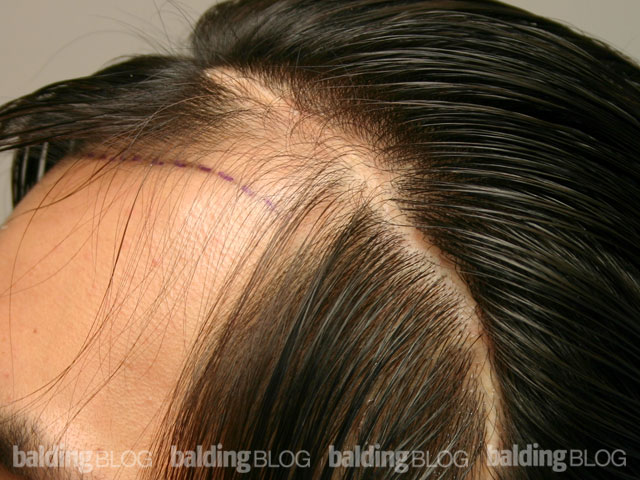
First, I want to make sure you’re talking about the temple peaks on the sides of the head, and not the corners of the hairline (many people refer to the corners of the hairline as the “temples,” but that isn’t right). So assuming you’re talking about the temple peaks (the prominences above your ears), then I’d have no problem transplanting those if you didn’t show miniaturization on the top of the scalp. If you meant the corners of the hairline, I’d need to see what your loss pattern is looking like.

Your question is a good one, because sooner or later you will bald behind the hair transplants if your hair loss pattern is still progressing, which is why the Master Plan is created by you and your doctor with the primary focus of keeping you always looking good. Really, the best way to answer this question is to be seen by a good hair transplant doctor who doesn’t just want to take your money.

Transplanting Into Scalp Scars

i have an unsightly scar on the side of my head approximately 4 inches long and 1/4 inch wide. is there anyway of repairing this? i tend to wear my hair short and i am fairly conscious about it.

Scars of the scalp can be difficult to deal with. I am assuming that the scar you are talking about is not related to a hair transplant. The management of scars is not well understood by many doctors because they generally do not look at the hair solutions that are, at times, critical in the final repair of the scars. Neurosurgery scars, accident scars, burn scars and the like require specialized knowledge of the scalp’s ability to heal in the area treated and the direction and location of the scar determine much of the outcome. Many scalp scars may have come with good medical care, so one has to think differently about scalp scars: what will make the next treatment better than the last one?

Send me a photo (preferably digital) and be sure that the scar location is clearly shown. Your confidentiality will be assured. My email address is on the Contact page.

Transplanting into Donor Scar

Hello,
I had surgery with NHI back on 01/24/2002, no problems, then had more grafts placed by a surgeon closer to home about 1 year after. Having been a trauma nurse for 6+ years, I told him to please be very careful around the donor area as there was not much elasticity. Post op had very bad infxn and after 10 days of oral abx I now have very large scars at the donor areas behind both ears and have to wear my hair long to cover these scars.

Since this is already heavily scarred, can anything be done to place hair here?

Yes, I know, I should have just gone back to you to get my second one done. Thanks

You are more than welcome to pay us a visit and we’ll see what we can do. We can address the scar and also transplant into the donor area if that is what is needed. There may be a better solution, but until I examine you, I can not render an opinion. It is interesting to note for the readers of this blog, I have not seen an infection in the donor area for more than 10 years. As you may know, we are an accredited facility through the AAAHC and during the last accreditation process we were told that amongst accredited facilities we were in the top 1% with regard to the incidence of infection. I believe that we are the only accredited hair transplant facility in California and possibly even the entire USA. This accreditation process inflicts the highest standards on its participating facilities and includes many if not most of the hospital-level outpatient surgery facilities in the nation.


2006-06-03 10:42:22Transplanting into Donor Scar

Transplanting Into a Neurosurgical Scar (with Photos)

This patient had an extensive neurosurgical procedure with a corresponding scar. Even when his hair was longer, the scar showed because he had frontal recession from genetic balding. We performed a hair transplant (one session of 1433 follicular units) and successfully treated both the scar and the frontal genetic recession. The “after” photos were taken just over 4 months after his procedure.

I have done this type of corrective surgery on many people. It is a life changing experience for these people, not having to face their deformities every day. Unfortunately, few neurosurgeons understand what modern hair transplants can do, not only for their patients, but for their own balding sons.

Click the photos to enlarge.

Before:


After (only 4.5 months):