
i have alopecia universal, i was wondering about eyebrow transplant. is it possible ?
If you have alopecia universalis, then you don’t have any body hair at all — so unfortunately, transplanting hair isn’t an option.
i have alopecia universal, i was wondering about eyebrow transplant. is it possible ?
If you have alopecia universalis, then you don’t have any body hair at all — so unfortunately, transplanting hair isn’t an option.
hello dr.rassman. I am an east indian male, 31 years of age. I have been on proscar for over a decade with decent results. I wanted to know if you or any of your colleagues have had any experience doing surgery on indian men and what has your experience been like? When I mean experience, I mean do they generally require less hair to cover a bald or thinning area, what are the hair characteristics and scalp laxity, hair thickness etc. I know it differs from each patient but there must be a general consensus on what type of hair indian men generally have. I don’t see to many pictures of indian men getting transplants so it is hard to judge.
Mine hair is black and wavy and then generally gets curly when its very long. I guess I am at an advantage because I am assuming I would need less hair to cover up my balding areas because my wavy hair would cover up the areas.
Thank you.
There is no difference to treating men from India than fair haired Caucasians from Minnesota. In fact, Indian men with the darker skin and dark hair have reduced color/contrast between hair and skin, which makes for a better hair transplant. The state of the art for hair transplants in India is not as advanced as in Europe or the US, so perhaps there are less Indian men going for hair transplants in India.
I have done hair transplants on many Indian men and they have done very well, referencing results.
I have read some doctors preaching the use of chest and leg hair for hair transplants. I have also read your comments and general lack of enthusiasm for this. What is behind your strong opinions against this?
Scalp hair is better understood and tested for over 50 years. Although the art form has only been reasonable for the past decade or so, the facts concerning hair growth from a scalp source as donor hair are well understood. It is always important for me to inform patients about their risks, expected growth rate, and reasonable results that they should target. We have no body of evidence that hair taken from body or leg parts will work to any reasonable degree, but there seems to be (as P.T. Barnum said) a sucker born every minute. I do not want to be part of such a process, at least until it is clarified as something real.
In the book by Elise A. Olsen, Disorders of Hair Growth, the rest cycles of hair are stated. Although I can not attest for the science of these figures, let’s take them at face value for a moment and see what it means if correct. All hair cycles go through various growth phases, so the length of these growth phases are critically important to understand. For head hair, growth cycles range from 2-7 years, with a sleep period of 3-6 months. Generally it is believed that head/scalp hair is in its resting phase for about 10% of the hair population, which means that of all hairs growing on the head, another 10% is lying dorment awaiting its growth phase.
With chest, arm, and body hair, the above numbers suggest that there is a large number of sleeping follicles at any one time. If this is true, then there will be questionable value from a hair transplant using these body parts from fullness or coverage point of view. Add to that the pain of hundreds or thousands of small wounds created all over your body might produce. I wonder about the doctors who are routinely performing this type of surgery and ask about their motives. I have concluded that any doctor who offers this must let his patient know that this is not a tested procedure, falling in the experimental rather than the clinical hair transplant offerings. I’d also hope they reveal the figures related to sleep cycle of the hairs from the various body parts as discussed above so that their patients are well informed.
Hey doc. How are you today?
I have been diagnosed as a Norwood 5 thinning pattern. Originally when I started finasteride I was a Norwood 3 vertex only, but obviously the medication is only slowing the process down. I had a consultation with a reputable Toronto Dr and he said it would not be be worthwhile performing surgery at that time. But now that things have progressed is it possible to perform surgery just to give me more density? I am fine with my hair line. Or is it dangerous transplanting in between miniaturized hairs? I’m 22 and have been on finasteride for 2 and a half years with a gradual decline in my hair count but hairline is still thick for some reason. What do you think ?
I am fine. Thank you for asking.
Transplanting between the miniaturized hairs may likely result in you losing those weak hairs, so you won’t be any better off than you are now (except with less donor hair and less money in your bank account). I can’t say for sure since I haven’t seen you, but based on your description the surgeon you saw might have done you a favor.
2010-03-23 10:32:562010-03-23 08:51:49Transplanting Between Miniaturized Hairs
For somebody with a tight scalp is a FUE procedure really the only hair transplant option?
If you have a tight scalp, you can “work” your scalp with an exercise program for 30 minutes per day for 3 months. Most people will succeed in getting more laxity with these exercises. We made a video of this here.
I have 2 VP Shunts one on either side of the back of my head. Would this be prohibitive to having a hair restoration procedure? Also, does Dr. Rassman have any experience working on patients that have shunts? Any information you could provide would be greatly appreciated.
For those that aren’t familiar with the term, a ventriculoperitoneal (VP) shunt is a tube that takes brain fluid and connects it to the abdomen where it drains for the treatment of hydrocephalus (or water on the brain). And yes, I have done hair transplants on patients who have had VP shunts (see here).
As you indicated that you are from out-of-town, I would have requirements for you if you wanted me to do your hair transplant. First, send me detailed pictures of your hair loss and then I would want to get specific X-rays to locate the shunts. I must know the course of the shunt and how far under the skin it is. With the shunt located, the hair transplant can be done safely. You can call my office at 310-553-9113 and arrange to have a phone consultation with me.
2009-04-23 14:31:312009-04-24 07:45:51Transplanting a Patient with VP Shunts?
If I am prone to forming keloids is it still possible to safely undergo hair transplant surgery w/out forming additional keloids? And have you ever done a hair transplant on someone who has a history of keloids?
Many patients undergo hair transplantation despite a history of keloids, and most of them do well. Keloids can appear on the frontal hairline, but that is relatively rare. Keloid scarring is more likely to form on the donor scar, but the surrounding hairs will cover it so that it’s generally not a problem.
Thank you for all of your informative hard work! I am currently a Norwood 2 & may be progessing to a Norwood 3. I was curious to see if you could post any pictures of patients who’ve went (w/ the help of FUT or FUE) from a Norwood 3 to a Norwood 2 & some pics of those who’ve went from a Norwood 2 to a Norwood 1. Thanks in advance!
 Norwood Class 2  Norwood Class 1 |
Most people who are young and have frontal recession are experiencing the maturing hairline and are not balding. I do not transplant the frontal hairline in these patients unless there is a reason that it has to be done. I remember an actor who had a lead role in a daytime soap opera TV series. As his hairline was maturing, he got indications that they were going to phase him out of the show because they wanted a person with a juvenile hairline, as the daytime women that watched the show apparently had fantasies about very young men (I’m not kidding). In that case, I did move him back to somewhere between a Norwood Class 1 and 2 and his million dollar a year income kept him secure.
I do transplant women routinely who have lost frontal hair and want their hairline back. Typically, a woman is a Norwood Class 1 and so to answer your question, I’d like to point you to a woman’s hairline reconstruction, which is now a Norwood Class 1. See Female Hairline Restoration After Brow Lift. There is essentially no difference in the process. Creating a female or Norwood Class 1 hairline is not an easy chore. The surgeon must be very experienced when creating it due to the direction of the hair in the corners. Look carefully at your wife, girlfriend, mother, or sister’s hairline and note the direction of the hair in the corners — it flows from the center of the hairline to the temple prominences. That growing process along with the transition from one part of the frontal hairline to another must be done right, or it will look awkward and artificial. If you are an actor or top line male model, I might consider bringing you back to a Norwood Class 1. In other words, I’ll do it, but it’s rare and we must have a meeting of the minds when embarking on this process.
Have you ever transplanted grafts along a non balding person’s hairline not to lower, but to thicken the hairline so that they could grow a fuller fringe if they had fairly fine hair?
In dealing with hairlines, transplanting a normal hairline just to thicken it is not advisable, as the transplant could damage the existing hair. I have fixed defective looking hairlines on male actors and models who need perfect frontal hairlines for their careers, so I have worked to keep their juvenile hairline intact.
For women who have normally high, non-balding hairlines, these can also be addressed with either frontal hair transplants to bring the hairline down or hairline lowering surgery. Many women have these procedures done.
hi, i want to ask, hypothetically could a NW7 get an FUE but instead of getting a natural hairline get his grafts redistributed to a Mohawk so he would have no hair growing out of the sides but instead have all his hair concentrated to a 1 inch thick line going from the front to back and if that could be done, how many grafts would that be?
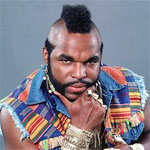 I’ve never had that request before, but yes, it is distinctly possible. What I tell all my patients is that the good and bad news about hair transplants is that they are absolutely permanent. As a young man, a mohawk may be a great idea for your particular look, but at 60 years old, will it still be great? Depending upon how thick you want it, it might take between 2500-6000 grafts.
Note: The image to the right is of the iconic Mr. T — and as far as I know, he didn’t transplant the mohawk to his scalp. I’m just using the photo as an example of the hair style.
2009-10-30 12:35:172009-10-29 08:48:15Transplanting a Mohawk into a Norwood 7?