Maturation of a Hairline — Moving From Juvenile to Mature (with Photos)

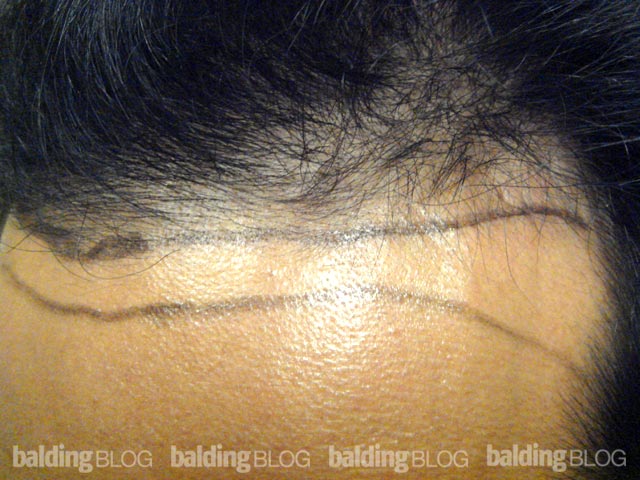
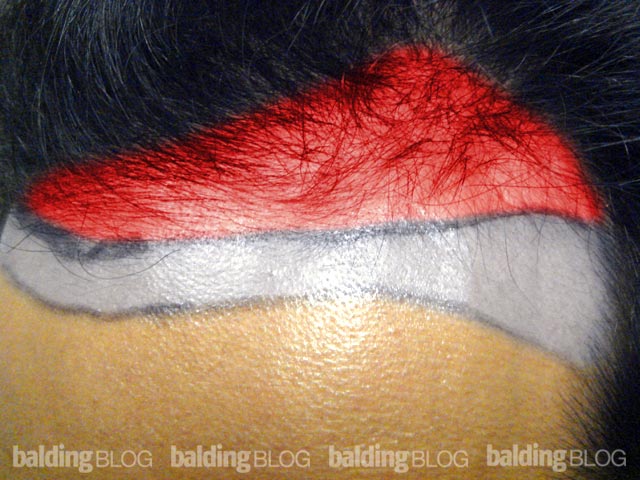
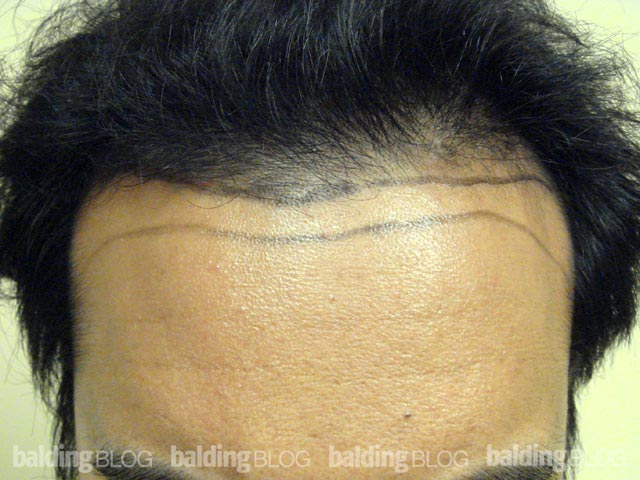
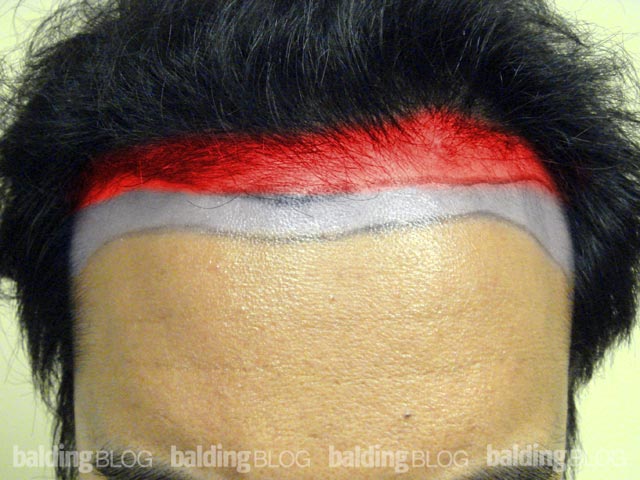
Normal male hairline progression from a juvenile to a mature one typically occurs between 17 and 29 years of age. The lowest line in the photo below is the hairline this man had when he was about 12 years old. The second line is the hairline that will be his mature hairline if he is not balding. The area behind this second line has miniaturizing hairs and it should be his permanent hair, so this man is clearly developing frontal balding. This process of a maturing hairline might appear like balding to the person impacted by this change, but it is self limited and stops within a few years once the location of the maturing hairline is established. Many of my readers think that the development of a mature hairline is balding (they panic but should not because it is not balding). Performing a miniaturization study at the stage where the maturing hairline is starting to develop would show miniaturization (in only the blue area). In this patient the blue area is completely hair free. Behind the blue area, there should be no miniaturization (not the case in the photos here). I call the entire area we are looking at in the photos, the frontal hairline, not the temples (as so many of my young readers call it). Although the average age of a maturing hairline appears between ages 17 to 29, it could be seen before 17 or after 29.

If this man wanted a hair transplant, I would put him on Propecia (finasteride 1mg) to stabilize his progressive hair loss and then transplant him (about 1300 grafts). One might think that the proposed transplanted area would be easy to see, but he has enough hair to hide any transplant he would get with some creative forward combing style. The balding on the right side is as extensive as the balding on the left side, but the way the hair is styled, it hides the balding well. I would place his hairline just where the blue area starts and give him what he would have had if he was not balding. The entire red area would be filled with transplanted hair.

So just to summarize, these photographs are of a 31 year old patient with early hair loss beyond his mature hairline. The lowest line is the location of his juvenile hairline and the upper is the location of where his mature hairline would be (usually about 1/2 inch above the juvenile hairline in the midline and an inch in the corner of the frontal hairline). I’ve put up the original version and a color-highlighted version to show the areas I’m referring to. The blue section in the colored photos is the area between the juvenile and mature hairline, and the red section is the actual genetic hair loss which has miniaturized hair (behind the mature hairline). Please click the photos to enlarge.
Maturing Scalp?

Hi, im a 20 year old male and have noticed signs of either balding or a maturing hairline. my hair is fair and has always been fairly thin as it runs in my family on my mothers side, but it seems rather selective, she has 6 brothers and 2 of which are balding and started at my age.

my question is, can a maturing hairline include thinning all over the scalp, or only in the frontal areas? because the thinning i have noticed is also in the crown area.

If you are thinning in the crown, then you probably have more than just a maturing hairline. Frontal and crown thinning and recession is a sign of genetic patterned hair loss. Get your hair and scalp mapped out for miniaturization and you will know what is happening to you.


2007-01-31 10:35:50Maturing Scalp?

Does maturing hairlines happen because of a males testosterone?

I don’t know for sure but I suspect that you are correct. We know that females generally do not get the receded mature ‘male hairlines’ that men do. Could this be caused by genes related to our sex alone or is it that two X chromosomes with the high estrogen levels in females protected against the mature hairlines. No one has been able to study this. These hairs in the zone between the juvenile and mature hairline certainly have an ingrained number of hair cycles which then produce ‘apoptosis’ (cell death) of these hair cells possibly triggered by testosterne,

Maturing hairline

Maturing hairline vs recessions: I believe that a “Maturing hairline” is the same as MPB receding hairline. Someone people just recede more slowly than others or have their hair loss isolated to their hairline.

That is not true. A maturing hairline is the normal evolution of a juvenile hairline that disappears in most Caucasian men between the ages of 18-29

Maturing hairline is not balding

Not a 3A, of course is not balding. A Norwood 3 might be balding. That’s a mature hairline means. A presentable hairline that is basically the final pattern of hair loss for a man.

The maturing hairline is not balding. The Norwood scale at a 1 or 2 show some form of the juvenile/maturing hairline. Balding starts when corner recession appears when the hairline takes on a gentle V shape as in a Class 3 pattern where the corners and possibly the entire hairline rises up. It can also be detected when or if crown thinning appears. The correct incidence of balding in the male population is about 50% of men believed to have inherited some form of balding in their lifetime. My grandfather died at 102 and he had his 5 year old hairline when he died. His hairline never went through maturation. Bill Clinton is another example of a mature male who kept their juvenile hairline.

Maturing hairline in 22 year old male – an interesting analysis (with photos)

I have always assumed that a male will not recede from genetic balding without some hair loss somewhere on the scalp. This patient has challenged me as I hold this concept. I believe that both the frontal forelock (in some people) and the juvenile hairline in all men, have a different genetic makeup with regard holding on to their hair. I have seen men who have kept a fully intact juvenile hairline and become a full Class 7 pattern of balding, and to me that proves this concept. The concept that a persistent frontal forelock remains as the corners recede is common and all of us have seen this. This 22 year old male is different because I have been following him before the juvenile hairline disappeared. I believe the corners of this line are now receding. Here is the letter I sent to him as well as a series of experts in the field of hair restoration for opinions on my question.

Good to see you today. We repeated your HAIRCHECK measurements today which we have performed on numerous times over the past couple of years. This instrument continue to report no balding evident which means that there is no detectable hair loss behind the frontal hairline. Despite this, you have now what appears to be some mild recession, but considering that you have a persistent frontal forelock, this may be an illusion and you could be developing a maturing hairline in the corners as there is no hair loss in the mid-line where the persistent frontal forelock is present. Notice the faint line I drew at the leading edge of your hairline, which takes into account the persistent frontal forelock and a location where I think a mature hairline belongs. This is where your hairline actually belongs. It does appear that you have some early erosion of this leading edge of the hairline.

The question we discussed is: What is the timing of finasteride? If you take it now, you will be locked into it for the rest of your life. IF you do have balding, then at some point decide to stop the drug which may have been holding the hair on your head, then you will develop catch-up hair loss. If you hold off starting the drug and come back in a year, it may become more apparent what you diagnosis is. We both decided to wait another year, repeat the HAIRCHECK test at that time, reassess your frontal hairline when compared to the photos we took today, and then take another assessment if finasteride is appropriate for you.

Question: Can frontal recession occur without any evidence of miniaturization or hair loss elsewhere on the head of a male.
Answer: Yes, recession in some men can be independent of miniaturization and hair loss behind the hairline.
maturing haiirline question


2020-07-02 08:01:44Maturing hairline in 22 year old male – an interesting analysis (with photos)

Maturing Hairline at 18 Years Old

Hey doc, I’m 18 years old and I have long wavy hair. I’ve noticed that my hairline is receding in the front…more so on the right side and a few small bald circular spots in the front. My dad is in late 50’s and he has a head full of thick hair while my mom is in her 40’s and is showing signs of baldness. However, she is constantly stressed out about various issues so I’m not too sure if its heridetary. My grand-dad passed away in his 50’s and he was balding. I tried shaving my head before and i look absolutely horrible! Is there anything I can do to promote the regrowth of my hairline? I am not exactly the Brad Pitt look-alike and my hair was the only thing I had! Are there any new treatments under development and on the market that can do something about this dire issue? Thanks for your help.

What you are reporting is the maturation of your hair line, which occurs between the ages of 17-29 in most caucasian men. The corners rise about 1 to 1 1/2 inches and the center rises about 1/2 inch to 3/4 inch. To see if this rise is normal, look into the mirror and lift your eyebrows up. There is a high crease, which reflects the top of the Frontalis Muscle, the place that hairline transition zone usually starts in boys and most women. As caucasian men go through an aging process (I like the term maturing process) where the hairline rises as discussed above, but for many non-caucasian men, the hairline is flatter and does not rise as far in the corners or not at all. If you have sisters, have them lift their eyebrows and look at that crease and you will see hair just touching that crease. This is a normal male process and nothing to be concerned about, provided that it does not rise higher than the measurements I just referenced. If it does, or if a doctor examines you and determines that you have miniaturization (too many fine hairs behind the mature, adult hairline location), then you may have early male patternedgenetic balding and the best drug to slow or prevent hair loss is Propecia. I have seen many wonderful, miraculous results from this drug in young men. Propecia has been on the market for about 7 years and it is safe. My son, many members of my family, and I take this drug and none of us has defined any negative side effect, sexual or otherwise.

Mature Hairline Measurements

Dear Dr Rassman,

I know you’re probably sick of hearing questions about this but here goes… I read in one of your more recent posts that ‘a mature hairline is usually about one finger width above your highest forehead wrinkle.’

Doesn’t this seem to contradict earlier measurements which suggest it can rise as high as an inch and a half in the corners? Or in this post are you referring to the center? If the corners receded by only a finger width (which is like half an inch) wouldn’t that be more like a NW 1.5?

The problem I am having with my hairline at the moment is that the sides are moving up (probably by just over an inch) but the center isn’t really moving. This is creating a weird angle. I actually want some of the middle to recede to even it out!

I have seen you describe this as ‘persistent forelock’ — but is a persistent forelock a greater indication of MPB than maturation?

In fact, the part of the center which persists actually seems to be more to the right, and the whole right side of my hairline is still thicker than the left. So maybe this isn’t a persistent central forelock and actually indicates the point remaining which still touches the highest forehead crease should fall out?

Just on a side note it seems as though a lot of males have a juvenile hairline whose central point is actually higher than the corners, kind of like David Schwimmer from Friends. So when their hairlines mature some of the corners recede and their hairline still looks straight. However, my central point was probably a tad lower than the corners (furrowing my brow shows a slight ‘dip’ in the middle’) and I still have hair touching the lowest line in that dip.

Thanks

This really is not that complicated. If you think you are losing hair and you want to do something about it, see a doctor. Even if you have a juvenile hairline or a “weird” hairline and you are bothered by it, you can address it with hair transplant surgery. If you can live with it, then leave it alone. If you think it will get worse, then have it examined by a doctor.

There is no point breaking straws and going over a definition of a juvenile hairline or a NW 1.5 versus NW 1.75 versus NW 2, etc. Nobody has a perfectly even hairline.

Mature Hairline, Is That What I Have?

I followed your advice, “The way you find out if you have hairline recession or have a mature hairline is lift your eyebrows high so that the forehead creases. The mature hairline is found one finger breadth above the highest crease.”

When I did this, my hairline touched the highest crease. What does that mean?

That means that you still have your juvenile hair line, and you are not receding. That is good news for this point in time. The hair line in most Caucasian men becomes mature somewhere between 18-29 years of age.


2018-06-22 10:29:51Mature Hairline, Is That What I Have?

Mature Female Hair Loss

I am a mature woman living in Florida. I have noticed that many of the ladies in the salons who are my age (over mmm.. let’s say 49), have thinning hair. Is there a bug going around that is causing women to lose hair? What can I do about it?

Female genetic balding affects possibly half of post menopausel women. All you have to do is go to the salons in retirement communities and look at what is going on. The hair stylists have learned that the best way to treat female genetic balding is to lighten the color of the hair (have you noticed how many women over 50 are blonde?) and to style it ‘puffed up’ (this is a man’s description of the process, sorry for my myopic male view). For most women, there are few options. A word of caution may be worthwhile here. Take anything that is offered to you in the solutions arena with a grain of salt. Believe less that what you hear and be skeptical of fixes, particularly those without first hand experience by people you know.