Keeping Hair Past the Age of 30

Dr. Rassman,

I read a while ago that if a male keeps most of his hair by the time he is thirty, he probably won’t go completely bald. It has something to do with testosterone levels. Is this true? If so, is it also true for individuals who keep theie hair by the use of Propecia or Minoxidil?

If you have not lost any hair or have any miniaturization of the hairs on your head by the time you are 30, then it is most probable that you will not lose it. The drugs you mentioned only slow down or reverse hair loss and they will not impact hair that is normal. Hair loss has more to do with DHT than testosterone, but if there is more testosterone, then there could be more DHT. Drugs like Propecia (finasteride), block the effect of DHT and it is the DHT that causes balding when the defective genes are in the person.


2006-09-12 08:53:49Keeping Hair Past the Age of 30

Juvista for Healing Hair Transplant Scarring?

I know this is years down the line, but when Juvista comes out, do you think that Juvista combined with tricho closure on HT scars (either after the process or in a revision) will allow men to cut their hair down to a 1 grade or even to the skin without the scar being too obvious? I know your response would be conjecture at this point, but it would be interesting to get your thoughts.

The scarring may be reduced, giving it a better ability to blend in (without being hyper- or hypo-pigmented or raised), but the hair will not grow on the scar. Scarring is very individualized. Even under the worst case scenario without a trichophytic closure, some people heal great and are able to cut their hair really short without visible scarring in the donor area. How well you scar is also a genetic factor (much like hair loss) and there is only so much you can do.

If Juvista does as it sets out to (eliminate scarring with a simple injection at incision site), it could be great for a percentage of those that it works for, but the drug just failed in its most recent clinical trial. Read Renovo, Shire Developing Anti-Scar Drug and Bad news on drug rocks Renovo for more.

So, the short answer to your question is… probably not.


2008-01-09 15:48:05Juvista for Healing Hair Transplant Scarring?

Juvenile vs Mature Hairline

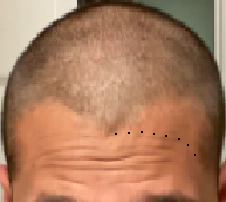
I drew in the juvenile hairline (see fine dots on the right side of the picture) that would have been his hairline when he was 5 years old. Note that the hairline moves upward as maturing occur. This man has a widow’s peak which shows the lowest position of the juvenile hairline. Young children of both sexes have a concave hairline and as they get older, most men lose it while some women keep it. Read this for more details: https://newhair.com/wp-content/uploads/2018/11/phenotype-article-published.pdf


2021-08-06 12:30:58Juvenile vs Mature Hairline

Juvenile vs Mature Hairline — Am I Going Bald? (Photos)

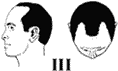
Many of my younger readers of this blog are seeing changes in their hairlines and are worrying about becoming bald. The problem is made worse when there is balding in their family line. I have placed three diagrams taken from the Norwood Classification for hair loss. By conventional wisdom, the Class 1 pattern is proposed not to be balding, the Class 2 pattern suggests that this is the beginning of the balding pattern (it may actually be the beginning of the mature hairline, just not named as such), and the Class 3 pattern is thought of as early balding, possibly worthy of transplants in some men. The line between the Class 2 and 3 patterns are fuzzy, at best. The reality, however, is not quite as simple as I believe that Dr. O’Tar Norwood had documented. In most men (more so in Caucasians), the hairline of youth rises to a hairline of maturity. The mature hairline is about 1/2 to 3/4th inch higher in the middle than where the youthful hairline is and as one moves away from the midline to the corners of the hairline, the gap between the mature hairline location and the youthful hairline location is slightly over 1 inch, changing the overall shape of the hairline to its characteristic ‘V’ shape.


Norwood 1 Norwood 2 Norwood 3


You can tell where your youthful hairline is/was by lifting your eyebrows up so that you can see your forehead wrinkle. I call this the furrowed brow, and the wrinkles you see reflect a muscle below the skin (the frontalis muscle which is present in everyone). The youthful (juvenile) hairline touches the top of the highest wrinkle of the furrowed brow and has a concave frontal shape to it. This often persist until the early teens, possibly longer. In the mature hairline (with its almost convex frontal shape (V-Shape) that extends from the temple prominences), shows a gap where there are no wrinkles and no hair present. None of what I just wrote is male pattern balding, yet many of our young readers panic when they see the rise in this hairline and they look to the Norwood Chart to identify where they are in the progression of their hair loss. It is particularly bothersome to the young men when the change occurs slowly and asymmetrically. Asymmetrical hair loss is common It’s even worse when the change produces a ‘chewed’ look. This maturing process occurs between 17 and 29 years of age and it is not uncommon to find one side go up faster than the other side. Not all men get a mature hairline (for example, former US President Bill Clinton retained his juvenile hairline — see his photo below) and retention of the juvenile hairline is more common in non-Caucasians as seen in many people from Asia and the middle eastern region.

They say a picture is worth 1000 words, so look at the pictures and labels below for clarity of this. Women almost always retain their juvenile hairline through their entire lives, while 95% of Caucasian men develop a mature hairline.

Set 1 (below): Photo on the left is of a patient shown with the “mature” hairline drawn in. The photo in the middle on the right is of that same patient with the “juvenile” hairline drawn in (the lowest line paralleling the highest crease of the furrowed brow). Note the gap between the highest wrinkle and the proposed mature hairline. That ‘gap’ should not be transplanted. The photo on the below is of my hairline — a classic mature hairline. Click photos to enlarge.


Set 2 (below): Photos on the left (Korean) and on the right (Hispanic) non-transplanted hairline. The photo below this is of an adult female (Cambodian) hairline (non-transplanted). Mr. Clinton’s hairline (above) takes on the shape of the female hairline shown here. Female Hairline = Juvenile Male Hairline. Click photos to enlarge.
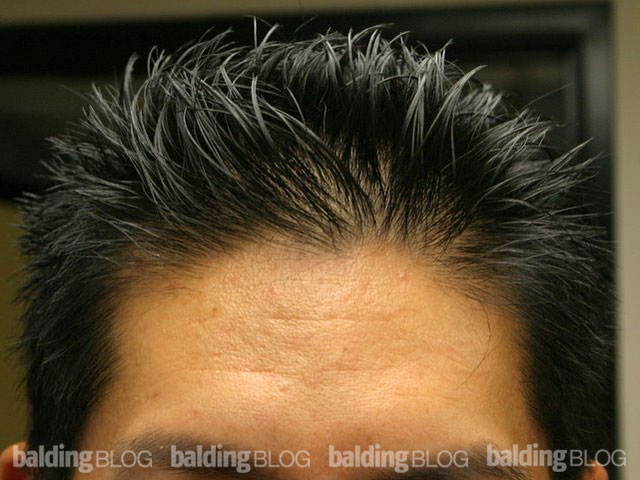
If the surgeon follows the rules set forth in this post, then the hairlines will be placed in a position exactly like it would have been had they never lost hair as shown in these two patient examples below. The man on the right saw his hairline go up from its normal mature position and the line drawn shows his normal mature position where the transplanted hairs were placed in a single session with these results. With the lower photo, this man had a Class 6 pattern of balding and this change in his look occurred in a single surgery. If the hairline was not placed in the correct mature position, he would not have looked normal. I call these hairlines “no hairline hairlines”.


Weekend homework assignment: Check out the hairlines of your sibling, parents, spouse, neighbor, and meter maid. It’s worth looking at a variety of hairlines so that you can see what I’ve discussed above and determine the difference between a juvenile hairline and a mature hairline.

Juvenile hairline in adult (from Reddit)

I have seen these unusually low hairlines for a mature male. They are common in children but usually disappear as the male matures. These hairlines are found more in the Latin and India countries than in Caucasians of European decent. Even for a juvenile hairline, this is low. Note that there are no temple peaks because they are incorporated into the rounded hairline.

Juvenile Hair Line

I am in the process of a losing my juvenile hairline. It is turning into the mature hairline. Does the hair that is receding to that of a mature hairline just fall out are does it have minuturization.

I am 26 years old and my straight across hair started changing to a mature hairline 2 years ago and have noticed minuturization for some time around the temple region,basically what i’m saying is this a normal event or the start of the balding process.I would be extremley grateful for your comments on the matter

As World War General Douglas MacArthur said in his retirement speech, “Old soldiers never die, they just fade away“. That is like hair and most people miniaturize some of the hair in conjunction with receding. The miniaturization process is an early indication of what the future holds, but there is no timeline on that prediction. We do not usually note miniaturization, because it sneaks up on us. Even your juvenile hairline will behave like the ‘old soldiers’ that General MacArthur talked about. The key for someone like you is to get the entire scalp mapped out to be sure that it stays in the juvenile hairline, otherwise drugs like Propecia may have great value in preserving the other hair you have before it sneaks up on you as well.

Just started to see my crown thinning?

I’ve noticed my crown has been looking quite thin lately. My hair, otherwise, is very thick – I haven’t noticed any temple recession or hairline receding, it’s just around the crown area. Am I able to apply minoxidil to treat just this one area? Or must I put on entire scalp?

Many people with the genes for balding start off seeing thinning in the crown. Topical minoxidil is the best first line treatment for this. Apply it nightly after a hot shower so your pores open up and only put it where the thinning is in the crown.


2020-11-04 08:29:30Just started to see my crown thinning?