In the News – Receding Temples or Crown Balding Means a Higher Risk of Heart Attack?

Snippet from the article:

People who had three to four signs of aging — receding hairline at the temples, crown balding, earlobe creasing, or fatty deposits around the eyelid — also had a 57 percent higher risk of heart attack and a 39 percent higher risk for heart disease in a study presented today at the American Heart Association’s Scientific Sessions 2012.

Using data from the Copenhagen Heart Study, researchers analyzed 10,885 men and women 40 and older for visible signs of aging and, over 35 years of follow-up, heart disease. By the end of the follow-up period, 3,401 participants had developed heart disease and 1,708 had suffered a heart attack.

Read the rest — What Hair Loss Says About Heart Disease


2012-11-07 11:23:03In the News – Receding Temples or Crown Balding Means a Higher Risk of Heart Attack?

In the News – Prostate Cancer Vaccine is FDA Approved

Snippet from the article:

A vaccine treatment for prostate cancer has become the first therapy of its kind to win approval for use in U.S. patients.

The U.S. Food and Drug Administration approved Provenge, a novel technique for fighting prostate cancer, on Thursday. The treatment involves taking a patient’s own white blood cells and using a drug that trains them to more actively attack cancer cells.

Read the full article — ‘Landmark’ cancer vaccine gets FDA approval


2010-05-04 06:45:34In the News – Prostate Cancer Vaccine is FDA Approved

In the News – Prince William’s Hair

Snippet from the article:

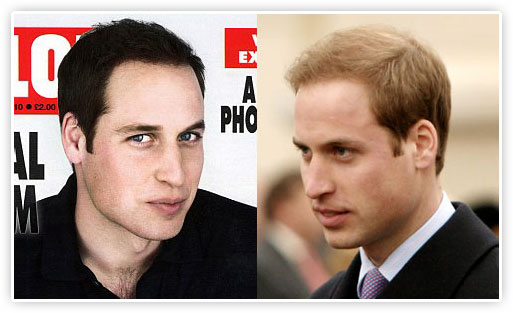
Prince William has found himself in a hairy situation. The British royal, 27, appears on the new cover of Hello! Magazine with a suspicious head of full, dark hair, a far cry from his usual thinning mane. While it looks as though the prince dyed his hair, inside images prove the cover photo may have been the result of some clever lighting or avid Photoshopping.

William sports his traditional dark blond locks in additional photos found inside the British tabloid, the Daily Mail reports.

Read the full article at NY Daily News

Prince William appears to have some hair thinning with his natural hair color, but the photo of the Prince with dark hair look like the work of Photoshop. Not only is his hair darker, but it looks thicker than in other pictures I’ve seen. Judge for yourself:

Prince William

In the News – Prince Kept His Hair By Playing Guitar?

Snippet from the article:

PrincePrince believes playing the electric guitar has stopped him from going bald.

The 52-year-old pop legend – who can play 27 different instruments – is convinced the electricity that flows through a guitar when he strums it is the reason he still has luscious locks.

He said: “Playing electric guitar your whole life does something to you. I’m convinced all that electricity racing through your body made me keep my hair.”

Read the full story — Prince: Playing the electric guitar prevented hair loss

So there you go, folks. The secret to keeping your hair — learn the guitar. Be sure to get a nice electric guitar with a huge, loud amp (bonus points if you live with people that are not musicians, since they will love to hear you learn).

I’m kidding, of course. Hair loss is from genetics… not electricity racing through your body.

In the News – Prescription Drugs Cost More in the US Than in Other Parts of the World

Snippet from the article:

Whether you are young or old, man or woman, very healthy or quite sick, it is almost a certainty that you are going to use a prescription drug in the next year or two. These medicines are crucial for preventing diseases and treating all sorts of ailments and problems.

They are also expensive — really expensive. For example, the best-selling drug of all time, Pfizer’s cholesterol lowering drug Lipitor, went for $3.50 per pill and up before going generic in late 2011. But these days some retail chains are giving away generic Lipitor while the rest are charging barely 50 cents a pill.

Prescription drugs cost Americans far more than they do people living in many other parts of the world. The drug companies say it is because they have to pay back the R&D costs which is largely put on Americans. Many think that this is because drug companies spend a fortune on direct-to-consumer sales and marketing (which they don’t do in other countries) and because other nations negotiate better deals for drugs than private insurers do in the United States.

Read the rest at CNN — How Big Pharma rips you off on drugs

In the News — Prescription Drugs Can be Dangerous!

Snippet from CNN article:

The U.S. Food and Drug Administration Tuesday ordered the makers of certain antibiotics to add a “black box” label warning — the FDA’s strongest — to alert patients of possible tendon ruptures and tendonitis.

“The new language will strengthen the existing warnings,” said Dr. Edward Cox, director of the FDA’s Office of Antimicrobial Products.

The FDA is requiring the label warnings and a medication guide for fluoroquinolone drugs, which include Cipro, Levaquin, Avelox, Noroxin and Floxin.

Full article — FDA orders ‘black box’ label on some antibiotics

This is another non-hair loss related post, but an important one that needs to be addressed. One of my most challenging problems are requests by friends to just prescribe an antibiotic for them for their flu symptoms. These friends feel that what they asked had no side effects and no risks so I should not be concerned. It just makes me slap my head sometimes.

The above referenced article shows that commonly used antibiotics which include Cipro, Levaquin, Avelox, Noroxin and Floxin have dangerous side effects. If we really knew all of the side effects, I am sure there would be more. The best thing to do is to take NO DRUGS unless the doctor knows what he/she is treating and the risks of treatment. Too many drugs that were thought to be safe are now known to be unsafe. Many of these drugs are killers. A good doctor earns his wage by not prescribing drugs at the drop of a hat. Mull that over.


2008-07-09 16:03:59In the News — Prescription Drugs Can be Dangerous!

In the News – Pill to Stop Hair Pulling?

Snippet from the article:

Most everyone plays mindlessly with their hair from time to time. But for some people it becomes such an uncontrollable compulsion that they end up with bald patches or eyebrows plucked bare (called Trichotillomania).

If it’s any comfort, animals too suffer from “grooming compulsions.”

Though the behavior is documented in the Bible and ancient medical texts, treatment for hair-pulling has not been studied much. But now a University of Minnesota researcher might have found an answer in a common, over-the-counter nutritional supplement that costs about $15 for 100 pills.

Read the rest — Pill could end urge to pull your hair out

If this is true, it would be a great, inexpensive way to treat this obsessive behavior. I’ll wait for the larger study to be complete, but the small 50 person study is promising.


2009-07-08 10:19:36In the News – Pill to Stop Hair Pulling?

In the News – Photographer’s Images of Alopecia

Snippet from the article:

It’s a hair loss condition that often robs sufferers of their self-esteem and confidence. Now a photographer has taken this stunning gallery of images of people with alopecia (many with alopecia areata) to raise awareness about the condition.

Daniel Regan, 28, said he wanted to tackle an issue that is often ignored by the public.

See the gallery — Photographer’s stunning images of alopecia sufferers as part of project to create awareness about the condition

The photographer said, “I hope that my images illustrated the drastic change that sufferers experience in their body image and place pressure on those in the right positions to pay further attention to this devastating condition.

In the News – Patient History is Key to Assess Hair Loss

Snippet from the article:

When patients present with hair loss, dermatologists should focus most heavily on patient histories, according to an expert who spoke at the 72nd Annual Meeting of the American Academy of Dermatology.

Many dermatologists perform a cursory exam and order a battery of blood tests, says Leonard Sperling, M.D., chairman and professor of dermatology, Uniformed Services University of the Health Sciences, Bethesda, Md. Dermatologists often dread these encounters, he adds, because they can burn daylight and often reveal problems that can’t be treated successfully.

Read the rest — Patient history is key when assessing hair loss

Few dermatologists use the modern tools for assessing hair loss (hand microscope to map for miniaturization and the HairCheck device for measuring hair bulk). Most dermatologists don’t like to do hair assessments if they can not tell if a patient is balding or not.

NW7A good example was in a 17 year old that came in to see me last week. I had seen him a year ago at the age of 16 where I did the HairCheck bulk analysis. His family history is significant as his father is a Norwood class 7 patient and two of his three brothers are also balding. One year ago, his bulk analysis showed 55% loss of hair in the front and 30% loss on the top. The crown showed no hair loss. On the visit last week, bulk measurements showed that his hair loss in the front increased to 75% and on the top it increased to 60%. Most significant was his hair loss in the crown, which was 50% of his bulk.

His hair was black, his skin was white, and the hair was medium-coarse, so that to the naked eye he showed only frontal hair loss. I already know that he will probably be a class 7 pattern balding patient like his dad. Without these instruments, I would not have seen any hair loss last year if I had not measured it, but even a year ago, it was evident that he was balding. Last week, we knew what pattern of balding he will probably be developing. He was placed on Propecia 1 year ago, but it did not stop his hair loss. He took the news well and we spent some time discussing a future Master Plan on what he might want to do as his hair loss becomes more evident. Shaving his head once he gets into college might be an option (with or without SMP).

In the News – Pain Relievers Linked to Erectile Dysfunction

Snippet from the non-hair-loss-related article:

Of those who took painkillers regularly, 64 percent said they could never get an erection, compared with 36 percent who did not routinely take NSAIDs.

After accounting for factors like age, weight, high blood pressure and cardiovascular disease, the researchers still found a 38-percent higher risk of ED among men taking painkillers.

Read the rest — NSAIDs Linked To Higher Risk Of Erectile Dysfunction

The study, published in Journal of Urology, looked at nearly 81,000 men aged 45-69 and found that of those that took aspirin, acetaminophen, ibuprofen, and similar NSAIDs, there was significant risk of developing erectile dysfunction.

USA Today also has the story.


2011-03-03 10:30:45In the News – Pain Relievers Linked to Erectile Dysfunction