
In the News – Baldness Cure is 2 Years Away?

Snippet from the article:

They are already talking with pharmaceutical firms about making the product, which would work by stopping the effects of a single guilty enzyme.

US-based dermatologists announced earlier this year that they had found that an enzyme, called prostaglandin D2 (PGD2), instructed follicles to stop producing hair. They identified it by screening 250 genes implicated in hair loss.

George Cotsarelis, head of dermatology at Pennsylvania University, said the one responsible for levels of PGD2 played “the major role”. He said he was now talking with several drugs firms about creating the anti-baldness product.

Read the rest – Baldness cure could be on shelves in two years

Two years seems like a bit of a stretch, considering there is no actual product yet… but the media is easily excited about hair loss “cures” as anyone that has been waiting for new treatments has surely seen. Apparently this new hype is based on a study of 17 people, but I don’t know where this idea came from about a proven safe and effective product being available by 2014. Whether or not PGD2 will be the next great hair loss treatment, there’s a lot of work that needs to be done first.

Just to sum this article up — apparently we went from a small study on PGD2, all the way to the miracle hair loss “cure” being on the shelves in a couple years even though there is no product just yet. I’ll believe it when I see it.
In the News – Balding Men 32% More Likely to Have Coronary Heart Disease

Snippet from the article:

Men going thin on top may be more likely to have heart problems than their friends with a full head of hair, according to researchers in Japan.

Their study of nearly 37,000 people, published in the online journal BMJ Open, said balding men were 32% more likely to have coronary heart disease.

However, the researchers said the risks were less than for smoking or obesity. The British Heart Foundation said men should focus on their waistline, not their hairline.

Read the rest — Male baldness ‘indicates heart risk’

This paper was actually based on meta-analysis of more than 850 existing observational studies, and it found that vertex balding (not frontal hairline balding) lead to an increased heart disease risk.

Whether there is anything to it, I couldn’t say… but coincidentally (or not), I had someone ask me just last week if having a hair transplant into his crown would reduce his risk for coronary disease.


2013-04-06 10:50:54In the News – Balding Men 32% More Likely to Have Coronary Heart Disease

In the News – Bald Chimp Looks Human, Still Throws Feces

Snippet from the article:

Other males may worry that losing their hair will make them less appealing. But for Guru the chimpanzee, his baldness has turned him into a star attraction. The 20-year-old, who is suffering from alopecia, has lost the hair from all over his body.

But the mischievous chimp still brings hundreds of visitors flocking to Mysore Zoo in southern India – despite greeting them by throwing stones. Dr Suresh Kumar, a zoo vet, said: ‘Everybody wants to see his biceps and triceps.

Read the full story (with many more photos) at DailyMail UK – Guru the chimp suffering from alopecia looks human

This is the 2nd bald chimp in the news this month. You may recall we mentioned Jambo the chimpanzee from the UK with alopecia… and now here’s Guru from India!

The article points out that Guru still gets down to business by throwing his poo at visitors to the zoo, so at least his alopecia hasn’t left him feeling depressed.


2010-10-22 13:39:54In the News – Bald Chimp Looks Human, Still Throws Feces

In the News – Avodart and Heart Failure Risks

A recent publication in the New England Journal of Medicine shows that Avodart (dutasteride) reduces the risk of prostate cancer along the same lines as finasteride did in earlier studies. The study also shows that in those men on Avodart, there was an increased incidence of heart failure.

Here’s a snippet from the Associated Press article:

Full results of a big study testing a drug for preventing prostate cancer show a higher risk of heart failure, a surprise finding that could dampen enthusiasm for expanding its use.

On Monday, GlaxoSmithKline PLC asked the federal Food and Drug Administration to approve its drug Avodart as a cancer preventive for men at higher-than-normal risk of the disease. The drug is already sold for urinary problems, and no heart failure risks have been seen with that use, doctors say.

Results of a study testing it as a cancer preventive were given at a medical conference last year, but the heart risk information had not been analyzed at that time so only the main results of the study were presented, a Glaxo spokeswoman said. Full results are being published in Thursday’s New England Journal of Medicine.

The study involved 6,700 men with high scores from PSA blood tests but no sign of cancer on biopsy. They were given Avodart or dummy pills and new biopsies four years later. Prostate cancer was found in 25 percent of those on dummy pills and 20 percent of those on Avodart.

Read the full article — Study finds possible heart risk with prostate drug

As the article does mention, the heart risk could be a fluke, but it is important to study this further. Just another reason why I can’t endorse dutasteride for users that wish to take it for treating hair loss.


2010-04-01 11:29:25In the News – Avodart and Heart Failure Risks

In the News – Aspirin Linked to Lower Cancer Risk

Snippet from the non-hair-loss health article:

Long-term use of a daily low-dose aspirin dramatically cuts the risk of dying from a wide array of cancers, a new investigation reveals.

Specifically, a British research team unearthed evidence that a low-dose aspirin (75 milligrams) taken daily for at least five years brings about a 10 percent to 60 percent drop in fatalities depending on the type of cancer.

The finding stems from a fresh analysis of eight studies involving more than 25,500 patients, which had originally been conducted to examine the protective potential of a low-dose aspirin regimen on cardiovascular disease.

Read the full story — Daily Aspirin Linked to Steep Drop in Cancer Risk

For years, there has been a suggestion that low doses of aspirin daily (75 to 81mg) can reduce the risk of death from a variety of cancers and vascular diseases. With increasing evidence like this, perhaps its time to consider taking one baby aspirin every day (talk to your doctor, of course).


2010-12-09 18:20:05In the News – Aspirin Linked to Lower Cancer Risk

In the News – Are We Taking Too Many Vitamins?

Snippet from the article:

Dr. Paul Offit doesn’t take any vitamins. In fact, while you might think that vitamins are great in any quantity, Offit urges you to take a step back and think before swallowing the equivalent of eight cantaloupes in a single dose.

“I think that alternative medicine is often given a free pass,” he told CNN chief medical correspondent Dr. Sanjay Gupta. “I think we should hold alternative medicine to the same standard that we hold conventional medicine. It lives under this sort of untouchable halo. I think we should be a little more skeptical.”

Offit, chief of the division of infectious diseases at the Children’s Hospital of Philadelphia, is no stranger to controversy — previously he has taken on the anti-vaccine movement. His book “Do You Believe in Magic? The Sense and Nonsense of Alternative Medicine,” came out Tuesday.

Read the rest — Vitamins: Too much of a not-so-good thing?

Vitamins and supplements are a multi-billion dollar industry, and this doctor warns that many of us are taking them in excess, ignoring or perhaps not knowing the possible health risks they may pose. These supplements are unregulated by the FDA, and as we see with the countless bogus herbal “cures” for hair loss, most of what people are buying into is marketing hype.

In the News – Are Bald Men More Virile?

Snippet from the article:

“The suggestion that bald men are more virile than their well-thatched contemporaries is probably an old wives’ tale, but it must be conceded that old wives are likely to be unusually authoritative in this matter.”

So said the esteemed British dermatologist John Burton back in 1979 when the topic was first explored in the medical literature. Burton was notably balding at this time.

Since the time of Hippocrates it has been known that eunuchs do not go bald. This link between masculinity and baldness was confirmed by the anthropologist James Hamilton in the 1940s when he studied the hair patterns of prison inmates in the United States. He was particularly interested in the sex offenders who had been castrated by the authorities as part of their sentence.

Read the rest — Are bald men more virile?

So are bald men more virile? Spoiler alert — The answer is “no”.

In the News – Other Takes on the Hair Loss Gene Findings

I’ve been reading more of the news items about yesterday’s publication of the two studies in Nature Genetics, and pulled some key quotes from various news sites that are worth highlighting.

From the BBC

“Analysis of DNA from 5,000 volunteers with and without male-pattern baldness found two stretches of the genome linked with the condition.”

“One was the androgen receptor gene and has already been linked to male-pattern baldness. The other region is on chromosome 20 and is nowhere near any known gene.”

We’ve long known that genes were responsible for hair loss, but now they’ve finally been identified.

From the Scotsman

“Until now, the only known genetic link with male baldness was on the female chromosome, meaning it could be passed down to men from their mother’s father.”

“Dr Richards said so far they had only identified a cause of hair loss.”

In other words, the cure isn’t here and this is still the very early stage, so don’t cancel your hair transplant just yet.

From the Wall Street Journal

But dermatologists say that looking at hair shafts under a microscope can spot shrinkage years before it’s apparent. “We can pick it up when kids are teenagers,” says Robert Bernstein, founder of Bernstein Medical Center for Hair Restoration, a treatment clinic in New York. He agrees that medication can slow hair loss only if it isn’t too advanced. Once an area is devoid of hair, only a transplant can restore it.

This is what I’ve been talking about all along — mapping your scalp for miniaturization.

In the News – Andre Agassi Wore a Wig

Snippet from the article:

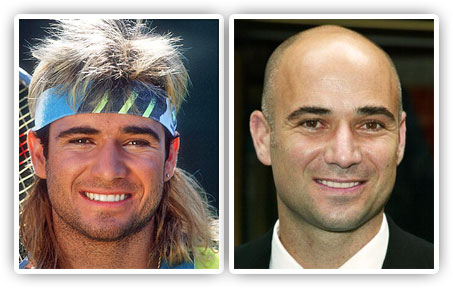
Former tennis star Andre Agassi has admitted the lion mane-style hairstyle he sported during the 1990s was actually a wig, in extracts from his autobiography published in British newspapers Saturday.

Agassi said he wore a hairpiece held together with pins in his first Grand Slam final, the 1990 French Open final, and blamed his concerns that it would fall apart for losing the match to Andres Gomez.

Before the match he prayed “not for victory, but that my hairpiece would not fall off”, he writes in “Open”.

Read the rest — Agassi admits mane was a wig

Well, coming clean about his wig-wearing days is certainly one way to sell books. Here are some before and after photos for those that might not remember him with his mullet wig in the 90s:

Andre Agassi