How Do You Know If You Lose 100 Hairs A Day?

Hi Doctor, you say that one lose on average 100 hairs each day. On what basis you say that? is it based on a scientific research and finding or just your own guess based on average number of hairs on someone’s head and the percentage of hair in telogen phase and length of the latter. If any of these parameters is in fact different, which is likely to be, then your assumption will not be accurate or correct. Thank you for all

The 100 hair loss a day has been widely published and accepted as the normal shedding of hair. Also note that it is not actually 100 hairs a day everyday, but “UP TO” 100 hairs a day.

If you take in to account that our hairs are also growing in cycles or telogen (resting), anagen (growth), catagen (transition) phases 100 hair loss a day out of 100,000 hairs is 0.1% of your total hair count. Also take into account while you are losing 100 hairs there are likely another 100 hairs that are starting their anagen (growth).

Anagen phase in measured in years, telogen phase in measured in months so more hair is actually in the growth phase in a normal cycle.

There are always exceptions to the rule, and not everyone is the same.

How Do You Get Dissecting Cellulitis of the Scalp?

well we finally got a name for my son’s hair loss problems! he is a white male 19 yrs old. first developed a “cyst” in 2005. it was drained, and a bald spot developed.hair finally started to grow back.about 6months ago started having more. it would start with a bump,break open with nasty yellow drainage and hair loss around the area.after seeing several doctors, last month,we were told it was dissecting cellulitis of the scalp.he is taking solodyn 90 mg 1 x a day. a few hairs have started to grow in that spot. but now he has several more started, and several more bald spots. what can we do to help his hair not come out? and to stop these bumps? how did he develop this in the first place? is it an imbalance of something? could this turn out to be serious health problems?? he’s very embarrassed about all the bald spots. please share anything you know about this. thanks!

Dissecting cellulitis is a very virulent infection wherever it is found. This type of infection can be life threatening as the bacteria eats away on the tissues of the impacted area. In the days before penicillin, Streptococcus was the main cause of battlefield deaths through dissecting cellulitis, which invaded every organ of the body and eventually led to multi-organ failure. I saw a number of such cases in Vietnam, but with modern drugs, most of these cases were controlled. Usually a recurrent cellulitis has a history of how your body keeps it under control. I would hope that you and your son’s doctor have a good line of communication open. I would assume that you have already received a second opinion from an infectious disease specialist.

How do you find the best hair transplant doctor in North America? (From Reddit)

My boyfriend is balding and does not believe in hair transplant procedures. I’m looking for a top doctor/establishment in North America to have a consultation and hopefully change his mind about undergoing the procedure. Was wondering if anyone has any recommendations since I’m not sure where to start/go looking.

There are websites that rate hair transplant doctors including Yelp and realself.com. I always tell patients to check out the doctor’s experience and rule out doctors who sell their services through salesmen or saleswomen. For example, you can look me up here (resume and cv): http://newhair.com/doctors/rassman/ and you can check out my references on those websites. If you don’t want to travel, then check out the doctors in your area and see how they present themselves.


2019-11-08 08:57:58How do you find the best hair transplant doctor in North America? (From Reddit)

How do you find a good FUE surgeon for mix races? (from Reddit)

I personally trained Dr. Diep and he along with other good doctors are capable of performing hair transplants (even FUE) on mix races without difficulty because they are well trained. I have been doing FUE on mix races for longer than any doctor in the world as I pioneered the FUE.

Best FUE doctors for mixed race hair? from tressless


2019-04-07 09:13:56How do you find a good FUE surgeon for mix races? (from Reddit)

How Do You Diagnose DUPA?

Hi Dr. Rassman,

I am an 18 year old male. I have experienced diffused thinning on the top and sides of my head for the past 10 months. I’ve probably lost 50% of my density. My sides are slightly thinner than the top. I was wondering if this would be diagnosed as DUPA?

The reason I’m asking is that my back is as thick as ever (of course there might be miniaturization that cannot be observed by the naked eye). Also, is it possible for a person to get DUPA this young?

In case it helps, no one in my family has MPB or DUPA. All 4 of my grandparents have quite thick hair on their sides, back and top

DUPA (diffuse unpatterned alopecia) is a condition found in men where the hair on the fringe area (back and sides) have significant miniaturization (greater than 20% of hairs). And yes, teens can have it.

No one knows what causes DUPA, but it looks like the pattern we see in women with significant female genetic hair loss, although their miniaturization may extend to other areas of the scalp.

How do you determine your Donor Density?

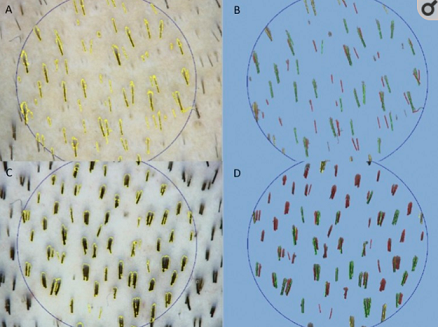
If you take a photo of your cut hairs like this with either a hand video microscope (available on Amazon) or a good camera with a zoom in feature, you will see the follicular groups. The average Caucasian density averages 2.1 hairs per Follicular Group so if you count the number of groups and the number of hairs, you can know for certainty what your donor density is. In these pictures, the circles in C and D have higher than normal donor densities as the average number of hair in each Follicular Unit averages significantly above 2.1 hairs per Follicular Unit. That means that the person who has the higher donor density has more hair to transplant and if they want to do FUE, can do certainly more grafts based upon the chart here: https://newhair.com/resources/#tab-id-4

How Do You Determine a Successful Hair Transplant Procedure?

Dear Dr.,

If you can’t accurately measure the growth rate of your hair transplants (as posted in a previous blog post), how do you determine if a transplant was successful considering that no quantitative data is available (i.e. 95% growth)…?…

Also, since you’ve been doing this so long, what is your opinion on whether people are too vain? You must see lots of interesting information regarding this since you are in a unique position as a hair transplant surgeon.

Success is determined by your ability to achieve your goals provided that you have had realistic expectations of it. A good doctor will tell you if it meets his/her expectations. I have had patients who felt that they had their expectations met and I did not, so in those very, very few patients I usually just do another hair transplant at my cost.

We are all vain, but we do not like to admit it. I can fill hundreds of pages of stories on vanity, but I’ll save them for another time. I don’t believe people are too vain, but some people see vanity as a problem, and that is where I disagree. There is nothing wrong with wanting to look as good as you feel (or hope to feel).


2009-03-19 10:18:46How Do You Determine a Successful Hair Transplant Procedure?

How Do We Really Know If a Doctor Has His Patient’s Best Interest In Mind?

Doctor Rassman.

How are you. I love the website. My question surrounds the importance of finding an ethical doctor who is not just about the money. As a layman (like myself) I am not that experienced in hair transplants and what to do, I rely solely on the doctor. The only experience or knowledge I have is by coming on your website and reading things about hair loss on the internet.

So, How would I know who is a good doctor, what is the proper number of grafts I should receive, and if the doctor places grafts into my head is he placing them in the right spot so I won’t have shock loss etc etc.

I would mostly go with what the doctor says because I am putting my trust in him, unless he says something totally absurd then I know to back off.

I can read all day on the internet about hair loss and what to do, but how do we truly know whatever the doctor says is in a patients best interest and isn’t about the money, because every patient and situation is different.

Thanks

I put together a guide for patients, where I detailed the approach I would take if I selected any doctor for any reason. If you go for a consultation and end up meeting a salesman, then I would generally suggest that selling is the doctor’s priority. If you come to my open house events, you can meet many patients face-to-face and look at the quality you will get (as what you see is what you get). Photographs can be misleading and show what the photographer wants the viewer to see. Photos of a doctor’s work should be augmented by meeting real patients in person.

We all have instincts which we must rely on, so use your instincts to know if you met the greatest bullsh*tter of all time. Some of the worst doctors in this business have a style like a con man and the looks of Brad Pitt. Can you tell a con man when you meet one? The recommendation of the doctor, with regard to the work you will need, should match other opinions you should get from other doctors. If they do not match up, then you need to challenge both recommendations and see if they make sense.

Fortunately, I have written many books and articles which cover most everything that you need to know (see our Medical Publications, where everything is documented). Lastly, ask yourself if you like the doctor personally, and if you trust him/her to be there when you need him/her. I carry my cell phone 24/7 and every patient has 24/7 access to me. That is my way of telling the patient that I will always be there if he needs me at any time. Over the years, I have helped men who had heart problems, having nothing to do with the hair business, so that is my way of saying “trust me”.

How Do Patients Deal with The Redness Right After Transplant Surgery?

My question is about coping with hair transplants. It seems like one of the biggest challenges/inconvenience of transplants is for patients to go out in public and resume their daily responsibilities after surgery because of the physical appearance of the scalp and how it initially is red, scabby, and punctured after surgery. I find this a very unappealing aspect about transplants and Im wondering how do patients cope considering the gruesome appearance of the scalp after surgery- do they take time off work and just lock themselves in their house until their scalp starts healing?

The scabbing can be easily addressed with good techniques and small wounds by the surgeon. Add good daily washes and most patients will have no significant crusting after the surgery. Everyone is different, but in regards to redness, only a few patients develop this. You can usually find out if you are one of them by performing a scratch test on the skin of your forehead. If it turns red 2-5 minutes after the scratch is performed, then you run a high risk of redness after surgery. The scratch incites histamine release at the skin level.

Remember, no matter how you want to look at it, a hair transplant is a cosmetic surgery. Just like any nose job, face lift, etc, there will be healing time needed. Some patients might get permission to wear a hat to work, others might adopt a new styling method to cover any initial redness from the surgery. Many of our patients go back to work fairly quickly after surgery (usually 2-5 days).


2011-12-27 09:13:14How Do Patients Deal with The Redness Right After Transplant Surgery?