8 Weeks After My Hair Transplant, It Still Feels Like I Have a Sunburn – Hair Loss Information – Balding Blog

Hi there,
Im 8 weeks post op…I had 4200 grafts done…Everything went well and i seem to have had no problems at all really other than my head feels like i have sunburn…It only stings for a few second if i touch it,other than that its not sore….Just wanted to see if thats normal? Would greatly appreciate your advice on this…Thanks

Block Quote

At 8 weeks after your hair transplant, you should feel normal without pain. I suggest that you see your surgeon and get his opinion.

How Much Hair Can I Transplant Now While Leaving Enough Donor Hair for the Future? – Hair Loss Information – Balding Blog

Dr Rassman,

I’m a Caucasian 27-year-old male with zero known family history of MPB. However, I’ve lost some hair on the front of my head, and crown miniaturization was detected — meaning that down the road, I could have a serious (Norwood 6?) pattern. I started taking Propecia and hope it can hold onto my hair for 5+ years.

That said, I already need a transplant. (A “conservative” well-regarded doctor recommended 1400 FUT.) I understand the need for a Master Plan and to not run out of donor hair too early. However, it’s very important to me to not be viewed as balding as a young man (I’m single and haven’t firmly established a career.)

I have fair skin and dark brown hair. Luckily, I’m blessed with wavy hair, donor density 2.3, that people commonly describe as coarse and thick. So, I’m wondering, how big of a transplant could I do now for the front of my head, and still leave enough donor hair for future loss? Could I transplant 2000-2500 grafts without worry? I imagine other patients might be in a similar situation to me.

Thanks so much.

Block Quote

Everyone is different. A 2.3 density suggests you have more hair in the donor area than many people, and with coarse hair you may be able to cover an extensive pattern. But for those with fine hair, it may not be enough to cover a class 6 or 7 balding pattern. I have many patients who have had more that 6500 grafts and most of them get quite depleted. A few of these patients have gone to 10,000+ grafts like this man, and although he could have passed the 10,000 graft number, he got realistically what he needed.

My Son Took Propecia for Over a Year and Had Many Side Effects – Hair Loss Information – Balding Blog

My 21 year old son has been experiencing heavy body hair loss since summer 2011. He took propecia for 13 months stopping in February 2011 due to sexual side effects. He still has significant sexual dysfunction,anxiety, panic attacks and depression. Loss of body hair has been reported to the FDA as a side effect of the drug. This is absolutely devastating for him.

Block Quote

Some people experience side effects from the drug that range from sexual to mood changes. Based on my clinical experience, I am of the belief that side effects disappear upon stopping the drug. There may be other things happening to him that your son’s doctor should assess. I hope he’s seen his prescribing doctor for a follow-up after stopping the medication.

Hair Loss InformationEltroxin and Telogen Effluvium – Hair Loss Information – Balding Blog

I have recently been diagnosed with hypothyroidism, and I have started eltroxin. I have also been suffering from FPB since the last 8-9 years. Is eltroxin likely to cause a TE to people who is predisposed, like me? When is this hair loss noticed, and can it be prolonged? Can anything be done to contain it?

Block Quote

There is an association between taking Eltroxin (levothyroxine) and hair loss, particularly in the first few months of taking it. You need to take this complication up with your doctor. It’s worth noting that hypothyroidism itself can cause hair loss, too.

Balding Men and Natural Selection – Hair Loss Information – Balding Blog

How are you, Dr. Rassman?

I don’t get it. A a firm believer in Charles Darwin’s theories about evolution and natural selection, I would have thought that those unfortunate souls who bear the gene that causes baldness would be an extinct breed. The overwhelming majority of women I’ve met find balding or bald men unattractive. Yet, the baldness gene hasn’t been removed from the human gene pool. How come this gene has made it?

Women and homosexuals find bald men sexually unattractive. Nobody chooses to sleep with a baldie over a hottie with a thick head of hair. Still, 50 percent of the male population has some degree of hair loss. Why does everyone find bald men that hideous?

I realize that my questions might be beyond the scope of this blog and that nobody really knows for sure. Nevertheless, I’d love to hear your thoughts about this.

Block Quote

We think of balding in terms of known times of recorded civilization. I wrote about this very question a few years back — Evolutionary Reason for Hair Loss?.

As humans grew their brains, intelligence and brain power came into play as an important factor for female mate choices. In the early years of humans, the disease tuberculosis was common, and men who had TB would become sickly. Women could often judge the long term health of their prospective mate by looking at the hair. Even though genetic balding was also present, women assumed that men who were bald (I suspect class 6 or class 7 pattern bald) would not make good mates because they would not live long enough to provide for them and their children. Those balding men with TB would die, so women assumed there was a connection between the two. Choosing a non-balding man with a full head of hair gave a woman some assurance that the man was healthy.

In modern Western society, TB is not common. Today’s balding men in Western societies are generally healthy. The genetics of balding may not negatively impact a woman’s choice if the man was smart, successful, and wealthy. I suspect that a class 6 or 7 bald, healthy, and successful man might be preferred over a poorer, full-haired man today. Ask if a sickly man lost his hair, would he be chosen by a good looking woman searching for a husband to produce a family today? The answer might lay in his bank account.

Besides all that, I’m sure there are plenty of people out there that would disagree with the idea that “nobody chooses to sleep with” a balding man.

Hair Loss InformationIn the News – Swine Flu and Alopecia Areata Linked? – Hair Loss Information – Balding Blog

Snippet from the article:

Here’s a reason to get your flu shot that you probably haven’t considered: infection with H1N1 may trigger baldness in a small number of people.

A new report from Japan suggests a link between alopecia areata, a condition in which patches of hair fall out, and swine flu (H1N1). The researchers report that seven patients experienced hair loss one to four months after developing the illness.

Block Quote

Read the rest — H1N1 May Cause Baldness

Apparently 7 patients with H1N1 (swine flu) saw hair loss, and although this is an extremely small number of patients to make a link, it’s worth exploring further. The exact cause of alopecia areata remains unknown, so finding even casual links could possibly lead to new information and perhaps even treatments.

Will Shaving My Head Bald Lead to Eventual Hair Loss? – Hair Loss Information – Balding Blog

Is it true that women that shave their legs all the time eventually will have less and less hair growing on their legs? What I’m getting at is, as a 23 year old man that shaves his head daily, if I decide in a few years to grow my hair out again am I going to run the risk of going bald from all the shaving? I’ve been shaving my head completely bald since I was a teenager and have no hair loss in my immediate family that I know of. And before I started shaving my head, I had no visible loss. I just want to know if I’m hurting my hair by shaving it off every morning.

Thanks!!!

Block Quote

These are old wives tales and have no truth to them. A similar myth is also shaving the head will make the hairs grow out thicker or fuller. False!

FUE Back into the Linear Scar vs Scar Revision – Hair Loss Information – Balding Blog

I’m thinking about getting a strip method hair transplant and then just filling in the scar with FUE. Is that an option thats worth pursuing? I don’t want the line scar but I want every graft transplanted. I understand FUE has problems with transection or something.

Block Quote

I get this question quite a bit from patients who have already had the hair transplant strip surgery and then inquire about having a follicular unit extraction (FUE) procedure to follow it up. It makes little sense for the person that already has a strip scar (no matter how wide it is) to have an FUE into the donor harvest. If it’s just about treating the linear scar, better solutions would be a scar revision or Scalp MicroPigmentation (SMP). FUE grafts used in linear scars are generally wasteful and an expensive way to treat the scar with less than ideal results.

My complaints about the way the FUE technique is used are:

  1. It’s generally more expensive than a scar revision for those with a troublesome linear scar.
  2. The grafts do not come out of the sweet spot in the middle of the donor area (where the grafts are easily taken by a strip).
  3. In my opinion, the overall survival of the FUE grafts are not as good as those harvested from a strip in most doctor’s hands (I do not believe that is a problem in our hands).

As the first to publish a paper on FUE (introducing it to the medical community), I can speak with authority on these issues. The ARTAS FUE robot has not really changed the process, except for leveling the playing field for those doctors not skilled in the extraction technique. The FUE technique, as done in most doctor’s hands without the robot, is not as good as the grafts produced by a strip surgery. If there was a formal study, I would expect that each doctor would show variable comparative results when comparing their FUE results with this strip results, making such a comparison between FUE and strip surgery essentially worthless.


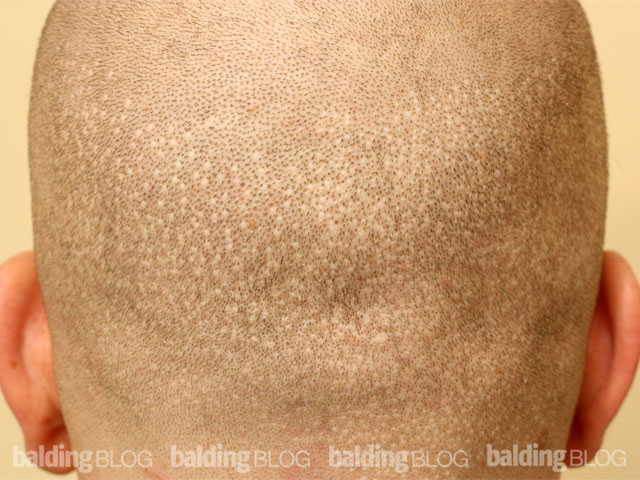
The presence of a fine line scar will not be seen in most patients who had a strip procedure, because they generally leave their hair just long enough to cover a strip scar. If they were to cut the donor area hair very close to the scar, at some point (depending upon hair length) the scar will show. I had two hair transplants and although I have a scar, few people can see it even when I show it to patients who visit me in the office. The public does not understand that there is scarring in FUE procedures, even though some doctors and clinics promote it as “scar-less” surgery. In some patients we have had to treat these FUE scars with SMP to allow for a close haircut or shave. The SMP process is the only one that treats FUE scars today and we are seeing more and more patients with this problem as time goes on. I suspect that the strip scar issue is more of a problem with a person who has dark hair and white skin, than the person who has medium brown hair and an olive skin. Nevertheless, both techniques do have consequences.

Here is an example of scarring from a large FUE procedure with the hair cut short. While there is no linear scar, you can clearly see the white pinpoint dot scars all over the back of the scalp. We’ve treated this with SMP (photos to come in a follow-up post later). Click the photo to enlarge.
 

With all that being said, I am not denigrating FUE. It is an important technique and in certain situations it may be superior to a strip surgery. Examples of superior candidates include those without large balding areas, and athletes who want to be able to resume full exercises and swimming within a week of the surgery; however, in patients with large balding patterns, taking the required number of grafts through FUE is not efficient and is relatively more expensive. There is massive experience with strip harvesting (some good and some bad). I have seen in some patients that visit me, that many doctors are harvesting grafts with FUE from the non-permanent areas to reflect a large need for grafts in a single session. Grafts that are taken from the non-permanent zone, may not last.

In the News – Actor Simon Pegg Had a Hair Transplant – Hair Loss Information – Balding Blog

Snippet from the article:

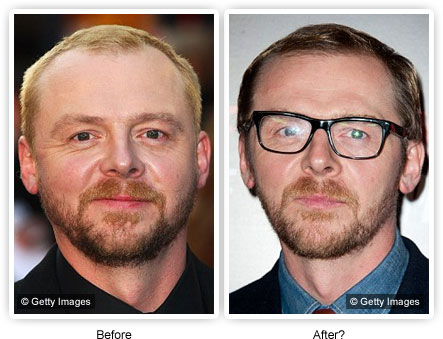
Starring in a film with Tom Cruise, can’t be good for any man’s ego. But it seems Simon Pegg gave his appearance a little helping hand by amended his receding hairline.

The Hot Fuzz star has been promoting Mission: Impossible – Ghost Protocol at various premieres this week, sporting a rather healthier head of head with a hairline that seems to have shifted a tad further forward.

Block Quote

Read the rest — Simon Pegg’s hairline appears to have shifted as he sports fuller head of hair

The article hints at a possible hair transplant for the actor, but I can’t find anything where Simon Pegg talks about surgery on his scalp. His hair does look thicker than before, but from the photos I’ve seen it appears he could just have some creative styling or products in use. What do you think?

Simon Pegg

Hair Loss InformationMy Hair Seems to Have Thinned in My Late 30s – Hair Loss Information – Balding Blog

I am 40 years old and noticed a drastic change in my hair texture and amount over the last two years. I have been about a NW2 with a strong frontal tuft that basically was quite curly and full. The top of my head was curly as well with a slight recession on the temples which seemed age appropriate. In the last two years that has changed in terms of width and density. It seems like looking back on pictures that my hair was darker and curlier only 1.5 to 2 years ago. Is this a common occurrence for MPB? I assumed it slowed down as we age but my case is reversed.

I have been stressed about it as well. The loss has been rather quick within the last two years at my age it seems that I had dodged the bullet for advanced NW patterns but looking at things now and I am certainly not as convinced. Should I start propecia and rogaine to restore the hairs that seem to have disappeared within a year? Family history is NW4-5 on dads side and moms side but later in life..what gives? thanks

Block Quote

Certainly, stressing out about losing hair could lead to further loss. Genetic balding, as we know it, develops in patterns. What you are describing doesn’t sound like patterned balding. I would want to do some testing on you to include bulk measurements of your scalp at different locations and miniaturization analysis to look for problems like diffuse unpatterned alopecia (DUPA), and even a pull test for telogen effluvium, etc. With a good examination and these tests in hand, I might venture a guess as to what is happening to you.