Hair Loss InformationNot Sure if I Have Enough Donor Hair 15 Years After My Last Transplant – Hair Loss Information – Balding Blog

I am a female, caucasion woman in her early 50’s. My hair color is blonde (treated now to hide the grey) and my scalp is fair. I had hair transplant surgery with NHI about 15 years ago (about 1800 grafts-I think in Palo Alto.) Anyway, 15 years later the transplanted hair is about all that is left at the top of my scalp. The doctor did tell me that since I have male pattern baldness (yes, he told me male pattern) that eventually the rest of my hair at the top would fall out, and I would be left with the transplanted hair. Which is where I am now. I am also noticing that my hair is more brittle (probably due to my age). I am so thankful that I had the surgery 15 years ago, because if I hadn’t I would be pretty much bald.

I have been using the Ovation Therapy system for about a month without much success. I’m contemplating another transplant, but don’t think I have enough donor hair to get the density of hair that I desire. I’m sure the cost is much more now too. I’m considering laser hair treatments. I know this isn’t your area (laser), but what are your thoughts? How do you suggest I proceed … next steps?

Block Quote

You should come in to see me (Dr. Rassman) or Dr. Pak for an examination and an opinion. If you lost only the native hair and had only one session with us, you probably can have another. We’d have to see the donor hair to make any determination, though. We’re no longer in Palo Alto, but we do have an office in San Jose, so we’re still nearby.

As for laser hair treatments, I’ve been very outspoken about them in the past on this site. I’ve yet to see any great results in treating genetic hair loss by using this low level laser light technology (LLLT), but ultimately it is up to you.

With regard to the diagnosis of male pattern baldness, I’d have to assume the doctor must’ve slipped and actually meant female genetic balding… but we can straighten that out when we see you.
Hair Loss InformationTwo Different Doctors Refuse to Prescribe 5mg Finasteride – Hair Loss Information – Balding Blog

Thank you very much for your useful blog. I have been taking propecia for a year and a half with great success. I have tried to get a prescription for finasteride 5mg from two different doctor but they both refused to prescribe it to me. So my question is do you know anyone that can do this in the London?

Block Quote

Some doctors aren’t open to prescribing the 5mg, but I couldn’t say for sure which ones would. You made sure to tell those doctors that you know you’re supposed to cut each pill when treating hair loss and you just want it to save money, right?

Dr Bessam Farjo is an occasional contributor to BaldingBlog, and he has an office in London. I can’t say for sure if he’d prescribe the 5mg dose, but it’s worth a try. Good luck!

Hair Loss InformationHow Long Does It Take Before a Surgeon Is Competent at FUE? – Hair Loss Information – Balding Blog

Hi,
This is a great blog. Very insightful and well written.

My question is how many years/ no. of surgeries or grafts would it take for surgeons to be competent at FUE?

If someone has only been providing the FUE service for a year or so (even though he has been tinkering for a few years previous to this with smaller sessions ie less than 600 grafts), should I feel comfortable enough to go ahead with a 2000 graft FUE offered by him for my frontal hairline?

Thank you very much for your help.

Block Quote

It isn’t just about how competent a surgeon is at extracting grafts with a punch or a follicular unit extraction (FUE) tool, it is about a combination of factors, of which extraction may be the most difficult for the beginner. Most surgeons take a few years to learn the extraction process and once they got it, it is relatively easy. The next skill is placing the grafts into the scalp without drying them or damaging them. When the grafts come out in the extraction process, the surgical team must trim the excess tissue from the FUE graft (which some doctors do not do), make sure the direction of transplanted hair is correct (which some doctors never get), make sure the medical staff are handling the grafts properly (quality control issue), and commanding the artistic process for each particular patient by controlling the distribution and direction of the grafts so that the fullest look will be obtained.

Hair transplantation is an art and technical skill that takes years to master for the doctor and the staff. Some people don’t realize that the doctor is not the one who inserts the grafts into the scalp (placing), but the doctor is the one that determines the direction and distribution of the grafts, and trains the staff to do it correctly. These are the most critical aspect in how well a hair transplant surgery turns out. With respect to inserting the grafts, it usually takes over a year for the medical staff to learn to insert the grafts efficiently. Some doctors will hire per-diem workers to do this work, so the quality will vary day by day, worker by worker.

I have said this before: cosmetic surgery is not like buying a car. It is not a commodity. No matter what the technique is advertised, each and every surgeon and their work is different. This is where due diligence comes into play. Before you put your head in the hands of any surgeon you should be well informed. There is no reason not to ask the surgeon if you can see his/her previous FUE patients and to speak with them about their experience. Find out if they were happy with the results and if their expectations were met. You should always voice any concerns you have so that any and all issues are addressed to your satisfaction prior to giving your consent to surgery.

Bottom line — some surgeons are more talented than others and there are a variety of factors that influence the outcome of any given procedure, therefore it is difficult to judge a surgeon based solely on the length of time they have been doing a particular procedure.

Male Eyebrow Transplants (with Photos) – Hair Loss Information – Balding Blog

Hello Doctors
I am a 39 year old man and had a problem with my eyebrows since I was probably in my 20s. My eyebrows aren’t very thick. I never plucked them and do not know why they appear thin around the edges or when it exactly happened ,but I wanted to talk to you about what a transplant looks like in that area for men. My hair is otherwise great on the scalp and I have a strong hairline. Have you done any man eyebrow transplants? Thanks

Block Quote

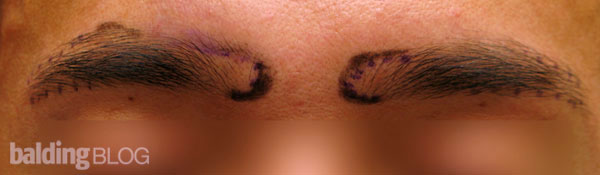
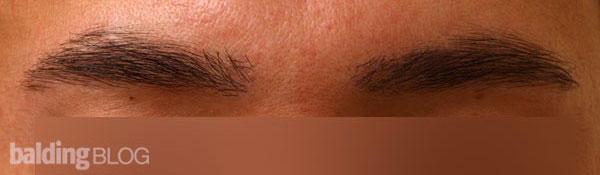
Here’s a male patient we haven’t shown before, with some beautiful eyebrow transplant results. I placed 189 grafts into his eyebrows with almost all single hair grafts taken from the scalp using follicular unit extraction (FUE).

In general, eyebrows are difficult to get control of the direction of the hair as it exits the skin, but these results turned out great! The after photo was taken about 7 months following his hair transplant.

Before photo on left // After photo on right. Click to enlarge.


Hair Loss InformationWoman Losing Hair Following Recent Move and Job Change – Hair Loss Information – Balding Blog

I am a 25 year old female experiencing hair loss. I can tell that my ponytail is about half the thickness it was about 2 months ago. I haven’t noticed any bald spots really, but at the front of my head and can definitely see my scalp and it is a lot thinner. I have had blood work done for thyroid and anemia. Everything came back normal. I attributed it to moving away and starting a new job and just being stressed out, but losing my hair is just making me stress even more.

There is even less hair on my arms, legs, and body. My skin is starting to become itchy, but no rash or dryness. And my hair is less oily. I have gained about 5-10 pounds, but I figure that’s because with my new office job I am less active. I have no history of hair loss in my family, but my dad does have thyriod problems, but that test came back normal. Any ideas on what could be going on?

Block Quote

Stress from your new job and the move could contribute to hair loss, and I realize losing hair in itself can also be stressful — so it seems like a never-ending cycle. That being said, there are many possible reasons for hair loss in women, so it would be difficult to solely place the cause on stress. You can find a partial list of causes here.

Did you just start notice your hair starting to thin during or following the move, or was there some loss going on prior to that when you were under less stressful situations?

Hair Loss InformationAny Long Term Risks of Using a Chemical Relaxer? – Hair Loss Information – Balding Blog

Hi there,

I wanted to know what are the long-term risks and effects of user a mild chemical relaxer. Could it harm the follicles and cause balding? I am a white Jewish male in his mid-30s with very curly and frizzy hair. I have all my hair. My father lost all his hair in his twenties, but the men on my mother’s side seems to have all their hair.

Thanks for your help!

Block Quote

Relaxers require an experienced application. The risks for poor use can be a disaster. With a good professional applying these chemicals, you can get away with it for years.

Do Miniaturized Hairs Always Die Off? – Hair Loss Information – Balding Blog

When hairs become miniaturized, are those hairs necessarily doomed to fall out and not be replaced? Or, can some men maintain miniaturized hair indefinitely?

Block Quote

I honestly don’t know. There are no set rules and I’m not aware if anyone has ever scientifically studied this in detail. We see finasteride hold on to miniaturized hairs for years and likewise some patients will be able to hold on to them with minoxidil.

In general, we know that for non-balding men and women, miniaturized hairs do exist. Those miniaturized hairs fall out eventually and a new hair grows in its place that most likely will be miniaturized as well. The percentage of miniaturized hair in non-balding men and women are low (under 20% or so) and if one looks at the length of these hairs, they are often short. The shortness tells us that these hairs are the vellus hairs that are found in the follicular units.

When you are balding or thinning, this percentage of miniaturized hair is much greater and many of those miniaturized hairs fall out, never to return after a few cycles.

Hair Loss InformationJohn Travolta’s Real Hairline Finally Revealed? – Hair Loss Information – Balding Blog

You called it, doc! John Travolta was on vacation without his piece!

Link: E! News

Block Quote

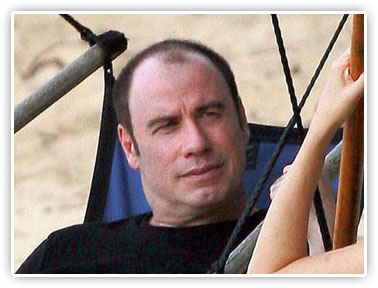
John Travolta was in Hawaii celebrating his birthday and the paparazzi caught him in what appears to be his natural balding state. One of Hollywood’s worst kept secrets, I’m not sure that I can or want to take credit for calling it. In fact, there was a photo taken years ago of what was likely his real hairline, so I don’t know why the entertainment reporters are making a big deal out of this. And we did point out the hairpiece years before that. At any rate, I got a few emails about this “late-breaking” news already, some of which sent a variety of photos. Here’s one:

John Travolta balding

Hair Loss InformationDoctors Gave Me Cortisone Shots for Treating Traction Alopecia, and Now It’s Worse! – Hair Loss Information – Balding Blog

I recently was diagnosed (by three unaffiliated dermatologists having all examined my scalp under a light with the naked eye) with traction alopecia, which I was more or less already aware that I likely had. I received cortisone injections from one of the three in the crown of my head and all along the line of my scalp/forehead. I had already had thinning, naturally, but now it’s looking as if the areas having received the shots are actually going bald in patches (as opposed to the former more diffuse thinning).

I’ve noticed that more and more frequently when I go to those areas to apply oils (emu, rosemary, etc) I will inadvertently pull out a few hairs from the root. My part is ever-widening, it seems. I’m very worried… Is it possible that the shots actually worsened my hair loss? And if so, is it permanent? And if not, with regard to the latter question, how long will it be before my scalp recovers…?

Thank you.

Block Quote

Steroid injections into the scalp for treating traction alopecia makes zero sense to me. As you found out, the cortisone shots could even cause more hair loss. This loss could be permanent, but only time will tell. It could take up to a year or so for regrowth to be seen. If no growth is seen by then, it’s likely permanent.