
Dense Packing of the Hairline (with Photos) – Hair Loss Information – Balding Blog

What is the average distance between each hair at the hairline and about a half inch behind it on a non balding adult male? And what is the smallest distance between each graft you can safely transplant at the hairline? When you normally transplant grafts at the hairline is the distance between the grafts always larger than the native hair of the person. I know only single grafts make up the first few rows of the hairline to give a natural looking transition but if they are not packed closely enough the hairline looks almost “see through” or whispy looking. I have noticed this on alot of transplant photos. Is there anyway to avoid this and give a very dense looking hairline transition even using single grafts?

I am a male with minor female pattern balding with very little temple recession but my hairline transition has become thin and whispy and looks similar to the hairlines created with a hair transplant in a totally bald area? My goal would be to thicken up the transition area so it looks thicker and dense similar to the hairline of Brad Pitt or Tom Cruise since I am in their age bracket. Is that even possible?

Block Quote

First off, I’d like to think I am a good surgeon, but I highly doubt I can make you look like Brad Pitt or Tom Cruise.

Second, a hair transplant cannot give you back the same hair density as you once had. Think about the simple fact that the surgeon has to get your OWN hair from the back of your head and move it to the front. In other words, the surgeon isn’t creating any new hair, just moving hairs around. If you move too much hair from the back you will be bald in the back (so to speak). Thus, the main goal for a hair transplant surgery is to give you a non-balding hairline and good enough coverage. But a hair transplant cannot give you back the fullness of Brad or Tom. Maybe another way to understand this point is to know that an average non-balding head has over 1250 hairs in a square inch (or 625 follicular units in a square inch).

The only exception to this is if you do not have too much hair loss (like Norwood 2 or 3) and understand you will not achieve the FULL look with one surgery alone. You need multiple surgeries to fill in the ‘gaps’ to achieve the fullness. You must also consider conserving the remaining donor hair available in case you continue to lose hair at the top and crown. This is what we refer to as the Master Plan.

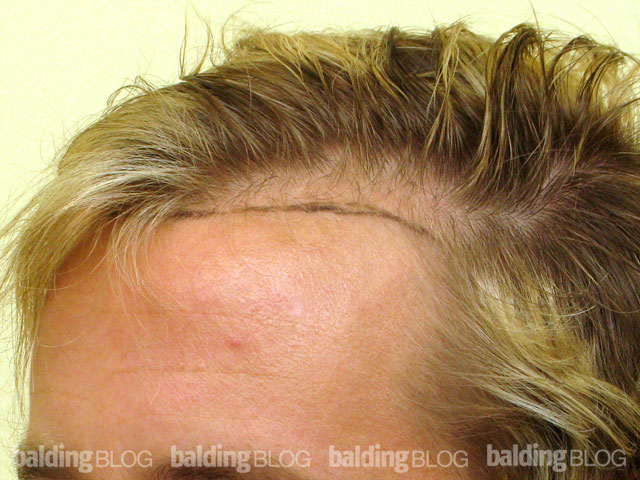
There are several patients that come to mind who requested precisely what you are asking for. The patient below is one such example of a Norwood class 3 pattern patient that had two surgeries with me in a very small area. Click to enlarge.

2 years after two hair transplants totaling 3182 grafts:


Before:
 

In the News – Balding and Stem Cells – Balding Blog

Snippet from the article:

An inability of stem cells in the scalp to develop into the type of cells that make hair follicles may be an underlying cause of male-pattern baldness, according to a new study. The discovery gives hope that people who are bald could regrow their hair with a future treatment, said study researcher Dr. George Cotsarelis, a professor of dermatology at the University of Pennsylvania.

In people who are bald, hair follicles have shrunken and become microscopic, Cotsarelis said. And scientists long thought that bald people also had a depletion of hair follicle stem cells, which are necessary to grow hair.

But the new study shows that bald people have the same number of stem cells as those with hair. So if scientists could coax the stem cells into producing more hair follicle progenitor cells, then it would be possible to generate bigger hair follicles that could grow hair, he said.

Read the full story at Livescience.com- Balding may be a stem cell problem

Our work on using plucked hair to grow a new hair in the balding area may touch on the subject material mentioned in that article. With new hairs growing from plucked hairs, does this mean that the new hair came from the plucked hair and its stem cells — or do the stem cells in the recipient plucked hair area stimulate the original hair to grow from “the stem cells which were unable to complete their normal development and become hair follicle progenitor cells“?

There is still much to learn here, but we have suspected for a long time that the bald areas contain the elements that can grow hair, but because of various defects that are described in brief in the reference here, they just don’t grow. I can imagine that some day we will harvest stem cells in enough quantity such that injecting them into the bald skin may bring back the original hair and cure baldness permanently. More research is surely needed and being done as this is the big lotto hit.


Balding Forum - Hair Loss Discussion

Paid advertisements (not an endorsement):


Shock Loss from Eyebrow Transplant? – Balding Blog

(female)
Hello Dr,
I was wondering if shock loss occurs in cases of eyebrow transplantation? Also, are there any other side effects that could potentially occur? Thank you for your time.

Shock loss can also occur with eyebrow transplantation. The main side effect (if it can be called a side effect) is lifelong trimming of your eyebrow, as it will continue to grow like your scalp hair. For the original viable eyebrows that falls out from what I will call hair transplant shock, these may not grow back and it can result from damage induced at the time of the surgery. Original eyebrows seem to be sensitive to trauma more so than head hair.


Balding Forum - Hair Loss Discussion

Paid advertisements (not an endorsement):


TV Chef Gordon Ramsay’s Hair Transplant – Hair Loss Information – Balding Blog

Check this out:Keep it under your hat but Gordon Ramsay’s had a £30,000 hair transplant

They mention that chef / TV personality Gordon Ramsay had a hair transplant using a “radical new treatment” called follicular unit extraction that “leaves no scars”. The press is so uninformed about things they report on sometimes. Hasn’t FUE been around for like a decade? What’s radical about it now?

Block Quote

Gordon RamsayOf course, you know that I pioneered follicular unit extraction (FUE) and published the first article in the medical literature on the technique in 2002. As for why the press is misreporting information, I don’t know why it happens. Perhaps it’s just laziness on their part.

FUE is far from a radical technique and it is incorrect to state that it leaves no scars, as anytime the human body is cut upon, there is ALWAYS a scar to some degree. The difference here between traditional hair transplants with strip harvesting (which leaves a linear scar) is that FUE leaves punctate scars that can be seen through the hairs in the donor area if the scalp is shaved very close there. Most people who have longer hair do not have visible scars, but that does not mean that it “leaves no scars”.

Good luck to Gordon Ramsay for the courage to address his hair loss concerns.

In the News – Interview with Dr. Christiano in NY Times – Hair Loss Information – Balding Blog

Snippet from the New York Times article:

Angela Christiano, 45, an associate professor of dermatology and genetics at Columbia University Medical Center, studies hair. Last summer, she announced the discovery of the genes implicated in alopecia areata, the hair-loss disease that she herself suffers from. The interviewer spoke for two hours in her Washington Heights laboratory and then later on the telephone. An edited version of the two conversations follows.

Q. When did you first learn that you had alopecia?

A. In 1995, a time of big transitions in my life. After doing highly successful postdoctoral research on genetic blistering skin diseases at Jefferson Medical College, I’d arrived here at Columbia to start my own laboratory. I had just turned 30. I was getting a divorce. When you start your first lab, a researcher is expected to find something different from their postdoc work. For my first six months here, I sat thinking, “What am I going to do when I grow up?”

Block Quote

Dr. ChristianoRead the full interview [login required] — Living and Studying Alopecia

Dr. Christiano is among the top doctors in her field, and her advances made in the understanding of alopecia areata (and thus future treatments) are to be applauded. I particularly admire her, because she is a person who identified a problem and made the decision to understand it as thoroughly as anyone.

The NY Times article may require you to login (it’s free to create an account), but it’s a good read for anyone interested in Dr. Christiano’s story.

Patients with DPA Can’t Get a Transplant? – Hair Loss Information – Balding Blog

In response to: Is Taking Propecia to Prevent Shock Loss an Indefinite Necessity?

I’m confused by Dr. Rassman’s response to this question. For the longest time you have written that sufferers of DPA have a stable permanent zone and they can usually can receive a transplant at the appropriate time. You’ve written that it’s suffers of DUPA that aren’t appropriate candidates for transplantation. Has something changed?

Block Quote

Nothing has changed. We always look to the health of the permanent zone when considering if someone is a candidate for a hair transplant. We weigh the balance between the supply of hair from this permanent zone and the demand of hair from the balding or thinning area.

Hair Cycling and Miniaturization – Hair Loss Information – Balding Blog

Question about the balding process…

My understanding of how we bald is that an individual hair follicle will start miniaturizing. It can go through many further cycles, but it will eventually become shorter, thinner, smaller and eventually non-existent. Is that correct?

If so, when we do see relatively thicker, longer and healthier looking hair shed/fall out, we shouldn’t assume that hair will never grow back, right? Rather, that’s just part of the natural cycle of hair growth.

Thanks in advance.

Block Quote

You are essentially correct. As it miniaturizes, hair becomes thinner and eventually ceases to regrow. Note the diagram on this page to see what miniaturization looks like in various stages.

Propecia and Healthy Sexual Function in Men? – Hair Loss Information – Balding Blog

Hi Doc, I had a question about finasteride, because I’m thinking of starting Propecia for hair loss and I’m worried about the sexual and other side effects. Basically, what is more responsible for healthy sexual function in males? DHT or testosterone? If testosterone is responsible, then shouldn’t Propecia help to increase sex drive – because speaking from a chemistry perspective, if Propecia reduces the forward reaction rate of the reaction that converts testosterone to DHT, then shouldn’t that lead to excess testosterone in the body? Unless Propecia inhibits testosterone as well?

Because I don’t understand how herbal DHT inhibitors like Procerin claim to have no sexual side effects, if they ultimately perform the same function. Unless of course there are other factors into play which I’m unaware of.

Block Quote

We have written about this over and over. Here’s some bulletpoints:

  1. See your doctor (as only a physician can prescribe Propecia) and ask him/her these questions in detail after they take your history and examines your scalp to determine that Propecia is something that would be recommended.
  2. Propecia has a side effect of decreased erection/libido in 1 to 2% of men. This side effect has been greatly exaggerated on the Internet. Moreover, many other drugs that treat blood pressure from cholesterol lowering drugs (any many other drugs) can also develop depression and have a similar negative sexual side effect.
  3. If you have a negative side effect, talk with your prescribing doctor and you may choose to stop taking Propecia. The side effects are reversible.

We can all hypothesize about the biochemical reaction of Propecia and testosterone and DHT, but in the end it works for male pattern baldness… and ultimately it is your choice to take it. I do not mean to brush off or not answer your question on the mechanism, but it will spiral us down a never-ending hole of “if this” and “if that”.

Healthy sexual function in men has nothing to do with drugs, Propecia, testosterone, or DHT in normal men. If you are a healthy individual in a healthy relationship, then you should have a healthy sexual function with or without Propecia. Propecia will not enhance or impede your sex life or health in greater than 98% of patients. If you think it does, then talk to your doctor. Of course, if you have your testicles removed, then you will have reduced testosterone and DHT, and will have wiped out your sex drive. DHT comes from the degradation of testosterone in the body, so if you do not make testosterone, then you will have very, very low levels of DHT.

Procerin is not a medication or a drug. It is a clever marketing name for an over-the-counter herbal product (saw palmetto) that sounds similar in name to Propecia. Procerin is not regulated by the FDA, nor has it been proven to actually treat hair loss.

Ethics in Medicine – What Do Doctors Do? – Hair Loss Information – Balding Blog

In a recent ethics article summarizing questionnaires from 10,000 doctors, the findings showed that doctors are human with the limitations that go with it. From the article:

“Honesty is the best policy” and “the patient always comes first.”

As absolute and correct as those aphorisms may be, they can be hard for doctors to apply in the complex world of modern medicine.

A recent Medscape medical ethics survey of over 10,000 physicians found that when it comes to patient treatment, a significant number of physicians struggle when it comes to topics relating to honest, straight-forward communication, and even pain management.

Block Quote

Areas that are particularly focused and difficult to deal with include death and the ability to openly discuss the subject of death with patients. The article continues:

From the patient’s point of view, “If I don’t know my time is limited I can’t put my affairs in order. I can’t say, ‘I’m sorry,’” …. What’s more, “it’s not like patients are asking Dr. Kildare, ‘What are my chances, Doc?’ Patients are increasingly educated. If you don’t tell them, they’re going to be looking it up on the internet the next day, so you should probably be the source of the data, because you’re a human and you care about them.”

Block Quote

Read the full story at Medscape — ‘Doctor, Are You Telling Me the Truth?’ Exclusive Ethics Survey Results
