
In the News – Getting the Word Out About Trichotillomania – Hair Loss Information – Balding Blog

Snippet from the article:

Laura Forbes has a ten-a-day habit that she is desperate to break. She tries to keep her hands and her mind occupied, but when she does succumb to temptation she feels guilty and frustrated to have derailed another attempt to give it up for good.

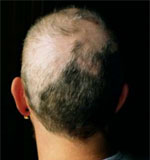
Laura is not addicted to cigarettes or to any other well-known vice. She is a trichotillomaniac – one of more than a million women in Britain who are tormented by the constant urge to tear out their own hair.

That Laura is plucking only ten hairs from her head a day is a great triumph of willpower for a girl whose obsession, at its peak, left her bald from the crown to the front of her head.

Block Quote

Trich
Photo source

Read the full story at DailyMail UK — The secret compulsion that’s as disturbing as any eating disorder

Trichotillomania is an obsessive compulsive disorder, and the article delves into looks at what triggers the desire to pull out your hair and how to possibly treat it. There’s no single solution that has worked across the board for everyone, but research has pointed towards new treatment paths.

Just a little over a year ago, we wrote about an over-the-counter pill that might help control the compulsion, but I haven’t found any newer info about it. If I find out more, I’ll post it on this site.

Preventive Propecia? – Hair Loss Information – Balding Blog

I have read many articles and questions on Propecia, but one think I never see is if propecia can be used as preventitive measure. For example Im 22 years old and still have a pretty thick heas of hair with a small receiding hairline, but my father is bald and so was my mother’s father so it is more then likely I will also go bald, so I was mainly wondering, is it ever to early with the hair loss stage to start using propecia even if I’m not sure if I will actually go bald.

Block Quote

You should not use Propecia (finasteride 1mg) for preventive measures. It’s a prescription medication, and you’d use it after you are examined by a doctor who can diagnose you with androgenic alopecia, prescribe it to you, and discuss all its risks and benefits. You have to know what you are treating first.

I Can’t Take Medication During Military Basic Training, But I’m on Finasteride! – Hair Loss Information – Balding Blog

Quick Question:

I am joining the military, slighted to leave for boot camp in a few months. I JUST started taking finasteride about a week ago (experiencing lots of shedding, which I am fine with), but I am not allowed to ingest any medication for the duration of basic training, which lasts a minimum of 11 weeks.

Should I continue the treatment, knowing I have to stop? Will the shedding I have encountered even grow back without treatment? Will stopping, then starting again, effect future treatment (the drug’s potency)? Thank you in advance!

Block Quote

Army trainingI do not believe 11 weeks in and of itself should have a detrimental effect on your hair loss issue.

I have had patients in the military that didn’t have issues with taking Propecia during training, particularly since it is a medication prescribed by a doctor. Even in boot camp I believe it would be against the law for the government to flat-out keep you from taking a physician-prescribed medication. Now if you are taking Propecia obtained from the Internet without a valid doctor’s prescription that would be another issue entirely.

About.com has more on taking prescription medication in basic training — “Over-the-counter medication is not allowed in basic training. If you bring any with you, it will be taken away. All prescription medication will be re-evaluated by a military doctor upon arrival. If the doctor determines that the prescription is necessary, the civilian medication will be taken away, and the recruit will be re-issued the medication by the military pharmacy.

So I guess it depends on what the military doctor believes is a necessary prescription. Since it is a cosmetic issue, there might be some resistance… but perhaps you should talk to your recruiter about meeting with a military doctor ahead of time to find out for sure.

Hair Loss InformationWas My Doctor’s Examination of My Scalp Thorough Enough? – Hair Loss Information – Balding Blog

Hello, first of thanks for this blog it helps dismiss all the paranoia and rubbish that is usually on the internet concerning hairloss. Im 17 and im worried about hairloss. I don’t know whether I’m a Norwood 2, perhaps a 3 its difficult to tell, but I’m somewhere around there, I’ve read your blog regularly and educated myself on the process of the hairline maturing and how it usually forms a gradual convex recession that is common to see on most fully developed males. My hairline though a Norwood 2 is not convex or gradually receded but more sudden almost exactly like that on the Norwood scale – is it safe to assume that if my hairline is not developing into a convex or gradual shape then what I am experiencing is male pattern baldness at an early age? I’ve never had a straight juvenile hairline like you’ve described, its always receded a little.

One more thing, I’ve read your blogs on getting miniaturization mapping done. Where I live the health care system does not offer such a test. I did however go to my doctor, who, in the final stage of MPB himself, ran his hands through my hair made a few “uhuh” and “yes”, sat back down and said it looks fine to him, and that my hair is the same density all the way round, he always said that I was far too young to be effected by MPB, but then went on to say that he started going bald at 18 only a few months older than I am. He then prescribed me a anti-fungal shampoo “just in cause”. I remember reading somewhere where you said if your doctor reacts like this run for the hills or something like that. Is it possible my doctor did a fair examination or should I seek further consultation?

Thanks

Block Quote

NW2I am going to assume you do not look bald at Norwood 2. You are very worried about some thinning in the front. The doctor you saw is likely a general internist who does not see hair loss patients as his primary practice. And even if that doctor is the most caring and sympathetic doctor in the world, if he does not treat patients with hair loss on a day-to-day basis as his number one priority, they would most likely not pay attention to young men who do not look bald. I do not think it is the doctor’s fault, but it is just the way doctors are trained. You see, hair loss is not considered an illness or a disease. It does not affect your health. So doctors really do not learn about it and its treatment in medical school.

If you want a good examination and evaluation of your hair loss state, you need to find a hair transplant doctor in your area. You can check ISHRS.org for doctors that specialize in this or since you indicated that you’re in the UK, you can see Dr Bessam Farjo in London.

In the News – Like a Forest Fire of Hair Loss – Hair Loss Information – Balding Blog

Snippet from the article:

Matt KelleyMatt Kelley was 38 when he first noticed a round, hairless spot in his beard. Within six weeks, every inch of his body that once had hair — including his eyebrows, eyelashes, arms and head — was completely bald.
“It was like a forest fire of hair loss,” Mr. Kelley said.

Mr. Kelley, now 43, has alopecia areata, an autoimmune disease that causes the body to attack its own hair follicles. Alopecia, which does not include normal male-pattern baldness, affects nearly 2 percent of the global population and has no universally effective treatment. Its progression is unpredictable and can range from a few bald patches to a completely hairless scalp to the loss of every hair on a person’s body — known as alopecia universalis. Sometimes the hair regrows, sometimes it does not, and sometimes it grows in only to fall out again years later.

Block Quote

Read the full story at the NY Times — A ‘Forest Fire of Hair Loss,’ and Its Scars

The article discusses how quickly this disease wiped out all of this man’s hair, the impact it had on his life, and the treatments he’s tried. The recent alopecia areata gene discoveries that were announced earlier this month has brought about renewed hope for a cure or at least a reliable treatment for those with this disease.

In the News – Testosterone Gel Increases Heart Risks – Hair Loss Information – Balding Blog

In non-hair-loss, but otherwise still important health news…

Snippet from the article:

According to a trial in older men using testosterone gel treatment, published in the New England Journal of Medicine, using testosterone gel results in a higher risk of adverse cardiovascular events, such as heart attacks and high blood pressure (hypertension) compared to a placebo.

The trial was stopped because of these adverse events. The study was supported by a grant to Shalender Bhasin, M.D., at Boston Medical Center from the National Institute on Aging (NIA), part of the National Institutes of Health.

Block Quote

Read the full text — Testosterone Gel Increases Risk Of Heart Attacks And High Blood Pressure In Older Men

The article points out that the treatment phase of the trial was stopped once the Data and Safety Monitoring Board made its recommendation, so I suppose that is one bright spot.

Hair Loss InformationKeeping My Hair Short After FUE? – Hair Loss Information – Balding Blog

I have been on propecia – Generic for about 7 months. I am bald on my crown. I am 43. I have not seen any hair growth. Should I stop. I am interested in FUe and not FUT. I keep my hair really short. I am happy with not having a full head of hair, and have successfully used a hair fiber to conceal my bald spot.

Can you provide me any advice on the propecia and also what I need to get FUE. FUT is just not an option for me due to the pain, healing time and the inability to exercise for 30 days.

Block Quote

I don’t know your medical history, you’re not my patient, and I didn’t prescribe you Propecia. Any one of those would be reason enough to make me uncomfortable giving you personalized medical advice about your prescription drug regimen. You should discuss any changes with your medication with your doctor. That being said, Propecia might not regrow your crown, but could be preventing it from getting worse. Like I said though, I don’t know your history so I’d just be making complete guesses if I continue.

As for your interest in follicular unit extraction (FUE), short hairstyles are possible without revealing any linear scarring (because there is no line), but if you shave your head you will still be able to see some tiny pinhole scars. I don’t know how short of a haircut you’re talking about.

You are correct in that healing time is quicker with FUE compared to the traditional strip technique, but the biggest trade-offs are price (FUE is more labor intensive and thus more expensive) and with the strip, we have the ability to get more hair in a single session. Those may be non-factors though, depending on your hair requirements and finances. For more info about FUE, see here and here.

Could FUE Give Me a Hairline Like Morrissey? – Hair Loss Information – Balding Blog

Hello Doctors

My question is about FUE & FUE2. Would it be realistic expectation for a male patient who is a Norwood IV and benefiting from Propeciea in the crown to achieve a good density in a conservative and mature frontal hair line? I get the impression from your previous entries that it may be expecting too much . I do also understand from the all the great articles you have provided that FUE seems to best used for smaller amounts of grafts needed in patients.

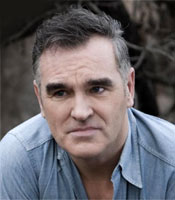
If i could get a outcome to resemble something like this mans hair i would be happy: Morrissey photo

I think that’s a great look. Thanks for your time and all the great info.

Block Quote

MorrisseyThe density has nothing to do with the harvesting method used, just the number of hairs per square mm that the grafts are placed in. Generally, depending upon hair/skin color and hair texture, the amount of hair needed to look full will reflect somewhere between 25-50% of your original density. One reason follicular unit extraction (FUE) might be best used for smaller cases has more to do with costs involved, since it is the more expensive procedure.

Could you look like Morrissey, the musician shown in the photo you linked to? I suppose that depends on what you start with. It is a great look, and if you have similar hair type and the grafts available, I don’t see why it isn’t possible. Take a look at our photo gallery and see hundreds of patient results. Or better yet, come to an Open House and meet some of our patients in person.

In the News – Napoleon Bonaparte’s Hair Sold for $13k – Hair Loss Information by Dr. William Rassman

Snippet from the article:

NapoleonA lock of hair cut from Napoleon Bonaparte’s head after he died has sold for US$13,000 at an auction in New Zealand.

Extra phone lines were installed for the sale to cope with an expected rush of international buyers seeking to snip up the hair cut from the head of former French Emperor a day after his death in 1821 while he was in exile on the island of St. Helena.

The circle of hair was part of a collection brought to New Zealand in 1864 by Denzil Ibbetson, a British commissary officer and artist.

Read the full article at Reuters — Lock of Napoleon’s hair sells for $13,000

I don’t remember a lock of hair being sold for so much before, but I guess this proves that there’s a market for everything.

Balding Forum - Hair Loss Discussion

Paid advertisements (not an endorsement):


Pityriasis Lichenoides Chronica and Hair Loss? – Balding Blog

I have been diagnosed with Pityriasis lichenoides chronica which I have had since I was 15. About the same time my hair started thinning. I am now in my mid 30s and I have general thinning (no hairline recession) from the crown to the front. Both sides and the back of my head is fully thick. I have started propecia and minoxidil.

Is there any connection between the PLC and my hair loss?

I have no personal experience with pityriasis lichenoides chronica (PLC), but as I understand it, there’s not much known about the condition. How it relates to hair loss is unclear. For those readers that are curious, PLC “is characterised by the gradual development of symptomless, small, scaling papules that spontaneously flatten and regress over a period of weeks” (source: DermNet NZ).

What I do know is that the most common cause of hair loss in men is genetic male pattern baldness (MPB). It occurs in a pattern from crown to front as you describe, leaving the hair on the sides and back “fully thick”, as you also describe. It could be possible that you have PLC along with MPB and the two are unrelated.

It seems you need a good diagnosis and you cannot get that here on the Internet. You need to find a physician who can examine you and give you his assessment. A miniaturization study may be helpful as well and may point to the association of genetic male patterned hair loss if that is also present.


Balding Forum - Hair Loss Discussion

Paid advertisements (not an endorsement):