
Protecting Against Shock Hair Loss – Hair Loss Information – Balding Blog

I have researched that after the hair transplant surgery, there are some patients who are experiencing a common side effects which is Shock Loss. I would like to know if this is the fault of the surgeon during the incission? Is there a way to prevent the further trauma to avoid more hair loss after the transplant? I am thinking of having this procedure done, but very much concern of loosing more hairs after the hair transplant. Please educate me. Propecia is commonly prescribed to patients before the surgery, but do you have to take this drug for the entire life or the remaining hairs will soon fall out

Block Quote

Shock loss is a hair loss process that accelerates immediately after getting a hair transplant. It usually occurs in the first 4 months after the surgery. Generally, Propecia will protect against most post-surgical hair loss from shock and it should be taken for a period to discuss with your doctor. The longer you take it, the better, but as hair loss is a progressive process it will kick in again when you stop the drug.

I generally recommend for patients to stay on Propecia for 9 months minimum just to deal with the threat of the shock loss, but that is not a hard rule. Everything depends upon your examination and the relationship you build with your doctor. I generally think that if you are serious about preventing any loss, men with genetic loss are best treated long term (lifetime is long term) with Propecia (finasteride).
Doctors Suggesting an Aggressive Approach to the Corners of the Hairline – Hair Loss Information – Balding Blog

Hi Dr. Rassman,

my husband has thinning hair on two of his front corners of his head Norwood 2-3. And he went to a doctor for a consultation about the problem, they suggest dense packing the two corners. However my husband doesn’t want to have the corners densely packed in case the rest of his hair in the center thins out in the future, which will look odd (Having two thick corners and a thinned out center). He feels this approach is too aggressive and wants a little more hair there just enough so it doesn’t look like it is receding. Is this a realistic approach to restoring the two corners? Do doctors normally make special request such as this?

Regards

Block Quote

I can’t say much about this particular case, as I don’t know enough about it (the level of miniaturization throughout the scalp, the age of your husband, etc). Generally speaking, as a surgeon I don’t dictate what hair restoration design should be done on someone. I listen to the patient first, and then build a plan that makes sense for both the patient and the doctor. It’s a back and forth process so that everyone is happy with the outcome.

It sounds like the doctor your husband met with wants to dictate what he needs and I would personally run for the hills… or at the very least, get another opinion. The results of this surgery will last a lifetime, so your husband is smart to be cautious.

Hair Loss InformationConfused About the Norwood Chart – Hair Loss Information – Balding Blog

I have a question about the norwood scale pictures. When the pictures show very little hair, is it supposed to represent literally that amount of hair, or any noticeable amount of thinning? I suppose an example would be 3 vs 4v. Does 3 mean there is no thinning at all and 4v mean they still have a decent head of hair, but the hair on top is thinner?

I’m sorry this question has been very hard to word, and i hope it makes sense.

Block Quote

The Norwood chart is just a list of patterns showing how men bald and probably where they stop in the balding process. But in the 1970s when Dr. O’Tar Norwood updated Dr. Hamilton’s initial studies, he surveyed a large number of men and clearly most were in some phase of the balding process.

It is not a progression of hair loss. For example — you do not go from Norwood 2 to Norwood 7 as you age. If you are going to be a Norwood 7 you will likely have thinning in a Norwood 7 pattern. You may not “look” like a Norwood 7 now (with all the hairs gone), but you may show early signs of it, especially when you look at your hair under a microscope. This is the reason why we always endorse a miniaturization study. I hope this clarifies things a bit.

My Doctor Told Me to Take Finasteride Only 3 Times a Week – Hair Loss Information – Balding Blog

After having a hair transplant this past September, my doctor prescribed me Proscar. He directed me to take 1/4 pill 3 days a week (Mondays, Wednesdays, and Fridays). My question is, will this dosage and frequency be enough to keep the hair I have and possibly grow new hair? I’m confused as to why my doctor did not direct me to take 1/4 pill EVERY day. Any comments on this are much appreciated.

Block Quote

I couldn’t tell you why your doctor directed your dosing as he did, as it makes no sense to me and he seems to be ignorant on the mechanism and pharmacology of finasteride. I can see valid reasons for taking a smaller dose in some cases, but I don’t see the point in taking the medication every other day (rather than daily). With a half life for the drug of 4-5 hours, there may be nothing to protect the hair follicle between doses.

Sex Hormone Binding Globulin and Hair Loss – Hair Loss Information – Balding Blog

Just wondering about your opinion on SHBG (Sex Hormone Binding Globulin) and MPB. In short, I’ve read studies and theories stating SHBG binds to free testosterone reducing levels of DHT. I know exercise and low insulin have been shown to significantly increase SHBG. Perhaps exercise and a low-glycemic diet may be beneficial towards slowing or preventing hairloss.

The study below shows balding men had low levels of SHBG, unlike men without alopecia.

Sex hormone-binding globulin and saliva testosterone levels in men with androgenetic alopecia.

Sex hormone binding globulin (SHBG), plasma testosterone and saliva testosterone were measured in sixty-four men with androgenetic alopecia and in forty males within the same age range without alopecia. There was a significant reduction in SHBG levels in bald men, compared with controls. Plasma testosterone levels were not raised in bald men, but their salivary testosterone levels were significantly higher than in controls.

Block Quote

This is interesting stuff, but I do not know what value it brings for the balding man and woman. We will not exercise just to change SHBG levels. It makes for great academia.

Hair Cloning and Organ Regeneration – Hair Loss Information – Balding Blog

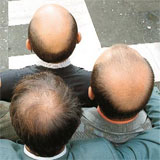
Bald headsI have seen some videos taken from CBS 60 minutes and another CBS news release that outlines an approach to growing organ parts (see here and here). The challenge of growing an entire organ like hair (which is a complete organ containing skin, glands, fat, nerves, blood vessels, stem cells and special hair growing cells) is more difficult than these video examples of finger tip and heart valve growth. Much of this research has been funded by the U.S. government and military and one has to be careful about taking such early studies and expanding on its greater meaning.
A number of readers recently pointed me to a press release apparently sent out by Drs. Hitzig and Cooley proclaiming they’ve successfully cloned hair using a special powder called MatriStem MicroMatrix. Here’s a part of the press release:

MatriStem MicroMatrix, a product of regenerative medicine innovator, ACell, Inc., is a wound healing powder that promotes healing and tissue growth and has now proven to help regenerate hair in the donor and recipient regions of hair transplant patients. While intended for diabetic ulcers, venous ulcers, pressure ulcers, traumatic wounds, second degree burns, surgical wounds (donor sites/grafts) and trauma wounds, Hitzig and Cooley have found that its properties offer a broader scope of treatment, including hair cloning.

Block Quote

There are some very early ideas on how this might work with hair, but there is no solid research available to support the hair claims. The press release is a bit sensationally written on the hair side, and I’d suspect this was sent out by an overzealous PR agency with a flair for the dramatic, rather than this being a case of these doctors claiming to do something that can’t be done with any consistency.

You can read the full text of the PR here.

Photo source: Associated Press

My Boyfriend’s Hair Transplant Didn’t Grow Back After Shaving His Head! – Hair Loss Information – Balding Blog

Dear Dr. Rassman,
My boyfriend had a FUE operation using hair both from the back of his head and his chest (all together about 1200 follicular) to cover the toothbrush look of his previous punch graft operations on the frontal part of his head. After less than six months the result was so great that everybody was under the impression that with another operation or two on the crown part of his head he would have a 70 to 80 percent of his previous normal hair days look back.

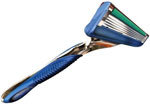
Approximately eight months after the operation he completely shaved his head with a Gillette Fusion razor with the hope that his new and old hair may look thicker and more ready for the next operation, but to everybody’s surprise (not to mention his horror) only 40 to 50 percent of his newly transplanted hair has grown back (after two and half months now) and the look of his frontal head now can be described as balding with previous plugs being visible again. I would really appreciate your comment and/or advice on the matter.

Block Quote

RazorFUE is not a perfect technique and it has a higher failure rate than the standard strip surgery, as the follicular units are often stripped of fat at the bottom of the grafts. Also, body hair transplants do not work to my satisfaction, because body hair does not grow the way scalp hair does. Body hairs do not grow continuously like scalp hair, as it is in its resting phase much longer. That is why most doctors do not perform body hair transplants; it’s not because body hair transplant is difficult.

Aside from these generalizations, I would only be guessing as to what caused the hair to not regrow after shaving it. And providing a guess would not be fair to you, your boyfriend, and even the surgeon. He needs to go back to his surgeon and follow up with this issue.

My Hair Started Rapidly Thinning in My Mid-40s – Balding Blog

Hi Doctor

I am male age 47 and my hair has been thinning very very rapidly over the last 5 months. Prior to this I just had normal daily hair loss which was unnoticeable. Is this normal at age 47 and also do you think propecia will grow back my hair given that i’m 47

Thank you

I am unclear as to why you are losing your hair so rapidly. What you’re describing is not usual, but certainly male pattern baldness is a possibility. Medications such as Propecia may help, but that is ONLY if you have androgenic (male pattern) balding. You need a good examination and a diagnosis before thinking of treatment options.


Related Posts Plugin for WordPress, Blogger...

Balding Forum - Hair Loss Discussion

Taking Finasteride and Giving Blood – Balding Blog

Hello Doctor,

With all of the terrible things happening in the world, I would like to give blood. However, I have been told that finasteride is not allowed in blood transfusions.

Are there any organizations for whom I can donate blood or plasma or platelets that can be used? It seems an awful shame that I can’t give blood while on proscar.

It seems as though I could stop taking it for a few days, give blood and then start up again, right? Or would it be possible to tag the blood as having finasteride and only transfuse it into male patients?

If you’re taking finasteride, blood donation is bad for recipient women who are pregnant due to the risk of birth defects… and that is why it is banned for blood donors. I don’t know about tagging the blood in the donation process. Finasteride users are supposed to wait at least a month after the last dose and dutasteride users should wait at least 6 months before donating blood.

There are other medications that take even longer, such as severe psoriasis treatment acitretin, which has a 3 year wait before you should give blood… and etretinate, which eliminates you from giving blood entirely.


Related Posts Plugin for WordPress, Blogger...

Balding Forum - Hair Loss Discussion

When I Get Drunk, I Have Less Hair Loss – Balding Blog

Hello Dr. Rassman,

I am a 35 year old male with a Norwood pattern II hairline. I have tried Propecia and Rogaine with no success.

I recently made an interesting observation about my rate of hair loss that has me perplexed, but hopeful. Ever since my hair loss began serveral years ago, I have noticeed a very consistent 40-60 hairs on the shower floor after towel drying my hair following my morning shower. Interestingly, however, on days when I have consumed a large amount of alcohol the night before (especially multiple nights in a row) I notice an astonishing decrease in the number of hairs lost (sometimes the total drops to as low as 5). Based on my knowledge of the science behind hair loss, it initially seemed highly unlikely that there could be a connection here – but I can no longer argue with the facts. The decrease happens every time.

Clearly getting drunk every night is not a desirable solution to my hair loss problem – so I’m hoping you can help me determine what the mechanism of action might be – and if there are any other ways of achieving the same result.

Beer can
I’m not going to suggest becoming an alcoholic to fight your hair loss, but I guess seeing less hair on the floor is a good thing. What you’re describing really makes no sense to me, though. There’s no basis for a relationship between a night of drinking and seeing less hair loss the next day. I wish I could pinpoint a connection for you, but I think we’re equally confused about this.

Maybe you just can’t count hairs accurately in the drain when you are hungover?


Related Posts Plugin for WordPress, Blogger...

Balding Forum - Hair Loss Discussion