Dr Rassman’s Minoxidil Opinion? – Hair Loss Information – Balding Blog

What is your personal opinion of rogaine/minoxidil regarding its effectiveness? Even though it’s FDA approved, most of the objective literature I find says its results are minimal, disappointing, that its window of working at all is brief etc. I noticed your NHI website doesn’t give it a good review.

Block Quote

I’d estimate that minoxidil works very well in about 15% of patients and there’s some effect in 30% more, but the remaining patients see no benefits with respect to growing new hair. The studies are generally poor for defining the results.

Hair Transplant Safety and Efficacy Standards? – Hair Loss Information – Balding Blog

Dear Dr. Rassman,
I find your blog very informative. I am looking for answers to the following questions:

  1. How is the success measured in hair transplant?
  2. What is the life span of transplanted hair follicles? (without any minoxidil/propecia)
  3. How does hair transplant compare to just minox/prop in terms of effectiveness and durability?
  4. Is hair transplant surgery proven via large scale studies done in compliance with standards that you would like to see in any other hairloss treatment before you could accept them?

Block Quote

Elvis

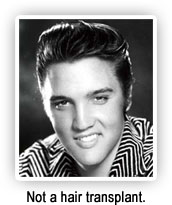
  1. The patient and doctor have to have specific and attainable goals before any surgery. No surgery will make you look like Elvis… in other words, no surgery will replace all the hairs you lost. So the success of the surgery is measured by the patient with realistic goals in mind.
  2. Transplanted hair has the same life span as the hair on the back of the head (the donor area), because that is where it comes from. As long as there is no disease present that would cause that area to lose hair (uncommon), the hair’s life span is until you die.
  3. Transplanted hair is genetically “strong” hair that is not affected by DHT or genetic balding. Drugs (Rogaine and Propecia) are meant for balding and thinning hair that is affected by DHT (genetic balding).
  4. Hair transplantation in one form or another has been practiced on a commercial scale since the 1950s! I have seen a number of patients who were transplanted in the 1950s and 1960s with the old hair plugs and they are still growing (for better or worse). It is in essence an autologous organ transplant, with each hair being its own organ, and it has been proven to work. Numerous studies exist that prove its success, but the cosmetic success and making it look natural is another issue that involves technique and artistry. I would argue the LARGE scale studies are right in front of you when you look at all the NHI patients in our gallery.

Can I Avoid Hair Loss Gene Triggers? – Hair Loss Information – Balding Blog

First off I would like to say thank you for answering people’s questions on this site. I’ve learned more here on the subject of hair loss than anywhere else. I have a few questions that I would appreciate some clarification on. I’m a 17 year old white male. My family tree doesn’t have much of a history of hair loss. My father is Norwood 2 at 50, and both of my grandfathers had full heads of hair, and so does my mom’s brother. The last bald person in the family was my maternal great grandfather. My hairline is probably identical to my fathers.

You spoke before of people having the balding gene but not expressing it – I’m wondering if that could be the case with any of these people and that I could have possibly inherited it. If it were, are there any triggers that could trigger it that I could avoid? For example, you said malnutrition can activate the gene. Specifically does that mean not getting enough calories, vitamins and minerals, or eating too much salt, fat, sugar, etc.

I’m also considering starting urine therapy for something completely unrelated to hair loss, but I read that male urine contains DHEA, which is supposedly another trigger of the gene. Do you think the amount of DHEA in urine would be sufficient to have any negative affect on hair loss?


Block Quote

TriggerI am assuming that you plan on ingesting the urine, as opposed to applying it on your scalp. I don’t think drinking it would be a negative on your hair (nor would applying it to the scalp — though I don’t know why you’d do that), but I have to admit that I don’t know a lot about urine therapy. Anyone with more experience in this area would be welcome to add a comment.

I do know that avoiding potential hair loss triggers really isn’t a great way to prevent hair loss, so long as you have functioning testicles. In other words, anything can potentially trigger it and there’s no perfect checklist to guarantee you’re safe from genetic hair loss.

In the News – Hair Loss from High Chlorine Shuts Down Jr High School Pool – Hair Loss Information – Balding Blog

Snippet from the article:

SwimmerMount Vernon’s Junior High School pool shuts down after it tested positive for high amounts of chlorine.

The school district was notified Wednesday by parents of possible high amounts of chlorine in the pool.

Block Quote

Read the full article — School pool shut down for high chlorine levels

The problem was discovered at the Mount Vernon, Indiana junior high when parents reported their children had rashes and hair loss. Chlorine is known to cause or accelerate hair loss, particularly at higher levels. It may be just a topical effect and if so, will reverse.

My Hair Thickened on Propecia – Hair Loss Information – Balding Blog

I started to notice my hair “changing texture” when I was 23. By 26, I was noticing a “cowlick” on the left side of the crown of my head for the first time. Then the right side. At 28 I started propecia. My hair looked okay dry, but the thinning was apparent when it was wet.

I am 29 now and I feel I have less hair but each remaining hair is thicker. Is it possible the thin hairs I lost will come back in as slowly has they thinned? I don’t know if I am paying for slow hair regrowth or false hope when I buy fin.

Block Quote

Regrowth at the hairline, which is where I assume you’re talking about, is rare. I can’t comment on whether you have less hair now than you did a year ago or even whether it is thicker, because I don’t know you or have any mapping to go from.

You need to see a good doctor who specializes in hair. If you’re buying a prescription medication, you should have a prescribing doctor — so I would discuss this with him/her.

In the News – Drinks Lots of Coffee and Tea, Have Lower Diabetes Risk? – Hair Loss Information – Balding Blog

In non-hair-related health news…

Snippet from the article:

Drinking more coffee (regular or decaffeinated) or tea appears to lower the risk of developing type 2 diabetes, according to an analysis of previous studies reported in the December 14/28 issue of Archives of Internal Medicine, JAMA.

By the year 2025, approximately 380 million individuals worldwide will be affected by type 2 diabetes.

Despite considerable research attention, the role of specific dietary and lifestyle factors remains uncertain, although obesity and physical inactivity have consistently been reported to raise the risk of diabetes mellitus. A previously published meta-analysis suggested drinking more coffee may be linked with a reduced risk, but the amount of available information has more than doubled since.

Block Quote

Read the full article — Drinking Coffee, Decaf and Tea Regularly Associated With a Reduced Risk of Diabetes

Drinking lots of coffee to avoid type 2 diabetes? I guess it just shows that almost anything can be linked to something else if you’re really looking for a connection. It’s the Six Degrees of Kevin Bacon game, but for diseases.

Frontal Fibrosing Alopecia – Hair Loss Information – Balding Blog

What is frontal fibrosing alopecia? I haven’t heard of this before and I just read an advertorial that mentions that it is a cause of hair loss in women.

Link here

Block Quote

Frontal fibrosing alopecia (FFA) requires a microscopic diagnosis made in the hands of a good dermatopathologist. To quote the link you sent, FFA “can cause women to lose up to five inches from their hairline. If FFA goes undiagnosed, women can even lose hair at the sides and back of their head.” For more info and some photos, see DermNet NZ.

In general, there are two types of hair loss — scarring alopecia and non-scarring alopecia. Genetic (male pattern) hair loss is the non-scarring type. We usually do not perform surgery for those with the scarring alopecia, because as the name implies there is scarring and inflammation underneath that is causing the hair loss. So a hair transplant would not likely work because your own immune system can still attack the transplanted hair.

My Iron Levels Are Normal Now, But I’m Still Losing Hair! – Hair Loss Information – Balding Blog

A few of months ago I started see that my hair was thinning all through out my head. Then I got scared so I am a 32 year old female and I went to see a doctor for my hair loss. They said I had low ferritan levels. So they gave me iron pills and by my next blood test they said my levels were fine. But now I’m still losing hair and now my scalp itches and burns. I take seizure medication, but I’ve been taking it for a long time and I’ve never had this type of reaction and I’m not pregnant. I don’t have pattern baldness that runs in my family either. I don’t know what to do :( What do you think it is? Is it fixable? Will my hair grow back? Should I do something different? Should I use certain hair products? HELP!!!!!!!!!!!!!

Block Quote

You need a doctor who will take charge of your problem, rule out all of the metabolic causes of hair loss and scalp itching, and give you a diagnosis. Seizure medications can contribute to hair loss, so discuss this with your doctor. Diagnosis comes before treatment, but unfortunately this is not something I can do over the Internet.

How Much Rogaine Should Be Applied to the Scalp? – Hair Loss Information – Balding Blog

Dr.Rassman

If I want to apply rogaine to both front of the head and the back, can I put 1 mL on the scalp and 1 mL on the front? or do I take the 1 mL and distribute it evenly on the front and back?

Thank you

Block Quote

You’re supposed to use 1 mL per dose of Rogaine (minoxidil), meaning you should apply 0.5 mL to the front and 0.5 mL to the top, if that is where you want it. The recommended treatment is two applications per day, so 2 mL total. Using too much minoxidil could result in a drop in blood pressure, headaches, dizziness, etc.

Laser Clinic Claims a 95% Success Rate? – Hair Loss Information – Balding Blog

Hello,

I am 23 years old and already begin to thin around the crown of my head. Starting to notice hair on my pillow and when I shower. Thinning spot has been getting progressively more noticeable over the last 6 months. I have been using Rogaine for the last couple months without very much success. I am quite certain that stress and genetics are both major contributors to the early hairloss I am experiencing.

I have now begin to look at alternative treatment options and came across a laser therapy center claiming they have had 95% success rate over the last couple years. Laser therapy for a year was quoted just over $4000. That includes 15 mins under a laser helmet once a week for 12 months, a laser comb and topical solution for the 12 month timeframe. I have been advised that after the 12 months I would have to purchase topical solution for the rest of my life to avoid build up of DHT again which will progressively begin hair loss again. ($150/bottle every 7 months). According to the clinic they guarantee success or your money back (not something I would trust unless I see it in writing)

I would like to gain some insight into this type of treatment and see if anyone has had similar treatment with success. I am more than willing to spend the cash as my hair is an important part of my image and I have no desire to be bald by the time I am 30. Just want to make sure that the money is being well invested and that this is not a Scam.

Could you please provide me with some information on this type of hair loss therapy? Results? Studies? Success Stories? or anything else that can help in my decision. Thanks

Block Quote

Guarantee?I have written extensively about the use of lasers as a hair loss treatment — and simply stated, they do not work as claimed. To tell a client they have a 95% success rate — well, it depends on how they define “success”. If only 5% of their customers ask for a full refund, perhaps their judgment of success was that they were 95% successful in retaining your money. If they advertised a 95% success rate in regrowing hair, they’d probably be in violation of consumer fraud or advertising laws.

There was a recent case of a laser clinic in Chicago that was sued for refusing to honor their money-back guarantee when the laser treatment was found to be worthless, so just be sure to look out for these types of practices.

Here are some laser links worth reading:

  1. What Percentage of a Chance Do You Give Laser Treatment of Working?
  2. Reader Adds to the LaserComb / FDA Debate
  3. Reader Checks in with His Thoughts on the Latest LaserComb Study