
Hair Loss InformationWas I Misdiagnosed with Alopecia Areata If My Hair Grew Back? – Hair Loss Information – Balding Blog

Hi Dr Rassman – In my late teens I had a bald patch appear in the back of my head that was diagnosed as alopecia areata, but it all subsequently grew back within a few months and has been normal since then. I’m now 30 and I’m thinking about a transplant to my hairline, I’m wondering if the previous alopecia areata puts me at additional risk for shock loss or any other complications (I’m already on Propecia). Thanks in advance.

Block Quote

Alopecia areata will often disappear months after it first appears. There is always a risk of it reappearing at any time, but considering how many years it is since its last appearance, it seems unlikely.

Alopecia areata (AA) is often regional so if you are genetically balding (more patterned loss) and the diseased area is outside the area of your need, it can be transplanted knowing that there is a remote risk of AA appearing in the recipient area. If the desire is to transplant a bald spot created by AA, then there are two conditions that I feel must be met:

  1. The AA has not been active for at least 3 years
  2. A biopsy should be performed to rule out it being active at this time

Hair Loss InformationI’m a Late Bloomer – Is It OK to Take Propecia? – Hair Loss Information – Balding Blog

I started thinning in one temple at 18 and was prescribed rogaine and biotin supplements. At 20 the entire top started thinning (especially in the frontal hairline area) and I am now nearing 21 and considering propecia, however, I am hesitant to start at such a young age for a couple reasons. I am a late bloomer with no facial hair and am constantly told that I look much younger than I am. I have two questions: 1) Will propecia effect my body’s development including facial hair? and 2) Is it more likely that something other than MPB could be affecting my hair because my body is so early in its development? I enjoy your blog and would appreciate any help you can give me. Thank you

Block Quote

It is possible (but not probable) that Propecia will slow down body hair growth. That has not been my experience. I really don’t know the answer to your perceptions of being a “late bloomer”. Some men don’t grow facial hair well at all, but at 20 years old your body is not early in development. I can’t say for sure what you’re experiencing without an exam, but from your brief one-line description, it sounds like MPB (frontal hair loss, top thinning). Propecia is a prescription drug, so discuss your concerns with your doctor.

Hair Loss InformationCutting Generic Finasteride – Hair Loss Information – Balding Blog

Dr. Rassman,

Good info is provided in this blog, I want to ask you a question regarding a previous posters comment on Generic Finasteride. Your response to the blogger was to purchase Generic Finasteride at Cosco or Wallgreens instead of ordering generic Finasteride online. How is this possible when Merck was granted an extended patent until 2013 (See Wikipedia on Finasteride)?

Also do you think its safe cutting the 5mg into 4ths which will be 1.25mg approx? Thanks!

Block Quote

Generic Propecia (1mg finasteride) isn’t legally available in the US due to the U.S. and International patents held by Merck, but generic Proscar (5mg finasteride) is available in the US and that’s what I was referring to. When cutting the 5mg pill, you’ll likely have some crumbs, so it might be a little less than 1.25mg. Regardless, I don’t think it’ll be a problem. If you can cut it into 5 equal pieces, that would be ideal… but not practical and the dose clearly does not have to be exact (as discussed elsewhere on today’s posts).

Hair Loss InformationYears After Hair Transplant, I Still Get Scabby Growths in Recipient Area – Hair Loss Information – Balding Blog

At least 5-10 years ago I had multiple sessions of hair transplants. All these years later, I am still getting scabby type growths at up to dozens of the implant recipient sites.They dont hurt ,but they feel annoying-as they feel like small crusty raised bumps that I have to kind of pick and tease off since hair is growing up threw the center of them.I am fair skinned Irish so I am very careful not to get a sunburn on my scalp or it makes this problem MUCH worse .Any advice/product or Rx recommended?? Thank You

Block Quote

I would have to see you and look at your skin to understand the problem. Flaky skin (dandruff) can be something brought on by a scalp surgery. Zinc and tar based shampoos will work to control this. You can buy this in any neighborhood drugstore.

Rogaine and Dandruff – Hair Loss Information by Dr. William Rassman

hello doctor,

My question is ive been doing both rogaine and propecia for almost ten years. All of a sudden a couple months ago i started to get some dandruff (mild case). i am now using dhs zinc shampoo. the dandruff is still there but im controlling it and its not too bad. should i stop using the rogaine as it may be causing the dandruff? and if i use rogaine having some dandruff will that cause hair loss? (i did see my dermatologist and he didnt seem to concerned about me having the dandruff plus using the rogaine)

Thank you for your time

Rogaine (minoxidil) can cause scalp irritation and give you flaking. The use of zinc shampoos like Head and Shoulders works to control dandruff, so you’re on the right path. You will not develop hair loss from the dandruff.

Balding Forum - Hair Loss Discussion

Paid advertisements (not an endorsement):


Hair Loss InformationWhy All the Negative Doctor Posts Without Stating Their Names? – Hair Loss Information – Balding Blog

Dr. Rassman. I have noticed that you have a fair amount of threads about bad transplant surgeons such as this one here, but you never say the doctor’s name. What is the point in posting this unless you mention the Doctor’s name so patients in the future will stay clear of this doctor and others? Without mentioning the doctor’s name, other patients will be subject to his horrible results.

Block Quote

CrookI would love to mention the doctors’ names, but that would almost certainly bring me into court, something that I do not wish to spend my life doing (it might bring me to the brink of financial ruin with large lawyer fees just to prove what I said). I get angry when I see the mess created by many of these doctors, but alas, you must use the information in ways to become a knowledgeable buyer, so I use this blog to call people’s attention to what they need to look for when engaging a doctor’s service for a hair transplant.
In 1994, at a medical meeting that easily had 400 physician in the audience, I rose to the microphone and openly referred to the sleaze in this business, with doctors low balling patients and deforming them without telling them the risks to hair transplantation (giving them proper informed consent). The surgical results before 1994 were often deforming and pluggy. These, in hindsight, were very substandard when compared to today’s artfully performed hair transplants. Many doctors would not enter the business to perform hair transplants because of the deforming nature of the surgery at that time. One doctor, in particular, was my target and when I exemplified this sleazy, dishonest doctor without mentioning his name (I called him a “crook” in the true sense of the word), the audience responded with a standing ovation for my being so outspoken, echoing my message. At the end of the session, I was surrounded by many doctors congratulating me on my outspoken comment. One doctor (the one whose name was never mentioned) waited for the crowd to clear and approached me with great anger, saying that he did not appreciate my calling him a crook. As I never mentioned his name, I said “If the shoe fits, wear it” and walked away.

Hair Loss InformationDid Retired Pro Hockey Player Eric Lindros Have a Hair Transplant? – Hair Loss Information – Balding Blog

Dear Dr. Rassman,

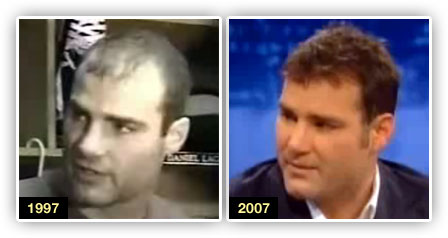
If you watch the attached videos of Eric Lindros (former professional hockey player), would you assume that he has had a hair transplant or is that a hair piece? I would estimate that the videos are 5-8 years apart. If it is a transplant, the results are exceptional. In the first video, he clearly has signs of a receeding/thinning hairline. Conversely, in the second video (interview after his retirement) he has a full head of hair. What are your thoughts?

Youtube – Eric Lindros in 1997
Youtube – Eric Lindros in 2007

Thank you in advance for your time. Best Regards.

Block Quote

Here are side by side still shots from the videos you linked to:

Eric Lindros

The comparison with the 1997 pictures show Eric Lindros is a Class 3 Vertex balding pattern (front and crown). From the pictures, I can not tell if it is a hair piece or a hair transplant, but he is doing something to give himself hair. When the hair is combed forward, a lot can be hidden. Perhaps he started on medication like Propecia or Rogaine. Propecia was FDA approved in late 1997, so he could’ve started it soon after. I really am just speculating, of course. For all I know, it could’ve been witchcraft (though I’m 99% convinced it wasn’t).

Hair Loss InformationHave Any Patients Gone Completely Bald While on Propecia? – Hair Loss Information – Balding Blog

Have you ever seen anybody end up going completely bald while on Propecia?

Block Quote

Interesting question. Some men start Propecia when they have advanced balding patterns and few start when they have a full head of hair with early miniaturization. Those that started Propecia with a full head of hair (with some miniaturization) are slowing losing hair to some degree, but I do not recall anyone that became completely bald. I suspect that there are patients who will develop a Norwood Class 7 pattern of balding even on the drug, but these are few and far between. This does not mean you are guaranteed to not go bald on Propecia. I suspect I have not followed someone long enough in the last 10+ years to have seen it (or if they became bald, they never followed up with me).

Hair Loss InformationIn the News – ISHRS Says Hair Restoration Patients Up 26% in 2008 – Hair Loss Information – Balding Blog

Snippet from the press release:

Despite the worldwide economic downturn in 2008, more people continued to seek treatment for hair loss, according to statistics released today from a recent member survey conducted by the International Society of Hair Restoration Surgery (ISHRS) — the world’s leading medical authority on hair loss and hair restoration. The extrapolated worldwide number of hair restoration patients treated in 2008 was approximately 811,363 (236,468 surgical patients and 574,894 non-surgical patients) — up 26 percent from 2006.

Block Quote

Read the rest at Marketwatch.com

These are some interesting statistics. If you’re considering a hair transplant, you’re obviously not alone. Hair transplants have never looked better, and with fees drastically reduced now is the time!

Hair Loss InformationIt Seems Doctors Are Seeing More Gynecomastia from Propecia – Hair Loss Information – Balding Blog

Dr Rassman,

I’m in my mid-30s and have been experiencing hair loss for the past 5 years. I feel like I’m at the stage where I need to decide if I want to take finasteride or not. My biggest concern is the side effects.

It seems that more and more I hear (both on the news and from friends who are doctors) how doctors are seeing a greater prevalence of male gynecomastia. The often sited reason for this is due to the increased use of finasteride (both for prostate treatment and hair loss treatment). Of course, it could just be that gynecomastia in men makes for an interesting story on a slow news day…

My question is, do the number and types of side-effects experienced by your patients on finasteride agree with published studies?

In reading this blog you do make mention of how some of your patients experience side effects, but you’ve never made mention if the number of side effects you’ve seen clinically are more, less, or the same compared to the numbers posted by Merck.

Block Quote

I’ve had 2 patients in the past 2 years that had gynecomastia. Both stopped finasteride and it went away. Most of my patients are on Propecia/finasteride. I would tend to agree with the statistics published by Merck.