Great American Dream Vote Winner, Follow Up (with Photos) – Hair Loss Information – Balding Blog

I’m very curious on the progress of the TV show contestant, Russ Jowell, that you transplanted in April of 2007. How is his progress? how was it compared to the photoshop projection that was shown the day of the show prior to the transplant?

Block Quote

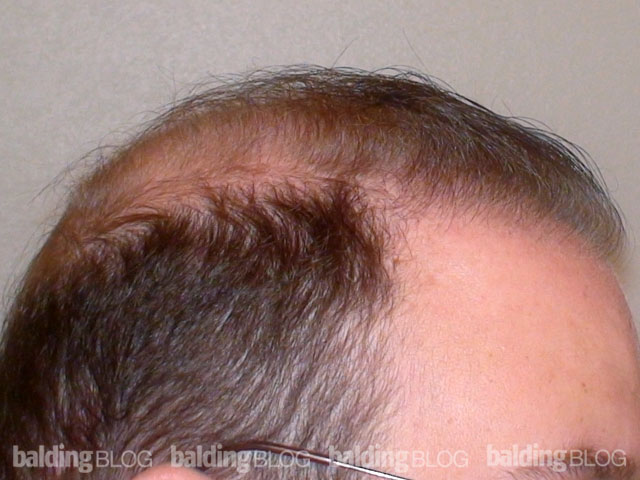
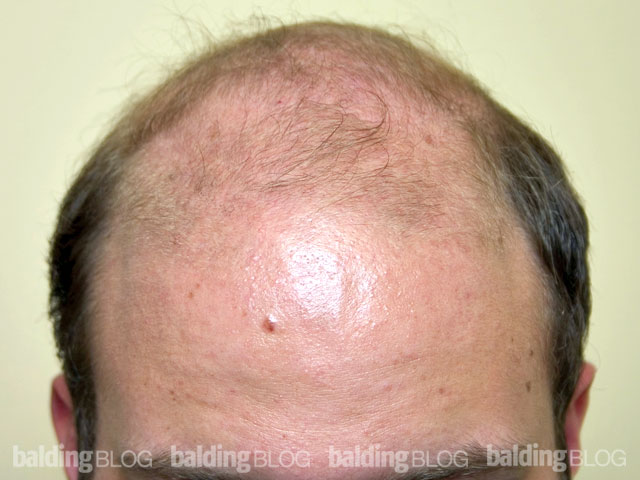
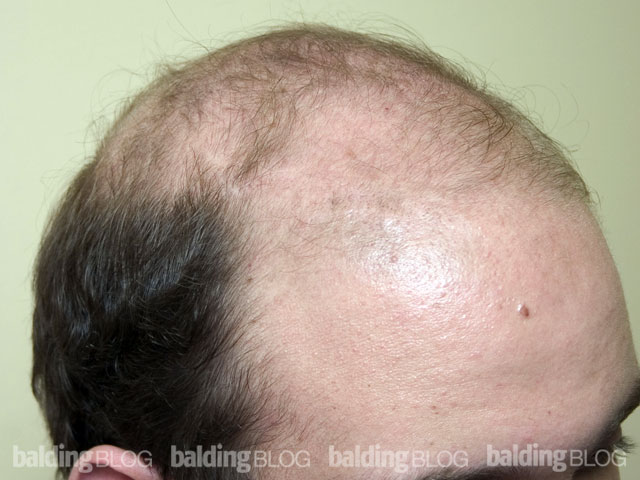
For those that missed it, ABC ran a special called The Great American Dream Vote where this young man with a Norwood Class 6/7 hair loss pattern (pretty extreme for a 22 year old) won his dream of getting a head of hair. Unfortunately, the show was canceled before his results could be shown… so here we are.

Russ’s results came out well, but he’s not at that Photoshop projection the producers of the show asked us to make. He has very fine hair, and the projection was made by taking the results of another patient’s hair transplant (who had a medium weight hair), so that will account for the difference in fullness from the frontal view. A coarser hair will have three or four times the volume (visual effect) than a fine hair with less bulk to it. Russ had another surgery after that 1st one for a total of 5816 grafts (photos below) and he just recently had yet another procedure (2856 grafts), this time to the top and crown to give him more coverage. We heavily weighted the transplants in the front on the 1st and 2nd time around, and it’ll take some time before we get photos of his 3rd procedure results, since that surgery was recent. Russ is very happy with the results thus far and can’t wait for the top and crown to grow in. Click the photos to enlarge.

After two procedures totaling 5816 grafts


Before


Hair Loss InformationIs My Crown Balding or Is that Just How It Parts? – Hair Loss Information – Balding Blog

Hello,

I’m 22 and have had long hair for about 2 years now, and hadn’t paid much attention to my hairline at all. Recently, in about the last 3-4 months i began to start looking at it and noticed that i have do indeed have a receding hairline. However, due to my long hair i cannot quite tell if i have any vertex hairloss as well. I took a picture and have a spot, but its possible that its just the way my hair parts and its been like that ever since ive had my longer hair (i never paid attention at all to the back of my head). As i have also noticed similar parts in other guys with long hair. None of my friends or family have mentioned it to me… and especially with my friends, cuz we talk about this type of stuff all the time.

What do you think?

Block Quote


First, thank you for allowing me to post your photo.

It is difficult to tell based on the lighting in the photo. Sometimes under harsh lights, the scalp can be seen even without any balding present. This indeed may be early crown balding, but the way to determine this is to map your scalp and look for miniaturization in both the frontal hairline and the crown. Then if you have miniaturization, you are genetically balding and should consider treatment.

Hair Loss InformationSensigraft and Folligraft – Hair Loss Information – Balding Blog

Hello Dr. Rassman. I wanted to thank you for having this blog and answering questions.

Sorry this is long, but…I’m a 27 year old guy who’s been receeding for 6-7 years, it quickly became a Norwood 5 and stayed there. What’s worse is I have a preppy, young looking face and overall appearance (which I enjoy and would like to keep), so the baldness clashes even more. I currently wear a fairly good hairpiece, but want to find a relatively permanent and hassle free solution, which brings me to my main question.

Have you heard anything about the non-surgical hair replacements like Folligraft and Sensigraft? I haven’t been able to find much information online either way (I always look for other places not on their website, so I know it’s not a marketing scam). My main concern is if it “breathes” to where you can sweat without being uncomfortable or itching (that’s a slight drawback of the hairpiece). The other would be the approximate cost, since I can’t afford a good HT. I obviously don’t want to blow a couple thousand dollars I barely have on something that may not even completely work, but I’d like to be able to have something more versatile (i.e. different hairstyles or able to be more comfortably active).

If I want to have the friendly youthful look, would you recommend staying with the ‘piece and save up for a good HT, or for hair cloning if it (hopefully) becomes available in the future? Or are the cosmetic treatments an idea worth looking into?

Block Quote

There is a fair amount of material on these websites — Folligraft.com and Sensigraft.com. Both appear to be like a membrane that is glued to the scalp. The scalp must be shaved to apply the Folligraft membrane and the manufacturer claims that it is porous so that the membrane may cut down on the sweating. As the hair grows, it almost certainly will impact the security of the membrane. It sounds like it requires a great deal of maintenance, probably driving up the costs, but clearly you can check them out at their websites and go from there.

If anyone uses either of these, I welcome your comments… but I don’t have any personal experience with them.

Chances for a Hair Loss Cure? – Hair Loss Information – Balding Blog

What are the real chances of any of these “baldness cures” becoming a reality, I mean REAL no BS to make us feel better. Things like TRX2 and Aderans, when do you really think we will, if at all, see these on the market?

Block Quote

Probably not… but I am hopeful. To elaborate, we are at the infancy of genetic engineering and cloning. We are still striving to find the cure for the common cold, diabetes, cancer, HIV, etc. I think the cure for hair loss is not on the top of the list of what scientists puts their priorities on.

There have been some recent announcements, including the ReGenica press release, that may be worth looking at.

Hair Loss InformationIn the News – Hypnotherapy and Alopecia Areata? – Hair Loss Information – Balding Blog

Snippet from the article:

Alopecia Areata is defined as a condition in which stress causes moderate to severe patches of hair loss on the scalp. Another form of Alopecia, known as Alopecia Universallis, is when complete hair loss affects the sufferer rendering them completely bald with the same side effects as those patients going through chemotherapy treatment for cancer. A study was performed to test the effects of hypnosis therapy on those suffering from Alopecia.

Subjects for this study included 28 people with severe Alopecia Areata for whom traditional treatment was ineffective. Twelve of the 21 participants showed significant improvement. This included 4 participants who had complete hair loss. Along with hypnosis therapy for hair re-growth, the participants were given therapy to help reduce stress.

Block Quote

Read the full text at Natural News

The study was just published in the International Journal of Clinical and Experimental Hypnosis and makes for some interesting reading. The study wasn’t very wide (only 28 people), but the results they discuss sound very positive.

Dutasteride and Sterility? – Hair Loss Information – Balding Blog

Hi Dr Rassman,

I have a growing concern about a couple of blogs you answered stating that dutasteride “could”, but not definitely cause permanent sterility. wondering if you have come across this situation,or a site on the net with some further info. I am a 40 year old male and have been on dutasteride (0.5mg) for 9 months. no side effects to date, unless it is mental, and have 3 children. results are good to date.

Thanks.

Block Quote

At the 0.5mg dosage you’re taking, risks of sterility likely aren’t great, if any. The FDA trial results should be released sometime this year. When the results are out, the answers to your questions will hopefully be there.

Can I Remove the Widow’s Peak that Formed After My Hairline Matured? – Hair Loss Information – Balding Blog

I am a 29 yrs old asian male. I had narrow forehead with a widows peak as a child. About 5 yrs ago, i started to notice receding hairline just on the temple. My hair line became more M shaped and now some of the frontal hair is thinning. However, the hairs on my widows peak are still thick. Is there anyway I can remove the widows peak and little bit of my frontal hair to make my hairline more natural? I know that will recede my hair line more than now but its okay since I have a narrow forehead. Thank you

Block Quote

Without seeing you, I can not determine if your requests are reasonable. If you lost frontal hair, a hair transplant may bring you back towards your original look. Removing a widow’s peak is possible, but that may not be what you really need.

Hair Loss InformationDoctor Calls Miniaturization Studies Unnecessary – Hair Loss Information – Balding Blog

Dr. Rassman,

I read your blog daily and really enjoyed the educational pieces about miniaturization that you recently posted. You made a comment that you have never understood why your colleagues don’t accept the approach you recommend for doing miniaturization studies.

I will probably be looking at getting a hair- transplant within the next 24 months. Because I work 7 days a week due to being self-employed, I cannot afford to miss work and come to see you. Fortunately, I have a very good surgeon about 45 minutes away. When I called his office though to inquire about miniaturization studies, his staff had no idea what I was asking about. I recently e-mailed the doctor to ask him about it. Below is my e-mail and his response to it. Perhaps his response will help to inform you of why some of your fellow surgeons do not embrace the concept. After reading, please tell me what you think in regards to his comments. Hopefully, maybe, everyone can eventually come to an agreement.

This is my e-mail to the doctor in question:

Dear Dr. (name withheld)

I will be looking into getting a possible hair- transplant within the next 24 months. I have been educating myself fiercely. I have become almost addicted to learning about hairloss. I have been listening to Spencer Kobren for the last year and have spent literally hundreds of hours on various hairloss forums. I am also a daily reader of Dr. Rassman’s Balding Blog.

One thing that Dr. Rassman constantly stresses is the importance of getting miniaturization studies done. The miniaturization study serves two important benefits. It predicts your eventual hairloss pattern and gives a baseline to show if, and how, other modalities such as Propecia and Rogaine are working.

I was very concerned when I called your office about 4 months ago to inquire about getting one prior to a transplant to “assess my damage” and to get a baseline, because I want to first try Rogaine and Propecia prior to a future transplant. I was very alarmed when your staff had no idea what I was even asking about. When I pushed the issue with the girl who took my call (she said she’s never heard of such a thing) she said she would check with someone else. She came back on the phone a few minutes later and said she spoke with you and claimed you said miniaturization studies aren’t done or needed because if you are already losing your hair, you don’t need a study to tell you so! This is false and there are several very valid reasons for getting them done.

Is this true that you don’t do them or recommend them?

Please advise.

This is the doctor’s response:

Bill Rassman is a good friend of mine and a top tier surgeon, and we generally agree on almost everything. On the matter of miniaturization studies though, we apparently disagree.

You made the following statement: It predicts your eventual hair loss pattern and gives a baseline to show if, and how, other modalities such as Propecia and Rogaine are working.

I am not aware of any technique that has been shown to reliably predict the eventual hair loss pattern. That would require many years of followup to determine accuracy, and that has simply not been done. Furthermore, there is no evidence that a magnified assessment is superior to a “naked eye” assessment.

While its true that magnified images can be dramatic, and can be helpful to show a patient his or her status, no experienced surgeon needs it to determine who is a good candidate for surgery and who should be rejected, nor to determine where to place the transplanted hairs. If a miniaturization study predicted only a Norwood III pattern, would it be safe to transplant a very low hairline? I would say no.

I was taught early in my medical career to perform a test or study only if the results would change the outcome, and in my opinion a miniaturization study would not give me any information I would not already have. I have no problem with the use of these studies, but they are not part of the “standard of care.” I do perform a magnified view of the donor area with a handheld device to determine density, and to determine how long and wide the strip should be, and obtain high magnification digital photography if a density study is to be performed.

As far as using Propecia and or Rogaine prior to a transplant, I think that’s a great idea, but you will not need the miniaturization study to know if those products are working. Standard photography and self assessments will do that quite well. {END}

I have removed all references to the doctor’s identity, but I can e-mail his name privately if you would like to know. I am very curious as to what you think of his response to the miniaturization studies you advocate.


Block Quote

Dr RassmanBest if I give you an example of a patient I saw yesterday. He was 39 years old and lost 1/2 inch of frontal hairline above where his mature hairline would be. He wanted it back.

He had no balding to the naked eye and when I mapped out his head for miniaturization, there was absolutely none present anywhere else on the scalp. He was started on Propecia and we arranged for a hair transplant. He asked what his future might look like and I said that based upon no miniaturization on his scalp (even on the leading bald edge where he missing hair was), the use of Propecia and his age, it would be unlikely that he will bald further.

Earlier in the week I saw another patient with a similar presentation. He was 34 years old with no evident balding in the top or back of his head, but when I mapped out the scalp, he had significant miniaturization in its early state impacting 80% of the hair in the front and top and 30% of the hair in the upper crown area. I told him that his future may not be bright and that his balding could progress further back. Only the Propecia will possibly thwart the process. I also told him that in a year we can remeasure his miniaturization and if the drug reversed it, it would be likely that he could control it, but if the drug did not and the process advanced, then he might be into more transplants down the road.

I clearly could not give either patient an absolute guarantee on what might happen to him, but using a metric and a little bit of science, both patients felt that they received value from my opinion and measurements.

Are Aderans Clinical Studies Run Through the FDA? – Hair Loss Information – Balding Blog

I noticed that Aderans has started their phase 2 studies: AderansResearch.com. However, I can’t seem to find anything from the FDA clinical site regarding their study. I tried e-mailing Aderans and got no response, so I was hoping somone with more clout might be able to help. Do you know anything about this? Are they going to go through FDA procedures and oversite?

Also, I thought that Ken Washenik was legit (he’s even presenting at the AAD conference this year). But he’s associated with this project and Bosley. Any insight into this? Is this going to be something we should consider if the technology does come out?

Finally, given the new information from Histogen, I have done some research and found that there’s a concern that some people may develp tumors from stem cell therapy. Is this something we should be worried about with this new technique presented by Histogen?

Thanks for all your help!

Block Quote

All of your questions and insights are significant and right on. We can not force Aderans to reveal what it is doing. FDA studies in this phase are kept confidential until results are formally released.

Yes, Dr. Washenik is the medical director at Bosley, which is one of the many companies Aderans owns. Also in their portfolio of companies is Aderans Co. Ltd (wig maker), Medical Hair Restoration (another large hair clinic chain), and a variety of others across the globe (see Aderans Group).

The concept of tumors produced by stem cells has been published in many articles over the years and you can research this on Google.

The Propecia Timeline – Hair Loss Information – Balding Blog

I understand that you’ve answered questions similar to this multiple times, however I’m still having a hard time putting the overall logic of this drug together…

First of all, here is my situation. I am 25 years old. I began experiencing light thinning around the crown and in the mid-anterior area about 6 months ago. It seemed to progress very slowly, but 3 months ago I decided to begin propecia 1mg daily. I experienced one or two days of VERY noticeably shedding about a month after starting the drug (I brushed my hand lightly over the top of my head once and saw dozens of hairs fall into the sink one time). I don’t know if this was caused by the drug. I have now been on the drug for 3 and 1/2 months. I now have noticeably more hair loss than I did at the beginning, when I comb my hair I see 10-20 hairs fall out. Am I too optimistic in believing that I should experience good results because of my age and that I began the drug within a few months of my hair starting to thin? Is how quickly you get results an indicator of how good those results will be?

You indicated in response to another reader “When Propecia works, it works very fast. You may not see the full impact for 8 or so months, but you do not have to wait to get the benefits”(March 21 2007). What is the difference between “impact” and “benefits”? One occurs very fast, the other takes 8 or so months? I’m confused… And I’m not necessarily asking you to make a premature prediction about MY results (although if you you felt like it I would be interested), I’m moreso just trying to understand the logic of how I should evaluate my response to the drug over time, so that i can make a more educated decision about whether to continue putting a foreign substance into myself for cosmetic reasons.

Thanks for your time.

Block Quote

The biochemical connection at blocking the DHT occurs in days or weeks after starting the drug, but as hair grows at 1/2 inch per month, it takes time for you to see the results. In addition to this, the impact on each hair may be different depending upon the degree of miniaturization and I believe that this is real, but there are no studies on this that show any science behind this statement. What we do know is that the benefits of Propecia seem to increase over time (up to two years) so my last statement may be the mechanism behind the incremental benefit that is seen. The decision to take Propecia is a personal decision for each man who is balding and all we can do as doctors is advise our patients on what we know.