My 3 Year Old Has a Bald Spot from an Accident… – Hair Loss Information by Dr. William Rassman

My 3 year-old son had a freak accident involving our treadmill about 7 weeks ago, and sustained several severe abrasions — one on his scalp. His head is mostly healed, except for a small spot in the middle; the surrounding area is pink, with no sign of hair regrowth as of yet.

My question is: how deep would the abrasion have to be to affect the hair follicles? How long should we expect to wait to know whether regrowth may occur?

The wounds that are deep enough to cut the hair follicle below the level of the skin may cause permanent hair loss, but in a classic abrasion, the hair should grow back. I would wait it out for a good 6-8 months before worrying about it. Hair loss could also be seen with any surgical scar that cuts or injures hair shafts below the skin level or if the skin edges separate and are not closed with sutures. Superficial abrasions may cause hair loss temporarily. This latter type of hair loss usually re-grows in a matter of a few months. If your son does not grow his hair back in those areas in 6-8 months, he may have lost it permanently. This type of balding spots could be excised or transplanted with hair successfully.

But, You Said Testosterone Can Cause Hair Loss… – Hair Loss Information – Balding Blog

In one of your responses, you state that testosterone can precipitate the hairloss gene’s expression and that testosterone itself can cause hair loss. Where does this information come from? Is this an opinion or documented information? Everything I can find indicates DHT as the problem source. If it is testosterone, why would balding not occur in teenage years as this is primetime for testosterone production?

Block Quote

I will attempt to correct any confusion that I may have caused:

DHT is a by-product of testosterone which occurs as the liver breaks down testosterone into DHT.

Thus, having more testosterone will produce more DHT. DHT is responsible for genetic male pattern balding (MPB) or androgenic alopecia. In other words, if you do NOT have the gene (or genes) for MPB you can have all the DHT in the world and it will not cause balding. Moreover, teenagers with “primetime” testosterone production may have “primetime” DHT, but if their genes are not programmed for hair loss to start at that age, they would not have hair loss. It is definitely in the genes, but it also has to do with timing!

Hair Loss InformationHow Is It Possible For the Forelock to Remain but Bald All Around It? – Hair Loss Information – Balding Blog

Dear Dr. Rassman,

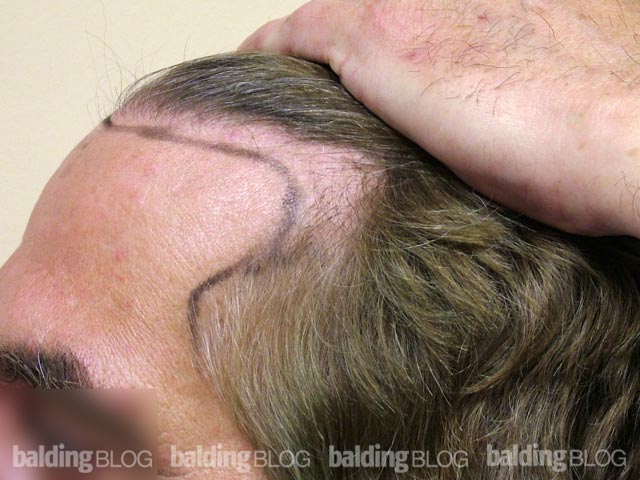
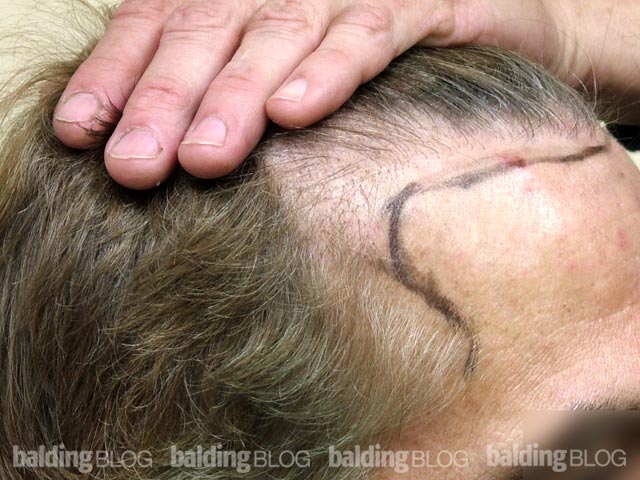
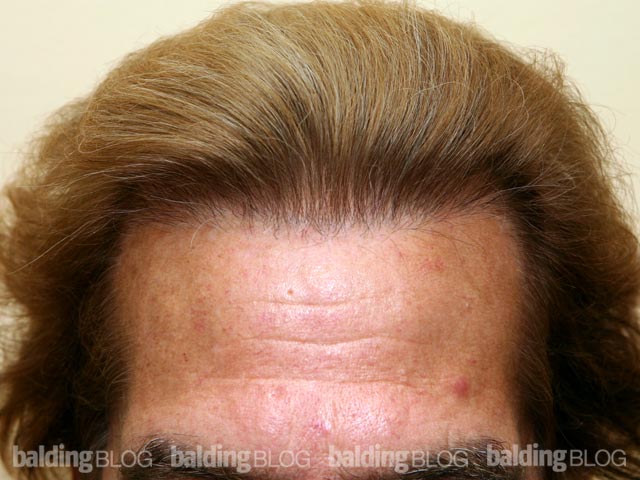
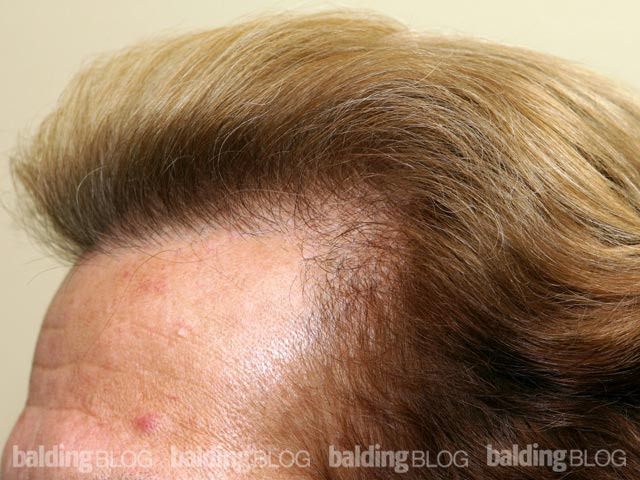
How is this possible? I’ve noticed this celebrity whose entire forhead is bald except for a little stubborn patch in the middle. It doesn’t make any sense. How can the entire forhead go bald while a little patch remains? Does not DHT miniturize all the hairs? Here is the picture of the celebrity below and another picture I found with a gentlemen who has the same pattern.

Celebrity – John C. McGinley

PG.com patient

Block Quote

I’ve been asked about this before, and I always point to David Letterman, who has a persistent forelock and hair loss around it. This is a genetic trait (shown well in your photo references) which is common in some families. I see it quite often.

Hair Loss Information » Intercytex’s Cloned Hair Photos? – Balding Blog

Dr. Rassman,

I believe you and your reader base will find this most exciting. Intercytex has released what appear to be the first photos ever documenting the growth of cloned hair on a human scalp. The pictures may be found at this link: Vavelta.com – PDF file.

I believe these pictures are from a Phase I trial which was designed to assess safety and not efficacy. Even so, have a look at them and tell us what you think about the quality and angling of the new hair.

I appreciate your reference here. Our readership should find it interesting. I believe that we will see the answer sooner or later and this company may have the solution, but I think it is probable that if this is shown to be effective, approval may take years.

Hair Loss Information » Shedding for 6 Months Since Starting Propecia – Balding Blog

hi! I’m 21 years old and 3 years ago i realised i was loosing too much hair, but nobody believed me.Now my hair is really thinner and i have lost a lot…i have been taking propecia for 6 months but it really has became worse…what is it happening? i though i was shedding effect but…6 months loosing hair because of the shedding effect? i was really better before taking propecia! should i keep it and wait or should i stopped? I mean…if it’s shedding efect it’s not so bad…but..i don’t know. could you help me? Doctors in Spain don’t take it serious…
Thank you!

You may be going through a very active phase of hair loss, genetically inspired. You need to consult with your doctor. If I was your doctor, I would have had your scalp mapped out for miniaturization so as you follow the progression of hair loss, there would be insights into the changes that may point to the cause.

Central Centrifugal Cicatricial Alopecia – Hair Loss Information by Dr. William Rassman

I am a 54 year old Africia American Female that has Central Centrifugal Cicatrical Alopecia, is there hope? and if so what can I do.

Also called “hot comb alopecia” in the past, central centrifugal cicatricial alopecia (CCCA) is a rare condition that presents with cicatricial alopecia in the central scalp. This lesion grows larger around its center and tends to destroy the hair follicles and causes permanent balding.

It was thought that this condition has to do with combing or use of oil for hair styling in African-American women. The cause of this type of hair loss is still not known and its treatment is difficult, as seen with this and other similar scarring alopecias. This condition that is usually seen in African women presents as an unusual sensation (pins and needles) on the top of the scalp followed by tenderness in those areas. There is no visible sign of inflammation in the area. Skin color may change to become fleshy and eventually hyper-pigmented (darker). Hair loss in this condition is usually permanent.

Balding Forum - Hair Loss Discussion

Paid advertisements (not an endorsement):


I Want a Hair Transplant, But I Am Concerned About Keloids – Hair Loss Information by Dr. William Rassman

i am seriously considering a hair transplant on the sides of my hairline. i am a african american women who have had traction alopecia for quite some time now. i have a small keloid on my ear, and my dermatologist has been giving me injections to clear this up. he also told me that if i get any plastic surgery, there is a chance that i will develop keloid scarring. i do want my hair transplant, are there things that they can do to remove the keloid from the donor site?

Keloids are very rare on the scalp. Many people have stretched (flat) or hypertrophic (raised) scars, but actual keloids (they look like tumors growing out of a wound) are so rare that they are worth reporting in medical literature. You can test the donor and recipient areas with a punch wound and/or a needle and then wait it out to see if it forms keloids. That may be the best way to know for sure.

Balding Forum - Hair Loss Discussion

Paid advertisements (not an endorsement):


Sensitive Nipples and Propecia – Hair Loss Information by Dr. William Rassman

Hi Dr Rassman, I find your site very interesting and helpful. After living in denial for six months I have finally conceded that the balding process has begun and have started taking propecia. I have only been on the drug for a week however I am already noticing sensitive nipples.

I am much too concerned about losing my hair to be bothered by very mild occasional pain, however developing gyno is something that really worries me, especially as i already have a very slight case of it from puperty (despite the fact that I am fit and slim). I plan on speaking to my doctor about this, but I would like to know from your experience, does sensitive nipples always turn into gyno? Would I be premature in halting the medication based on this alone? Is there a chance that it could simply go away as my body adapts to the drug, or even if it continues not necessarily mean I will develop gyno?

Thanks for your time.

Yes, it is possible for sensitive nipples to develop into gynecomastia. I would try stopping it (you are early in the process) and see if the sensitivity goes away. Certainly checking with your doctor is important. Breast enlargement or nodules can occur with Propecia, but it is relatively rare (about 1 in 300-500 cases).

What Questions Should I Ask When I Get My Miniaturization Test? – Hair Loss Information by Dr. William Rassman

Doc,

Thanks for this gem of a site! I’m scheduling my first miniaturization with the Hair Club for Men. Two questions:

  1. What questions should I ask the physician when we meet?
  2. Have you heard anything from your colleagues in the hair transplant world re: Hair Club for Men’s experience and success in restoring hair?

Thanks for your time!

  1. First and foremost, you should educate yourself on hair transplant surgery and hair loss. Just as you have found this site, you can find tons of information on the rest of the web. Just double check sources and make sure the information is credible. You can also use NewHair.com for extensive medical information on hair transplantation and hair loss.
  2. With respect to the reputation / success of other medical groups, it would be unprofessional of me to comment (positive or negative) on the matter since it would obviously be a conflict of interest. We have many suggestions in this blog on how to qualify doctors and you should follow that advice.

You need to know what the mapping of your miniaturization shows and you should ask the doctor what he/she might predict will be the eventual loss of hair (distribution/pattern) and the rate at which you might bald. If you are using medications like Propecia, you should be able to compare the progress or reversal of the miniaturization over a time period of months.

Balding Forum - Hair Loss Discussion

Paid advertisements (not an endorsement):