Hair Grows As It Miniaturizes – Hair Loss Information – Balding Blog

In regards to the thread of Low testosterone and low LH……..

Doesnt hair miniaturization happen between growth cycles? When an old hair is shed then a new finer/thinner hair replaces it, correct? The way my hair is progressing is that it is miniaturizing as it is growing… I have no shedding, my hair is continuing to grow as it miniaturizes… is that normal?

Block Quote

The hair that is miniaturized is not the hair that appears between cycles as you postulated. Miniaturized hair grows until it becomes so thin that it is thread-like, but miniaturized hair does grow, albeit slower than normal hairs.

Hair Loss InformationUnlimited Donor Supply (or Follicular Unit Multiplication) – Hair Loss Information – Balding Blog

Hair multiplication has been a hot topic in hair restoration field in the last few years and many patients with severe hair loss hope that using this technique they can get back a full head of hair without worrying about donor supply limitation.

I think it would be helpful to review a recent article in the journal of dermatologic surgery on a similar subject: In Vivo Follicular Unit Multiplication: Is It Possible to Harvest an Unlimited Donor Supply? Ergin ER, MD, Melike Kulahaci, MD, and Emirali jamiloglu, MD 32:11:NOVEMBER 2006.

The article discusses a method for multiplication of hair follicles without a need to culture them. The authors have removed hair follicles using a FUE technique and cut them in different levels, trying to see if two hairs can be obtained out of one hair follicle. The researchers implanted the upper parts of these partial grafts in recipient area and the remnants back in donor site. The procedure was done on five male patients. Hair follicle counts and thickness analysis were performed after 1 year by a third party investigator.

Results of the hair count and thickness analysis showed that the growth could be seen in both the upper and lower parts of the cut follicle. From the grafts that were cut in upper one third, only 20 percent showed growth in the recipient site, while 84 percent of the remnant that were left behind, grew in the donor area. There was 29% growth rate in recipient area in the grafts, which were cut in halves vs. 68% growth of the remnants of these same grafts in donor area. Finally 41% of the grafts cut in upper two third grew hair in recipient area vs. 53% growth in the remnants of the same hair follicles in the donor area that they were taken from.

The authors concluded that hair follicle growth is complex and hair follicle contains stem cells in different levels, which could participate in the growth of new hairs. We know that stem cells are located in the bulb of hair follicles and in the outer sheath, in the middle of the hair shaft where the sebaceous gland is located. The authors assumed that each half of the follicle contains a stem cell reservoir that would potentially allow the growth of a new hair. The rate of the growth in a new hair follicle is reported to be 41 percent at best. All of the partial hair follicles grow thinner hair in comparison with intact hair follicles that were transplanted in the same patients.

The authors suggest that these sub-units of hair have value but they provide a lower yield than growth of hair from intact grafts both in numbers of viable hairs as well in the actual thickness of the hair that do grow. They also suggested that FUE is a promising technique is a mechanism to get the hairs for an eventual hair multiplication process once it is worked out, but it should be avoided if the transaction rate is higher than 10 percent.

Of course, this is not the only study on this subject and some other studies reported comparable results. As we have suggested in our previous publications over and over again, FUE is a great technique for the patients who have small donor area requirement, a limited balding area, a tight scalp and the ones with a contraindication for removing a strip. FUE should not replace strip technique in standard cases.

Hair Loss InformationWhen Should I Be Concerned About My Female Hair Loss? – Hair Loss Information – Balding Blog

I am a healthy 25 year old female and recently I have noticed a great deal of hair loss. About 2 weeks ago, I started to notice an unusual large amount of hair in my hair brush and on my bathroom floor when I would get done styling my hair. I didn’t really think about it, until my boyfriend started pointing it out to me. He noticed that after I got out of the shower, there would be a clump or two of hair that had fallen out of my head. Is this something to be concerned about? I have no idea what would cause this.

Block Quote

Just seeing hair coming out more than usual is not an indication of hair loss in women. If you have a long hair, you might be just going through normal hair cycling. If you noticed widening in parting of your hair, or if you could see your scalp more than usual, you should be alarmed and those might be indications that you are really losing hair. Hair loss in women as described in multiple posts in this site could have several treatable causes, like hormonal changes, medications, and medical conditions. If you have any of the above problems, you need to see a hair specialist and get your hair mapped for miniaturization.

Hair loss in women can sometimes be caused by underlying medical conditions, so it is important for you to be evaluated by your own physician. If clinically appropriate, the following disease processes should be considered: anemia, thyroid disease, connective tissue disease, gynecological conditions and emotional stress. It is also important to review the use of medications that can cause hair loss, such as oral contraceptives, beta-blockers, Vitamin A, thyroid drugs, coumadin and prednisone. The following laboratory tests are often useful if underlying problems are suspected: Estradiol, FSH, LH, SHBG, Prolactin, T4, TSH, ANA, Iron, TIBC, Ferritin, Free and Total Testosterone. It might help to print this page out and show this to your family physician.

Does DHT Play a Role in Bodybuilding? – Hair Loss Information – Balding Blog

Would propecia affect my performance in the gym, and my muscle gains. I know propecia kills the DHT which is a byproduct of testosterone, but does DHT play a role in bodybuilding?

Block Quote

Propecia blocks conversion of testosterone to its byproduct DHT, the hormone responsible for hair loss in male pattern baldness. DHT also increases the size of the prostate gland and increases the risk of prostate cancer. Although testosterone is mostly responsible for muscle growth, animal studies have shown that injection of DHT can also stimulate muscle growth in animals after castration (see Selective androgen receptor modulator treatment improves muscle strength and body composition and prevents bone loss in orchidectomized rats).The portion of DHT in muscle expansion and whether or not blocking production of DHT alone can affect muscle building are not clear yet.

Can High DHT Suppression Create a Reversal Effect in the Body? – Hair Loss Information – Balding Blog

Dr. Rassman

The first post caught my attention and I was wondering if you take a medication that has a higher DHT suppression does the body have a “reversal effect” and create more DHT because more is being suppressed in the body causing hair loss after some time?

Block Quote

DHT is the byproduct in the breakdown of testosterone. So more testosterone will produce more DHT, but if the DHT is blocked, the effect of the increase will be mitigated. What actually does happen is that testosterone levels rise by about 15% when you take finasteride and that is the body’s way to dealing with the change in DHT levels. Some people get an increased sex drive from this change (in my experience about 10% of the population).

What is Superoxide Dismutase? – Hair Loss Information – Balding Blog

Can you please tell me what Superoxide Dismutase is, if it has any solid research behind it and why it is a popular ingredient in many anti-hair loss products.

Block Quote

See Wikipedia – Superoxide dismutase

Some people feel that many of the body’s health problems will be solved by the use of antioxidants. Hair loss is included in this targeted group of conditions. There is no proof for the claims, but you can draw your own conclusions. Here are some more links to research:

Tips to Keeping Newly Transplanted Hair from Going Dormant for Months? – Hair Loss Information – Balding Blog

Thank you for your Great Blog! I was wondering if there are any “tips or Tricks” to keep from losing the transplanted hair to dormancy?

Block Quote

There are many claims by some doctors that medications like Graphcyte or minoxidil do just what you are asking, but I studied both of these medications and find that neither have stopped the recently transplanted hair from going dormant. Sorry.

Besides Propecia and Minoxidil, Any Other Measures You’d Recommend? – Hair Loss Information – Balding Blog

Hi, Recently I have started using propecia (3 months). I am only 22 and have seen no effect really yet. I have been evaluating my hair carefully for the last 2 years and have noticed it thinning particularly on the crown. I am probably only losing 100 hairs per 24 hour period but feel my hair is not replacing at the same rate, as my hair is shedding more noticably then in the past. I still have a fairly good head of hair and want to save it before its too late. Besides propecia and minoxidil, do you recommend any other measures, whether they are scientifically backed or not, based on your experience?

Block Quote

It usually takes 8-12 months for Propecia to give you benefits you can see. The 100 hairs lost per day is normal for any person. The best and only significant medication for a 22 year old with early MPB is Propecia (finasteride).

Hair Loss InformationIs an FUE Procedure a Less Successful Hair Transplant? – Hair Loss Information – Balding Blog

What do you mean by saying “FUE can be done in one surgery (our group did as many as 2600 in a single patient in a single session) or it can be done multiple day surgeries”? You said that this does not mean that FUE produces viable hair, so does that mean that you see less success in FUE procedures???

Block Quote

Anyone can claim that they are an expert at a procedure, but where is the credibility? The results of an FUE procedure in good hands will be as good as the standard strip procedure, but yet all FUE grafts are not equal. In our original article, we talked about the candidacy of patients, where some patients were better suited for FUE than others. Now the non-candidacy group is smaller, but the quality of the grafts may become an even more important issue.

For the future, we can look to the past, as Dr. Jae P. Pak’s engineering work led to a robotic application and a U.S. Patent granted for the FUE technique in 2003 (U.S. Patent 6,572,625). We can expect to see a robotic application coming out in a year or two.

In brief, Follicular Unit Extraction (FUE) can produce damage that range from transection (cutting) of the hair follicles to avulsion of vital elements of the graft. The percentage of such damage should be under 10 percent. When compared to the traditional strip surgery, the follicular units taken under the microscope from the strip excision are mostly perfect. The FUE procedure is not as time efficient as the strip either. Local damage to each individual follicular unit depends upon:

  1. the skill of the doctor
  2. the instruments and techniques used
  3. the tissue characteristics of the patient

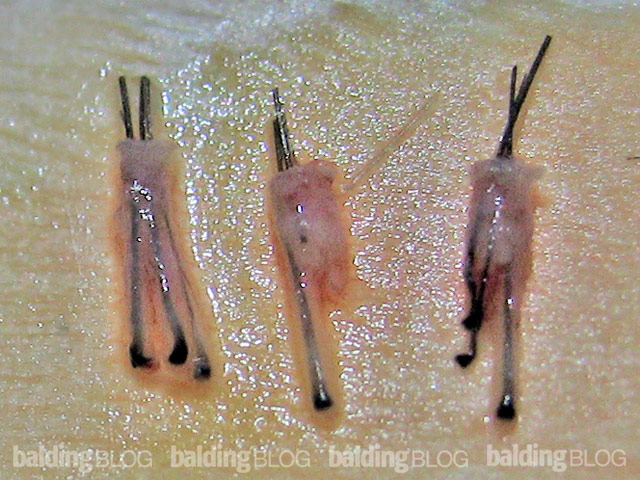
Most doctors do not classify the quality of each individual FUE graft nor do they calculate the transection rate, so the integrity of the doctor in making this assessment is just as important as his/her skills. Please note that nothing is 100% and always be wary of doctors or salesmen promising you 100% success rates, or a willingness to take on any patient for an FUE, or flippant comments like ‘our grafts’ do not get damaged. Always ask the doctor how he/she knows. Look at the picture of the three grafts below. The graft on the left is a normal FUE three hair graft with good fat and fibrous tissue surrounding the follicular unit, the one in the middle shows transection of one out of two hairs (only one hair may grow, but it is denuded of skin so it may not grow to its full bulk), and the one that is on the right is a three hair follicular unit which shows that the follicles have been stretched and the surrounding supportive tissue has been stripped away (these grafts will ‘probably‘ grow, but they may not have their normal width when they grow out). If this patient had coarse hair normally, the graft on the left would be coarse when it grows (like his normal hair), the one in the middle might be less than coarse (less than his normal) and the one on the right may be ‘finer’ hair. A coarse hair has better bulk and better coverage for this patient than a ‘fine’ hair and the results of the fine hair graft when and if it grows will almost certainly disappoint the patient when compared to what it should have been. Click the photo to enlarge.


For further reading about the FUE process, please see What Doctors Don’t Want You to Know About FUE.

Errors: http://baldingblog.com/photos/061214_fuegrafts.jpg is not accessible or supported filetype.

Losing Hair on Back of Head – Hair Loss Information by Dr. William Rassman

Doc, I’ve recently taken notice that along with my frontal hair loss, I’ve been losing way more hair from the back side of my head. Since that is the permanent zone, could this have an effect on any future hair transplants? I’ve been on Proscar cut into quarters taken daily since January. And can hair length increase or influenece hairloss (as mine is just about shoulder length)? Thanks

I must sound like a broken record. To make a diagnosis, you need to have your hair mapped out for miniaturization to determine what is actually happening. If you are losing hair from the ‘permanent’ zone and you are a male, then you may have Diffuse Unpatterned Alopecia (DUPA) (see Follicular Transplantation: Patient Evaluation and Surgical Planning?). If you are a female, then this is not unusual, especially if you have genetic female hair loss. Get to a good doctor and find out what it is and then what to do about it.