Taking Tamoxifen with Propecia for Hair Loss – Hair Loss Information by Dr. William Rassman

Actually I don’t think I’m a candidate yet for grafts. My question is about Propecia. I have tried propecia twice: once at the normal dose and once at a much lower dose. Both times I have experienced mild breast enlargement. I have a job for which having a full head of hair is very important. Given this, what I’m wondering is, if a low dose of Tamoxifen or some other anti-estrogen could be justified.

The following link shows the side effects of Tamoxifen in men. I have no experience with this or other approaches like other anti-estrogens.

Balding Forum - Hair Loss Discussion

Paid advertisements (not an endorsement):


Transplanting Transgender Patients – Hair Loss Information by Dr. William Rassman

My younger brother (32 years old) is undergoing a sex change operation. He’s on the hormones and going to the doctors, and i’m not really sure what is involved but the family supports him. My question is relating to the genetic hair loss that runs deep in our family in almost all of the males (our dad, my cousin, me, my brother). He started to lose his hairline before he began his transition and i think it is quite rare for a woman to lose the hairline, right? Right now he wears a wig, and he’s going to have enough challenges with closed minded people that i don’t want him to have to deal with something like hair that he can probably take care of with a hair transplant. What do you recomend? Thank you for your time.

When men become women, they bring with them whatever male patterned hair loss they had. As such, looking like a female is not possible without either a wig or a transplant. The reverse is also the case if a woman becomes a man. Exposure to high doses of testosterone will precipitate a male pattened loss if the person has the genetics for genetic balding. In this situation, their balding genetics were protected when they did not have testosterone and were a woman, but that protection is lost when the sex is switched. Transgender patients may be candidates for hair transplants if their balding can be diagnosed as genetic hair loss.

Juvenile vs Mature Hairline — Am I Going Bald? (Photos)

Juvenile vs Mature Hairline — Am I Going Bald? (Photos)

Many of my younger readers of this blog are seeing changes in their hairlines and are worrying about becoming bald. The problem is made worse when there is balding in their family line. I have placed three diagrams taken from the Norwood Classification for hair loss. By conventional wisdom, the Class 1 pattern is proposed not to be balding, the Class 2 pattern suggests that this is the beginning of the balding pattern (it may actually be the beginning of the mature hairline, just not named as such), and the Class 3 pattern is thought of as early balding, possibly worthy of transplants in some men. The line between the Class 2 and 3 patterns are fuzzy, at best. The reality, however, is not quite as simple as I believe that Dr. O’Tar Norwood had documented. In most men (more so in Caucasians), the hairline of youth rises to a hairline of maturity. The mature hairline is about 1/2 to 3/4th inch higher in the middle than where the youthful hairline is and as one moves away from the midline to the corners of the hairline, the gap between the mature hairline location and the youthful hairline location is slightly over 1 inch, changing the overall shape of the hairline to its characteristic ‘V’ shape.


Norwood 1 Norwood 2 Norwood 3


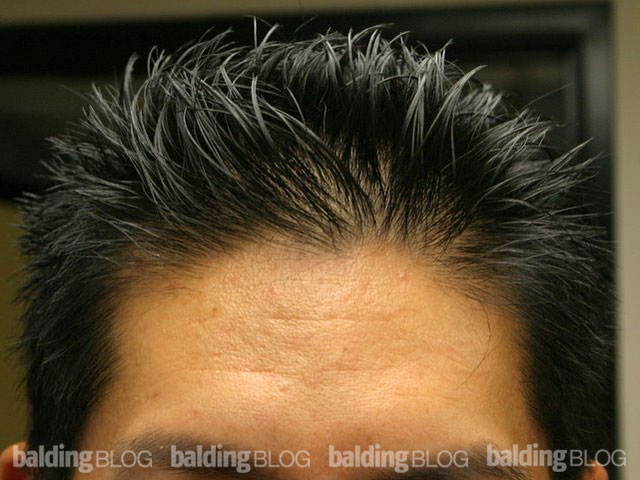
You can tell where your youthful hairline is/was by lifting your eyebrows up so that you can see your forehead wrinkle. I call this the furrowed brow, and the wrinkles you see reflect a muscle below the skin (the frontalis muscle which is present in everyone). The youthful (juvenile) hairline touches the top of the highest wrinkle of the furrowed brow and has a concave frontal shape to it. This often persist until the early teens, possibly longer. In the mature hairline (with its almost convex frontal shape (V-Shape) that extends from the temple prominences), shows a gap where there are no wrinkles and no hair present. None of what I just wrote is male pattern balding, yet many of our young readers panic when they see the rise in this hairline and they look to the Norwood Chart to identify where they are in the progression of their hair loss. It is particularly bothersome to the young men when the change occurs slowly and asymmetrically. Asymmetrical hair loss is common It’s even worse when the change produces a ‘chewed’ look. This maturing process occurs between 17 and 29 years of age and it is not uncommon to find one side go up faster than the other side. Not all men get a mature hairline (for example, former US President Bill Clinton retained his juvenile hairline — see his photo below) and retention of the juvenile hairline is more common in non-Caucasians as seen in many people from Asia and the middle eastern region.

They say a picture is worth 1000 words, so look at the pictures and labels below for clarity of this. Women almost always retain their juvenile hairline through their entire lives, while 95% of Caucasian men develop a mature hairline.

Set 1 (below): Photo on the left is of a patient shown with the “mature” hairline drawn in. The photo in the middle on the right is of that same patient with the “juvenile” hairline drawn in (the lowest line paralleling the highest crease of the furrowed brow). Note the gap between the highest wrinkle and the proposed mature hairline. That ‘gap’ should not be transplanted. The photo on the below is of my hairline — a classic mature hairline. Click photos to enlarge.


Set 2 (below): Photos on the left (Korean) and on the right (Hispanic) non-transplanted hairline. The photo below this is of an adult female (Cambodian) hairline (non-transplanted). Mr. Clinton’s hairline (above) takes on the shape of the female hairline shown here. Female Hairline = Juvenile Male Hairline. Click photos to enlarge.
If the surgeon follows the rules set forth in this post, then the hairlines will be placed in a position exactly like it would have been had they never lost hair as shown in these two patient examples below. The man on the right saw his hairline go up from its normal mature position and the line drawn shows his normal mature position where the transplanted hairs were placed in a single session with these results. With the lower photo, this man had a Class 6 pattern of balding and this change in his look occurred in a single surgery. If the hairline was not placed in the correct mature position, he would not have looked normal. I call these hairlines “no hairline hairlines”.


Weekend homework assignment: Check out the hairlines of your sibling, parents, spouse, neighbor, and meter maid. It’s worth looking at a variety of hairlines so that you can see what I’ve discussed above and determine the difference between a juvenile hairline and a mature hairline.



2020-01-15 13:28:27Juvenile vs Mature Hairline — Am I Going Bald? (Photos)

What Will Take the Place of Hair Transplants? – Hair Loss Information – Balding Blog

What and when do you think will take the place of traditional hair transplantation?

Thank you for any comment or answer.

Block Quote

The theory, in answer to your question, may be some form of cloning, cell manipulation, genetic transfer or magic drug. Possibly we will identify some substance, stem cell, genetic alteration or the like that will be more acceptable than traditional hair transplants for the balding man.

When I started in the field of heart surgery (1966) we were just learning to replace heart valves in diseased adults and fix the broken hearts of children born with heart defects. It was a glamerous thing to fix the broken heart and for doing it, some doctors thought it would make them rich, so either for the glory or the money, many, many surgeons became heart surgeons and eventually most of the defective heart valves and hearts got fixed, leaving surgeons with nothing to do (possible bankruptcy or even to become a family doctor, whichever was better). Then we learned that we could re-vascularize the heart with veins taken from the leg and save lives, and the new bonanza happened again. The unemployed heart surgeons were feasting one more time until they caught up on the backlog of blocked heart blood vessels to repair. Then, a shift appeared (away from the heart surgeon) with the new ‘invasive’ cardiologist who became part of a new feast and the era of cardiac catheterization was born, shifting the work from the surgeons to the new bread of surgical ‘like’ cardiologist. Many heart surgeons found themselves unemployed again. One day, we will find an easier way around the cardiologist’s catheter and possibly this new break of cardiologist will learn to adapt or fall into the unemployment lines, just like the heart surgeons of yester-year.

When the day comes that hair transplants will be replaced with a needle injection into the scalp, doctors like me may be unemployed. One might think that any doctor can inject magic potions into the bald scalp of men for profit. As with Botox, they will. Personally, I do not believe that I will be unemployed for years yet as I do not believe that hair transplantation is going to go away anytime soon. If you are balding, ask yourself the following question: Am I willing to wait for years, possibly decades, for the best solution to hair loss and remain bald during my youth and most productive years just to avoid a simple surgery?

Hair Loss InformationHair Robot Funded in UK for Hair Cloning – Hair Loss Information – Balding Blog

The excitement continues on the possibilities of cloning hair from special cells located in the hair follicles of healthy hair.

The company says:

We take cells responsible for hair growth, multiply them and then inject them in the head. We tease out the cells responsible for growing a new hair… The hair is taken during a 30-minute operation under anaesthetic and replanted three weeks later after the cells have had time to grow.

Block Quote

The process for harvesting hair from the permanent zone is performed today using my Follicular Unit Extraction technique. If this is to be done on a larger scale, my patented instrumentation (of which, Dr. Jae Pak is co-inventor) will be employed (see USPTO.gov).

One license for this patented technology has been sold to a California robotic company which is presently attempting to automate the entire hair transplant procedure.

Update: Here’s another article about this — BBC News

Hair Loss InformationTopical Solution for Treating Alopecia Areata? – Hair Loss Information – Balding Blog

I am a 37 year old hispanic female. less than 2 months ago I noticed a small bald patch (the size of a nickle) on the crown of my head. I thought it was ringwom and so did my doctor. He gave me a cream and shampoo to treat it. A week later I noticed another but smaller bald patch not to far from the first one. at this point my doctor sent me to a dermatologist. The dermatologist said it alopecia areata and gave me a topical solution that will help grow my hair back and to see him again in a month. Now I noticed that the hair on the top part of my head is thinning and some areas are read and burn a little. (not much itching) I don’t find hair on my pillows, towels, brush, or floor, but I can start to se my scalp specially where I part my hair. Does this mean I will lose all my hair? Is it common to have bald patches and then thining of the rest of the hair at the same time?

Block Quote

Alopecia areata is a known condition which you can learn about at National Alopecia Areata Foundation. I am confused with your history. To make a firm diagnosis of alopecia areata, you would need a biopsy. The questions you are asking are reasonable questions which your doctor should answer for you. As I have not examined you myself, I can not do any justice by giving you advice, unseen. In the past I have been surprised at the simplicity of the questions that should be asked of the treating physician. I wonder if doctors are becoming detached from the people they are treating and just treating the condition. When my son entered his surgery training, I gave him some simple advice. I said: “Never refer to your patient as the man in room 202 with the amputated right leg. Always talk about Mr. Smith in room 202, the musician (or carpenter, or father of four daughters). You need to relate to the human being and his/her human needs. In doing so, you will relate to Mr. Smith, a man in need of your services and a person who you are there for you to help, not the man with the amputated leg.”

He told me that he remembered my advice. He told me that he learned to listen to his patients and in becoming a good listener, he became a better doctor. The woman with her scalp problem reached out for insights into her condition. She has reasonable questions and she should expect that her doctor will answer them. If she picked the wrong doctor, she should make it right and get another one.

Phytotrixil to Prevent Balding? – Hair Loss Information – Balding Blog

Hello Dr. Rassman
I am a 22 years old male and i am loosing hair. I started using this one product called “phytotrixil” more than a year ago. (do you know anything about this drug??) And fortunately my hair got a little bit thiker. It is said in the instruction manual for the product that it can restore up to 19% of the volume of the hair and i think i have maneged more than that…so my question is: if i use this drug for 5 years, will i restore my hair completely?? (oh yeah…and my balding is genetic)
thank you!

Block Quote

This appears to be about as good as anything else out there that does not work for restoring hair. I can’t comment on whether it volumizes or not, but volume and hair growth/regrowth are two different things. If it works for you, let me know in 5 years how much of your genetically balding hair is left.

Hair Loss InformationIf I’ll Have Propecia Side Effects, When Will I See Them? – Hair Loss Information – Balding Blog

Hi Dr. Rassman,

I’m a 30-year-old male who recently started taking Propecia. My question is, if there are any side effects, how long until the side effects would show up? I haven’t noticed anything, but believe your answer would be a good piece of information to have, regardless.

Thanks!

Block Quote

If a man on Propeica is going to get a decreased sex drive (one in a hundred) they should see that side effect in the first couple of weeks. If you have had no sexual side effects, welcome to the majority of men who have taken the drug daily for years.

Can Propecia Cause Increased Thinning? – Hair Loss Information by Dr. William Rassman

Hey,
I am 22 and have thinning hair in the temple regions and on the top side areas of my head, as well as generally not as good hair up front. My hair has always been cyclical (good months/bad months) but this is the first i’ve noticed real thinning. I was going to go to my dermatologist to look into propecia, would a regular derm be able to test my hair fine? And would propecia ever cause increased hair loss/thinning?

Thinning of the hair is not a known side effect from Propecia. It sounds like you are possibly experiencing genetic male pattern hair loss. In the young man, I always suggest that you get your hair mapped out for miniaturization to get a diagnostic base like and a firm diagnosis. A dermatologist can do this, and it may be helpful to print out Miniaturization: Critical to the Master Plan for Hair Loss to show him/her.

Balding Forum - Hair Loss Discussion

Paid advertisements (not an endorsement):


Woman Prescribed 5mg of Finasteride Daily – Hair Loss Information by Dr. William Rassman

I am a woman and have been prescribed a dose of 5mg of finasteride daily for hair loss. It is working, but I am concerned about the high dosage. Since I am not of childbearing age, do I need to be concerned about side effects?

This is a question best asked of the doctor who prescribed it. I am always concerned when something is prescribed outside the normal FDA approved channels, where the drug is approved for safety and effectiveness. Both are up in the air when it comes to women and finasteride at the 5mg dose.

Balding Forum - Hair Loss Discussion

Paid advertisements (not an endorsement):