
Using animals for organ donors have been tried for years, but cross species transplants have done very poorly over time. Now the use of CRISPER can tolerate organ donation much like Dolly the Sheep. Genetic material are used in pig cells in the early embryo and implanted in sows. The plan is to create pigs that have also been altered to make them more immunologically similar to people. In theory, this should mean transplanted organs are less prone to attack by a recipient’s immune system. This work is being done by Robin Weiss of University College London as reported in the New Scientist August 19, 2017 issue.
Criticism of Strip Suture Line
This is a beautiful skin closure, but it has a problem in that the hairs inside of these sutures are being strangulated and will probably die. This will then leave a scar the width of the suture line. What we do is (1) either use surgical stables which go far back from the wound and never strangle the hairs or (2) put very fine sutures (5-0 absorbable) within 1mm or less of the edge so that we make sure that the hairs are not in the suture pull. That minimizes the scar even further.
2020-06-22 04:00:482020-06-23 15:21:40Criticism of Strip Suture Line
Creatine Increases DHT?
Based on the questions and answers on your excellent blog, you seem to have taken an ambivalent position on creatine and hair loss in the past. I am 25 and very athletic, and I have a medical background so would never consider taking steroids or other dangerous substances. Creatine is a safe and effective athletic supplement that I have been taking for some time, but a recent study published in the Clinical Journal of Sports Medicine found that creatine raised serum DHT by 40 percent when taken at the moderate dose of 5 grams per day. In addition, creatine has recently been shown to increase the ratio of DHT to testosterone in young athletes. Do you think this is sufficient evidence for young hair loss sufferers to entirely avoid this otherwise excellent ergogenic aid?
I found the study you’re referencing — Three Weeks of Creatine Monohydrate Supplementation Affects Dihydrotestosterone to Testosterone Ratio in College-Aged Rugby Players
The study was very limited (only 20 men) and the amount of creatine taken can vary wildly amongst those that use it, but I would avoid creatine if it indeed increases DHT levels in the body and you’re worried about possible hair loss. The study itself concludes, “Further investigation is warranted as a result of the high frequency of individuals using creatine supplementation and the long-term safety of alterations in circulating androgen composition.”
I appreciate you bringing it to my attention.
Creatine increases DHT
In this published article, Creatine was taken by a Rugby player and his serum DHT levels went up. Although the article did not relate this to hair loss, we have seen men who take Creatine as a supplement and find that they notice more hair loss if they have the genes for balding present: https://pubmed.ncbi.nlm.nih.gov/19741313/.
2020-08-12 02:56:062020-08-08 11:12:26Creatine increases DHT
Crown transplants and Swirl (photo)
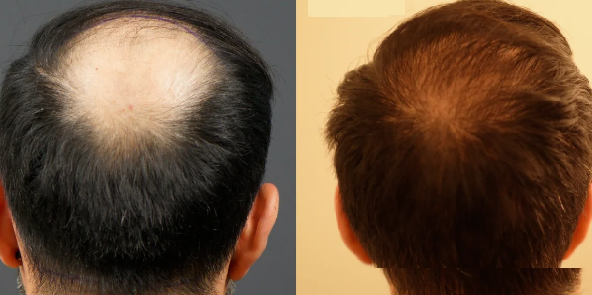
The swirl area is always difficult because the hairs do not layer but rather draw one’s eye to the center of the vortex. The impacts of 4000 grafts depend upon the thickness of your hair shafts (fine, medium or coarse). The thicker the hair shafts, the better the coverage. I suspect that, looking at your result, your hair has a medium or medium-fine hair thickness. Please let me know if I am correct. The transplant was largely done in front of the swirl, but half of the upper swirl was included in the transplant. Note how difficult it is to get a tight swirl unless you put in more hair or have coarser hair. This is a nice result. Rarely does new hair appear from a hair transplant beyond 9 months. Congrats!
As an aside, look at my crown hair transplant, which was fine when it was done; however, when my hair thinned out with age, a see-through appearance showed my scalp. I had SMP done and the change was dramatic, see here; https://baldingblog.com/i-just-finished-my-smp-on-my-crown-area-today-see-before-and-after-photos/
cut my dose of finasteride by half and the sexual side effects went away
I posted a while back asking if anybody had any anecdotes for taking smaller doses to alleviate sides. Well I bit the bullet and bought a pill cutter last Thursday and from then until Monday took 0.5mg fin every day. It was by the Monday that I woke up with proper morning wood for the first time in weeks and had the horn all day. At this point I noticed more hair in my hands than normal after washing, so went back to 1mg Monday night.
You should probably stay on the half dose as it is 80% as effective as the full dose.
2019-11-04 04:41:172019-05-10 12:43:14cut my dose of finasteride by half and the sexual side effects went away
Cutis Verticis Gyrata and Hair Loss
I have a condition that is called ‘cutis verticis gyrata’ where the scalp grows ridges or abnormal lines on the surface. I have had this condition for some time, but have never been concerned before because I have hair that covers the ridges in my head. I’m in the beginning stages of MPB, and have been taking propecia for about a month. I don’t know if my hair loss will ever be extensive enough to show the condition of my scalp, but it causes great concern because I do not want this to happen. I am 32 years old. Have you ever dealt with this issue before? I have read a little on the internet to try to see what people have done with this, but there is not much out there about it. I have read that it has been treated with scalp reduction, which sounds reasonable, but then what? Any ideas?
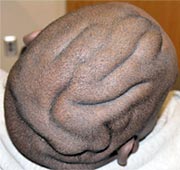 After receiving your email, I wrote to a group of well-respected doctors to inquire about experience in this area, and the general consensus was that this should not be treated surgically. Most of the doctors I wrote to were dermatologists who may have an aversion to scalp reductions in this situation. You need to be evaluated by a surgeon, perhaps a very specialized plastic surgeon who has experience doing this surgery in a patient with your diagnosis. Logically, scalp reductions should work, but I wouldn’t recommend that you be the first patient to attempt surgery to correct this condition.
If you are concerned about balding (which might make the appearance more detectable) then I strongly suggest a miniaturization study to see what degree of hair is at risk of falling out, followed up by a Master Plan. If I was your doctor, I would explore your options after you became my patient, but I simply cannot give you an in-depth answer as I have not examined your scalp or your hair.
Image from DermAtlas
Cutis Verticals Gyrata (photo)
Cutis verticis gyrata describes a scalp condition with convoluted folds and deep furrows that resemble the surface of the brain. Cutis verticis gyrata is a progressive condition. It is mainly troublesome due to the cosmetic appearance. Rarely, it can be complicated by malignant melanoma developing within a melanocytic naevus. Cutis verticis gyrata occurs more commonly in males. The primary form of cutis verticis gyrata has a reported male-to-female ratio of 5:1. The incidence of cutis verticis gyrata may be reported as lower in women because longer hair may camouflage the condition (Ref: Dermnet NZ).
This is a cosmetic issue for those who have it. As you can see in this photo, styling the hair can be a problem.
2020-05-04 04:00:182020-05-04 12:39:19Cutis Verticals Gyrata (photo)
CT Scan and Hair Loss
Hello Dr – I read with interest your answer about MRI scans and how there is no link from them to hairloss as they use magnets. What then, would be your opinion on CT Scans? Could these cause hairloss and if so over what time period? i.e – a few days after the scan or a few years? Thank you for your time.
The amount of radiation that a CT scan (also known as a CAT scan) will administer is not sufficient to cause hair loss. It takes much, much more radiation to cause radiation sickness and have the side effects to cause hair loss.
For more information about CT scanning, please see: Wikipedia – Computed tomography
2006-10-11 11:32:492006-10-10 16:15:41CT Scan and Hair Loss