
Do DHT Blockers Produce More Dementia or Other Conditions?

Dementia tied to hormone-blocking prostate cancer treatment

July 5, 2019 by Lindsey Tanner
prostate cancer
Micrograph showing prostatic acinar adenocarcinoma (the most common form of prostate cancer) Credit: Wikipedia

Alzheimer’s disease may be a risk for older prostate cancer patients given hormone-blocking treatment, a large, U.S. government-funded analysis found.

Previous evidence has been mixed on whether the treatment might be linked with mental decline. But experts say the new results stand out because they’re from a respected national database and the men were tracked for a long time—eight years on average.

Among 154,000 , 13% who received hormone-blocking treatment developed Alzheimer’s, compared with 9% who had other treatment or chose no therapy, the study found.

The risk for from strokes or other causes was higher: It was diagnosed in 22% of those who got hormone-blocking treatment, versus 16% of the other patients.

The results, using perhaps one of the largest and most reliable databases, suggests there truly may be a connection, said Dr. Sumanta Pal, a prostate cancer expert with the American Society of Clinical Oncology. Pal was not involved in the study.

The analysis from University of Pennsylvania researchers was published Friday in JAMA Network Open.

The results aren’t proof but experts say they underscore the importance of discussing and benefits when choosing .

The researchers analyzed data from a National Cancer Institute database of cancer cases and treatment and covers almost 30% of the U.S. population. The study focused on men in their 70s, on average, with local or diagnosed between 1996 and 2003. They were followed until 2013. Medicare records indicated dementia or Alzheimer’s diagnosis.

Hormone-blocking treatment can include testes removal to reduce levels of testosterone, which fuels prostate cancer growth. But it more typically involves periodic drug injections or implants that achieve the same result.

Most U.S. men who receive this treatment are in their 70s or older. It’s sometimes used in men who might not be healthy enough to tolerate other cancer treatments including surgery to remove the prostate and radiation.

It’s unclear how the treatment might be linked with mental decline. The researchers noted that it can lead to diabetes, which also has been linked with dementia—perhaps because blood vessel damage from diabetes can restrict blood flow to the brain. Hormone treatment also raises risks for and depression, which both have been linked with dementia.

Researcher Grace Lu-Yao of the Sidney Kimmel Cancer Center in Philadelphia, said the potential dementia risks from hormone-blocking treatment may outweigh any benefit for younger, healthier patients with longer expected life spans.

While the study doesn’t prove that the causes dementia, she said, it is important to tell patients “because of the potential impact of Alzheimer’s disease or dementia on the quality of life of patients and their family.” She was not involved in the study.

More information: Ravishankar Jayadevappa et al. Association Between Androgen Deprivation Therapy Use and Diagnosis of Dementia in Men With Prostate Cancer, JAMA Network Open (2019). DOI: 10.1001/jamanetworkopen.2019.6562

Journal information: JAMA Network Open

© 2019 The Associated Press. All rights reserved
Do DHT Levels Change Over Time?

Dear Doc,
I was just curious to how the levels of DHT change in the body over time. Do DHT levels rise to some sort of critical level before the onset of baldness? or do the follicles just become less resistant to DHT as one ages? Also is there a difference in DHT levels in bald and not-bald males?

thanks

Yes, DHT levels change as we age, but the level of DHT does not necessarily correlate with balding or androgenic alopecia (AGA). It is your genes that makes you susceptible to the DHT impact on hair that produces balding. In other words, you can have a high level of DHT and if you do not have the gene for AGA, you will not lose hair. Or you can have a very low level of DHT and have the gene for AGA and be bald. As DHT comes from testosterone, it is your testicles that are the supplier of the hormones that cause baldness. If you did not have testicles, then the balding process would stop, but your hair would not come back.


2007-09-05 13:33:30Do DHT Levels Change Over Time?

Do Cowlicks Lead to Thinning or Will It Just Stay the Same?

Cow licks (actually called widow’s peaks when they are central) are actually remnants of your juvenile hairline. Many women think that they are attractive in men and in women-over half of them actually have some for of widow’s peak present. I wrote an article on this here: https://newhair.com/wp-content/uploads/2018/11/phenotype-article-published.pdf. There are some good photos of widow’s peaks in men and women in the article.

Do Eastern Europeans Follow Norwood Patterns?

Dear Sirs,

Do all people follow the same pattern of hair loss, meaning they start from the temples and progress in a specific way as Norwood classification describes or there are unique variation for each person? People from the Balkans as Greeks, Bulgarians, Romanians are considered Caucasian or for them there are different hair loss patterns as Norwood describes?

Thank you in advance

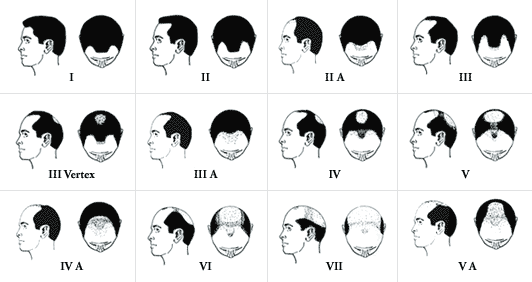
Every male, from anywhere in the world, can have a balding pattern that has been defined by Norwood. The Norwood patterns are not showing a progression of balding that one goes through, but they show the end stage of a process as Dr. Norwood described it.

For example, to develop a Norwood class 6 pattern, you will not start with a 2, then go to a 3, then a 4, and then a 5 pattern. Most men with a Norwood class 6 pattern start losing their hair with thinning in that pattern that precedes the end stage of the balding (the hair begins to thin all over in that pattern).

Norwood chart

Do Doctors Track Transection Rates in Hair Transplant Surgery?

I was curious if you know if any doctors track the survivability of the grafts? I know that there is quite a bit of information on transection rates for different surgeons but was wondering if anyone monitors this metric? If they do – how might the survivability be determined outside of just counting the grafts in the recipient area a few weeks/months after the surgery? Thanks

This is a great question. We track transection rates when we perform FUE surgeries. The transection can vary from 5% to 50%. I believe 5 to 10% is an acceptable number. If there is a high transection rate then we will abort or never recommend surgery. This is the reason why at NHI we always pre-test all potential FUE patients, but I realize other clinics and doctors may not do this.

The data for other clinics and doctors is not available or well published in studies. I believe mainly it is directly linked to business. No one would publish poor results or high transection rates, as it is not good for business. As unfortunate as it may be, the consumers and patients are left to do their own due diligence and trust their doctor, probably by contacting patients who had it done by that doctor. One way around this would be for patients to ask about seeing actual patients in person or seeing their own surgical records of how the grafts were tracked (if it is done at all). In theory, the transection rate should be documented on the day of surgery, but I realize not all doctors will keep this record (as it is not mandatory) and some may refuse to show it to their patients. I can say this because I have heard these issues come up in consultations with some patients that have had procedures done elsewhere previously.

I know of one doctor who promotes and reports 96% good FUE grafts (4% or less transection), yet I have see many of his patients and found a high degree of failures in those of his patients who came to me for a second opinion. This is a buyer beware business. Sometimes you can expose poor practices through reports by the chamber of commerce or the courts in the areas where the doctors practice. I’ve also been asked to post the names of doctors to be weary of, but if I were to speak up and identify those who may not be honest in their representation, I would become a target for slander. I have better things to do than take up residence in the court system.

Do Body Hair Transplants Work?

Body hair transplants work, but the body hair has a short growth cycle. This means that for every 10 hairs that are transplanted, they will cycle about every 6-8 months meaning that only half of the hairs are growing at any one time as the sleep (telogen cycle) is also long. If you don’t have enough scalp hair, the beard is a better donor source, as its growth cycle is like scalp hair.


2020-01-07 07:29:55Do Body Hair Transplants Work?

Do hard drugs promote hair growth

I just watched the Andy Irons documentary (A Pro surfer) with Andy and his brother who are known to have used hardcore drugs and are perfect Norwood 0’s. David Bowie, Bob Dylan, Robert Plant, Comedians like Richard Pryor, Joey Diaz. Do you think hardcore drugs lower your Testosterone and DHT levels? When ever I hear people saying hair is a diet thing I think absolute bullshit. David bowie lived off of cocaine in the 80s with like a can of tuna fish and some peanut butter or some shit and had perfect hair.

These guys are public. I doubt that their hair has anything to do with hard drug use.

Do Hair Transplants Take Longer to Grow After Multiple Surgeries?

I have undergone my 3rd hair transplant surgery in March 2010 and I am at the 8 month mark. I am mostly satisfied with my results, but hoping for some more growth and increased density. I was wondering if the transplanted hair takes longer to emerge and mature when you have had successive hair transplants. I was told by my doctor that the hair transplants take longer to emerge after the third hair transplant and i should expect some more hair growth and increase in density.

I would like to get your thoughts around this. Thank you.

I’m not sure why your surgeon would’ve told you it takes longer for hair to grow after the multiple procedures, because the growth period is roughly the same for each surgery. The third surgery should grow at about the same time as the first one did. If you are concerned about growth, speak with your doctor again. I occasionally see some growth occur between 8-12 months, but that is usually in addition to what is grown by the 8th month.

You should be alarmed if there is no growth within the one year time frame, but less concerned if it has only been under 6 months. In your case at 8 months, you should see some good growth by now with hopefully a little more in the coming months.


2010-11-09 12:13:54Do Hair Transplants Take Longer to Grow After Multiple Surgeries?

Do Hair Doctors Still Use Plugs?

Are doctors still using the plugs that I see on the street, in the malls and at airports all of the time?

Not as a rule. The old plugs that gave this industry a bad name in the 1970-80s have largely been replaced with small grafts that are called follicular units. But there are some doctors that use ‘combination grafting’ which is a mixture of larger small grafts and naturally occurring follicular units. Only the follicular units are undetectable in bright light or close inspection.

Do Gray Hairs Fall Out?

Good morning doc. I’m a 26 year old male who is starting to go gray, pretty heavy on the sides & starting to in the front as well. Is this a good sign that said gray hair won’t fall out? Does this mean the gray hair has already passed a barrier to balding or is it just as likely to fall out as the other “youthful” (brown) colored hairs? Thanks for the great blog!

The graying of hairs is independent of balding (no relationship). Graying is genetic and not necessarily reflecting getting ‘old’, and you are not alone. I have seen many men and women who turn gray in their 20’s. The reason most people do not see them is that they hit the dying bottle and never show their secret.