
Catch-Up Hair Loss, Finasteride, and Hair Cell Suicide

Hi, Dr. Rassman.

You’ve written a number of times about the “catch-up” loss that happens when a patient discontinues finasteride/propecia. I know you didn’t design the drug, but I was wondering if you know how this catch-up process works.

What I have a hard time understanding is this: If androgenic alopecia is a gradual process of miniaturization, why doesn’t that process-when you stop the drug-just pick up where it left off at the start of therapy? It seems like something must be getting worse “behind the scenes” during the course of therapy. Is it known what that something is?

I hope that made sense. Thanks!

Propecia (finasteride 1mg) sustains scalp hairs that are genetically susceptible to falling out. It does this by a process of competitive inhibition. When the drug is no longer available, the DHT is manufactured by the body and it ‘attacks’ the hair follicle which is like turning off the ‘life’ switch of the dermal papilla cells (which manufactures the hair follicles).

Once you stop taking the medication, you will not lose all the hair at once, but the ‘attack’ will occur over a few months. The hairs that were being supported by finasteride will go back to its pre-destined state, which is something called apoptosis (these dermal papilla cells that generate the hair follicle commit suicide — just die off).

For more about apoptosis, see ResearchApoptosis.com and Wikipedia.


2008-06-25 09:32:23Catch-Up Hair Loss, Finasteride, and Hair Cell Suicide

“Catch-up Hair Loss”

If you used finasteride for a year and it slowed or stopped your hair loss and then you stopped the drug, you would play ‘catch-up’ hair loss and could lose all of the hair you would have lost while you were on the drug.

Yes, if you used finasteride for a year and it slowed or stopped your hair loss and then you stopped the drug, you would play ‘catch-up’ hair loss and could lose all of the hair you would have lost while you were on the drug.


2019-05-01 08:06:44“Catch-up Hair Loss”

Causes of Dandruff?

I read your answer to another problem that dandruff is caused by exposure to the elements i.e. the sun, UV rays, etc. I don’t buy this or else similarly situated people would have the same amount of dandruff.

We are all different and we manage our skin differently. Dandruff is caused by the accumulation of dead skin cells on the scalp, often in dry scalps. There are good shampoos for this and I would suggest that you try them serially until you find what works for you.

CB-03-01 Anti-Androgen — Is It a Future Hair Loss Treatment?

Hello, Doc. I found a study about a future topical antiandrogen that appears to fight baldness.

This is the link: Cosmo reports exciting results in P.O.C. alopecia study

Do you see this treatment as a potential option in a not so distant future?

Thanks for keeping us informed through this great blog.

CosmoIf you understand a basic fact about hair loss, it’s really quite simple: Blocking the impact of androgens at the hair level will favorably impact hair loss. It could be a promising direction, but at this time good data is not in hand, so an anti-androgen cream is not a proven solution for the hair loss problem.
The link you sent is for a press release from Cosmo Pharmaceuticals of Italy, which boasts “exciting results” to get readers interested, but in reality this is just announcing that a proof of concept trial has concluded for something called CB-03-01 on 40 men and 30 women over the course of a month.

The studies and products you and I find on the Internet are usually not new or groundbreaking, though they might sound promising. Both doctors and patients hope the next great hair loss treatment is right around the corner, but we will have to wait for good science to be presented to us before getting too excited about this as a future option. There’s a lot of hurdles it would need to cross before making it to market.

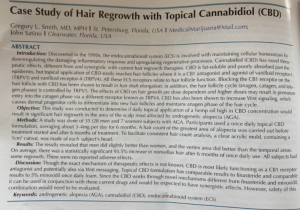
CBD may be a finasteride substitute

From the recent issue of the Hair Transplant Forum and also an article in the recent issue of the Journal of the American Medical Association, there is a report that CBD may work on preventing hair loss similarly effective but by a different action to Finasteride. There is no mechanism suggested for this finding at this time.

Apologies for the poor photo


2021-10-05 09:59:06CBD may be a finasteride substitute

CDC: Forty percent of cancers linked to overweight or obesity

“Being overweight or obese significantly increased the risk of developing at least 13 types of cancer, according to a report by the Centers for Disease Control and Prevention. Now that a larger proportion of the American population is overweight or obese, the rates of obesity-related cancers have increased. Between 2005 and 2014, the rate of obesity-related cancers, excluding colorectal cancer, increased by 7%. Over the same period, non–obesity-related cancers declined, according to C. Brooke Steele, DO, of the CDC’s Division of Cancer Prevention and Control, and her associates” (source: Internal Medicine New, October 10, 2017)

Celexa and Lexapro Can Cause Hair Loss

My daughter is 38. Her hair began thinning when she was on Celexa. The doctor changed her to Lexapro, and now her hair is falling out by chunks. She is now almost bald in the frontal area of her head. She’s going off of the Lexapro in hopes of her hair growing back. I wanted to report the Forest Laboratories Lexapro to the FDA, but my daughter wants me to wait until she sees a difference in her hair loss or if it will grow back. She has spent a lot of money on hair regrowth products, doctor appointments, and even went to an endocrinologist. Nothing has helped. Please, everyone, get the word out. Report your hair loss issues to the FDA. This massive hair loss my daughter has sure not helped with depression/anxiety. I wish I could upload a photo.

Celexa and Lexapro can cause hair loss. Your daughter needs to have a sit-down with her doctor about the side effects she experienced.