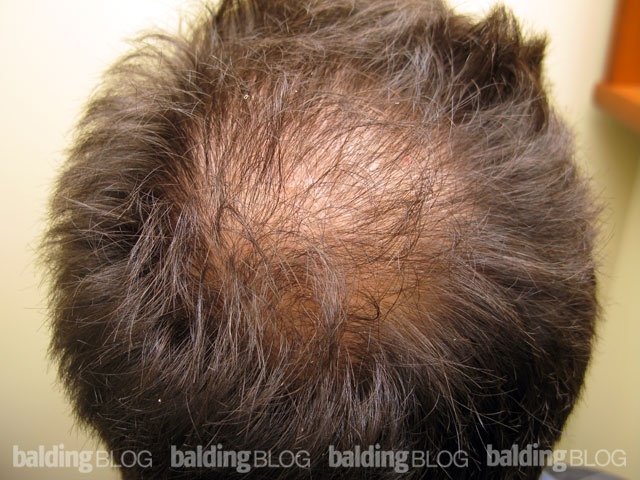
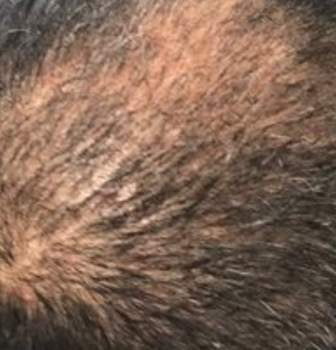
Demodex Folliculorum and Hair Loss

I recently read about Demodex folliculorum. From what I understand it is a parasite that lives in the hair follicles and feeds off the sebaceous glands. I have also read reports stating that this infestation may cause diffuse hair thinning.

Is this true? How common is this condition, and how is it treated?

Demodex folliculorum is a tiny mite, less than 0.4 mm long, that lives in pores and hair follicles. It is usually seen on the nose, forehead, cheek, and chin, and often in the roots of your eyelashes. Demodicids look like worms. People with oily skin, or those who use cosmetics heavily and don’t wash thoroughly have the heaviest infestations, but it is not uncommon for adults to carry a few demodicids.

Follicular inflammation produces edema and results in easier epilation of the eyelashes. Loss of lashes may happen when there are abundant mites located near one hair follicle. Demodex are harmless and don’t transmit diseases, but large numbers of demodex mites may cause itching and skin disorders, referred to as Demodicosis.

Diagnosis is through a high index of clinical suspicion. This condition usually doesn’t cause any symptoms. If symptomatic, patients may experience itching and local (not diffuse) hair loss. Treatment for the symptomatic cases include cleansing the area and even antibiotics for severe cases.

Image: jashbotanicals.com

Demodicosis

I have been suffering from some major skin problems on my face for 9 months now!! Doctors haven’t helped. I’ve spent thousands of dollars. I have recently come to believe I might be suffering from demodicosis/demodecosis/demodicidosis. And yes, I have noticed a ton of my hair everywhere. I noticed someone wrote in a few months back saying he had cured himself of it. Is there any way I might be put in contact with him?? I’m curious to know what type of protocol he followed & his symptoms. You must understand, this plague has ruined my life and I want to get rid of it. I’ve pasted the link below. Your help would mean the world. Thank you kindly

Demodicosis and Hair Loss

Not all people who write use a valid email address, added to the fact that the sheer amount of email this blog receives would make hunting the person down pretty difficult (I realize there is a “search” feature in most email programs, but alas, the message was from half a year ago). Perhaps the person that wrote the original email is reading this and will get in contact with me again with permission to pass his contact info on.

I did find an article of human infestation that may be of interest. See: PubMed. You might have to be logged in to read the article, but the summary is:

49 patients with different clinical types of demodecosis were examined. There was a pronounced decrease in the T-cellular immunity state on the skin. The state of immunity was directly dependent on the degree of clinical manifestation and when the patients contracted the disease, and it correlated with data from the humoral immunity state study (CIC).

This article suggests an immune problem may exist in those that have the infestation. You should see a good doctor (dermatologist) if you feel that this infestation is present. Good luck.


2006-08-10 15:39:27Demodicosis

Depleted Donor area at 8 months from 1500 FUE grafts (Photo)

Unfortunately, this is not an uncommon complaint; however, your donor density must have been very low to get such a depletion with 1500 FUE grafts. The only solution for this is Scalp Micropigmentation. I wrote a paper on this which can be seen in this post: https://baldingblog.com/2017/07/21/many-fue-grafts-many-fues-grafts-one-know-safe-limits/. Take a look at this site for more information on the only treatment for this: https://scalpmicropigmentation.com/gallery/bold-shaved-look/#!


2020-09-17 09:23:22Depleted Donor area at 8 months from 1500 FUE grafts (Photo)

Dense Packing and Transection Rates

Dr. Rassman,

In regards to hair transplants, I believe that you’ve written that around 25% of the original density can be enough to provide coverage, and that as the graft density of a HT procedure increases (above 40%?) the transection rate goes up and one gets diminishing returns, etc.

So, I was wondering how this relates to “dense packing” of the frontal area — how dense can the grafts be when you do this?

Thank you for giving so much information and comfort to people in need of it.

Every patient is unique, and their goals and expectations will be variable. For those who want high density, “dense packing” it is attainable, but as you state there are issues of the diminishing returns observed by several doctors who reported growth findings in dense packing studies. I believe your concern for transection of neighboring hair in the recipient site is valid and it may contribute to this diminishing return phenomenon. However, surgeons who know what they are doing rarely will produce transection in adjacent hairs in a second or third procedure. Transection in the first procedure is never a problem unless we are talking about remnants of ‘original’ hair that is present (miniaturized or not).

Transection rates in strip surgery occurs on the edges of the excised strip and this is estimated to be no more than 5% in the hands of the average surgeon. For FUE, on the other hand, the transection rate ranges widely depending upon the surgeon’s skills. The FUE must be done by the surgeon (not assigned to a technician) by law in all 50 states. That means that the surgeon should have the skill to do this, but my experience from seeing the results of many FUE surgeries suggests significant failures in the hands of many doctors. Although the Artas® hair restoration robot is designed to minimize transection (keeping it under 10%), the studies so far have not followed the damage as those grafts are manually removed from the scalp and handled by the technicians when moved to the recipient site. Just keeping the grafts exposed to air for 20 seconds will kill them, even though there will be no evidence that damage has been done (other than the graft will never grow hair).


There is also a perception of how one sees the density when more than 25% of the original hair has been transplanted. For example, if the hair is fine, much higher densities are needed than if the hair was coarse. In normal thin haired individuals, the hair is often ‘see through’ in bight light with 100% of its original density. Obviously, in order to produce more fullness with medium weight hair, the weight of the hair alone is not adequate to determine the see through nature of the hair as it depends upon other things such as the character of the hair and the color contrast of the hair and skin. In adding an extra 100 grafts to an area with 1000 grafts, the change will barely be detectable, while adding 100 grafts to an area with 200 grafts will certainly look fuller (assuming that both areas have comparable surface areas). In the end, if you are willing to have multiple surgeries you can theoretically incrementally replicate the original density.

Now if your question is about dense packing an area with just one surgery, there is a limitation of how close you can place the grafts based on the needle or blade that is used to make the sites. It is a matter of graft survival, as the grafts may be handled differently for dense packing. Again, here the skills of the surgeon is paramount. There is also the doctor’s art in making the surgery result look dense with limiting the harvested grafts to keep costs down. I am sure most doctors can dense pack, but if you dense pack ALL the grafts, you may not likely be able to cover the planned treatment area especially if the bald area is high. For reference, a square inch of a non balding scalp in an average person is 1250 hairs (or 650 grafts) in an person with average density! So the trick is to utilize the number of grafts you harvest to dense pack certain KEY areas and spread it variably in other areas to make it look natural and full. This is where the artistic skill (not the technical skill) of the doctor comes in to play.

If you want a simple answer to how dense we can pack grafts, it is slightly wider than the needle/blade we use (some of which are sub-millimeter).

Dense Packing Limits?

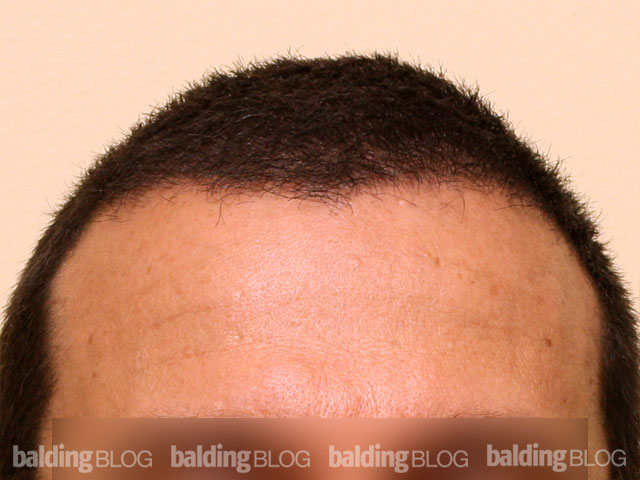
I am a 26 year old male, who has had two hair transplants in my frontal area. The density of hair in my transplanted regions is much lower than that of my natural hair, and hence looks a bit unsightly. I want to know if there is a limit to the number of FU grafts one can transplant in order to improve density. If so, what are the dangers of exceeding this limit?

The normal hair densities of non-transplanted hair are measured at 193 hairs per cm squared (97 follicular units per cm square). A transplant doctor can put in densities of half of that in a single session. If you have thinning hair, then your density is not up to a level adequate to appear full. There are no inherent dangers in dense packing the hair in a transplant surgery provided that the doctor’s team is able to do it.

Dense packing, a technique we defined in 1993, makes for less surgeries and more fullness. If the wounds are over a particular size (more than 1.7mm each) then the risks start impacting the patient, for example, with regard to blood supply. If the wounds are smaller than 1.7mm, then the risks of dense packing of the grafts all but go away. We use wound sizes of about 1mm (the size of the wounds vary with each patient). The smaller the wounds, the faster the healing. Healing in this context means that the wounds on the skin become almost impossible to see, something that usually takes a day or two on most of our patients. Wounds greater than 1.7 mm, tend to show for longer periods. Some transplant patients in the old days saw wounds measuring 3-4 mm each (the old plugs), and they were visible for weeks after the surgery.

Density of Hair Transplants

Hello, I just had a wonderful procedure. Their offices were clean, procedures were excellent, and the staff was very accommodating. In 2002 I had 800 grafts done by another group in San Francisco and then again I just did 3500 grafts. The follicles were transplanted throughout my scalp approximately 25 FU/CM2. I have a very nice NW2 hairline. Also, I had a very high number of 4-hair grafts. Over 400 of them! They excised a strip of 3500 grafts and got 3703!!!

Do most of your patients get about 25FU/cm2 and are happy with it? I think it will be ok but just need reassurance.

A normal person will have 1250 hairs or 600 two-hair follicular units. When converted to cm/square, that would extrapolate to 100 follicular units per square cm. If you received 25 follicular units in 1 cm, that would suggest that in one procedure, the doctor returned 25% of your normal density on the transplanted area. This is often not really the case, as some areas will have higher densities put in and other areas lower densities. For a person with average weight hair, olive skin, and brown hair, 50% densities overall should be more than enough to produce a full appearance. If you had a high number of four-hair grafts, then that might mean that your overall densities are higher than average. I generally target 25% density return on the first session, but at times I will go higher or lower depending upon other factors.

Densely Packed Hair Transplant? (with Photos)

hi dr,
i’m curious to know how dense you can make a head of hair if you have plenty of donor hair to work with? i like to keep my hair short is why i’m asking & just wondering what kind of density you are able to create.

here is a link to a famous actor christian bale. my hair resembles his in color & density so i’m wondering if you would be able to re-create that kind of density. heres the link [Google Image Search].

i appreciate your time…

Packing the recipient area with transplants can be done, however, you would want to discuss the general supply/demand ratio with your doctor when it comes to evaluating the donor area.

Here’s an example patient that had work in the hairline and crown. There was a total of 5756 total grafts moved over two procedures at NHI. I realize the side view photos aren’t the exact same angle in the before and after shots (sorry), but it should still give you a good idea of what was done. Click the photos to enlarge.

After (5756 grafts):


Before:


I Have Dents from Chronic Steroid Injections on My Scalp, What Can I Do About It?

These dents are the result of constant steroid injections which causes atrophy of the skin of the scalp. This can be treated by injecting fat cells into the dents to rebuild the scalp infrastructure. Hair transplants, if you need them, fix this problem nicely.


2019-02-20 06:52:15I Have Dents from Chronic Steroid Injections on My Scalp, What Can I Do About It?

Damaged hair grafts from FUE (photos)

The surgical team placed all of these grafts to marvel on the job that they did; however, they shouldn’t have been proud of it as many of these grafts will never grow. Note that the hairs within the grafts are cut in portions (transected). See the zoomed in section identified


Zoomed in area on the left


2021-05-15 14:06:28Damaged hair grafts from FUE (photos)

Can Dandruff affect growth from a hair transplant?

No, Dandruff is common and more pronounced after a hair transplant because skin turns over more frequently (skin shedding). If you are concerned about the growth and you are at least eight months since the surgery, then go back and speak with your doctor comparing your expectations to your doctor’s expectations.

poor growth