Fat cells to treat scars

The University of Pennsylvania has been on the cutting edge of both (1) stem cell development for hair growth and (2) fat cell use in the treatment of acute scars producing reprogramming of cells in a wound. This is going to become a huge field with almost incalculable value. We have known for a long time that fat has stem cells has significant value when used in the treatment of various skin and scar problems. For example, the yellow fat next to the hair follicles seen in a hair transplant, has strong supportive characteristics that are important anatomical elements contributing to a successful hair transplant.

Various presentations on the use of such fat cells have been presented at medical meetings and in various medical publications. One in particular stands out was the use of hair grafts for the treatment of huge ulcers on the leg resulting from vascular disease. When these ulcers are transplanted with hair grafts that contain significant amounts of fat around them, these non-healing ulcers fully heal. As my background included the treatment of such non-healing ulcers, I was amazed to see the value of such grafts in such dire circumstances.

Read here: https://tonic.vice.com/en_us/article/doctors-may-have-figured-out-a-way-to-heal-scar-tissue
Fat Burner Causing Hair Loss?

For about 3 weeks, I used a “fat burner” that contained 75 mgs of 7-oxo DHEA (7-Oxo-Dehydroepiandrosterone) @ 225 mgs per day. I noticed hair loss after the third week, and stopped use. But hair loss continued and was rapid.

I have been off it for about three weeks, but hair loss seems to continue. It seems to be a bit slower now.

I asked to have tests done, but my doctor simply recommended Rogaine. Rogaine doesn’t seem to do anything.

Is it possible that it is “too late”? That once this hair loss has started, it will simply continue on its course — even though I no longer take this fat burner? Not sure what else I can do at this point.

A recent article in the Wall Street Journal (September 13, 2005 issue) stated that short term weight loss of as little as 8-9 pounds, could cause hair loss. Whether it is reversible or not, only a proper diet will tell you. We have long known that malnutrition is a major cause of hair loss in the history of man and hsi hair problems. For those with the genetic balding process, stress can precipitate the process. A weight loss program that is associated with a good diet is not a problem for most people, but acute or chronic malnutrition in men and women can cause hair loss.


2005-09-20 13:13:52Fat Burner Causing Hair Loss?

Fat Burners Constrict Blood Vessels — Would That Lead to Hair Loss?

Hey Doc Rassman, great site. I’ve been hooked onto it since I started losing some hair myself- and of course, the fact that you’re called one of the pioneers of hair surgery just increases the blogs credibility.

I’m an 18 year old male, and I’m a serious teen bodybuilder. I’ve been competing, and recently, I’ve started using a fat burner (Nutrex Lipo 6) which contains a lot of caffeine, synephrine, yohimbe and some other stuff to get into my final competition stage. Now regardless of these ingredients, what concerns me is that all fat burners constrict blood vessels to increase blood pressure, and in turn increase metabolism to burn calories faster. That’s alright, fine with me. But it’s the hair loss I’ve been experiencing since I’ve started using this product that’s causing concern!

Just taking a shot in the air, would you say that the fat burner is causing poor blood circulation due to the high BP (a case associated with cigarettes too as I’ve read), and in turn causing this balding? Would this then mean that people with high blood pressure (something I have a family history of) have poorer quality of hair?What are your views,doc?

I can’t really comment on a specific fat burner as the cause your hair loss. Many medications report hair loss as a side effect, so even this ‘substance’ may have similar side effects. If you have hair loss it is most likely related to genetic male pattern baldness (MPB), otherwise known as androgenic alopecia (AGA)… particularly in a young man of your age. You may consider an examination by a doctor and possibly starting finasteride as a treatment option.

With regard to any connection between blood supply as a cause of hair loss, it is not ABSOLUTELY the cause of hair loss. The fat burner you are talking about can not possibly reduce the blood supply by constricting scalp blood vessels. There is also no connection between high blood pressure and hair loss either.

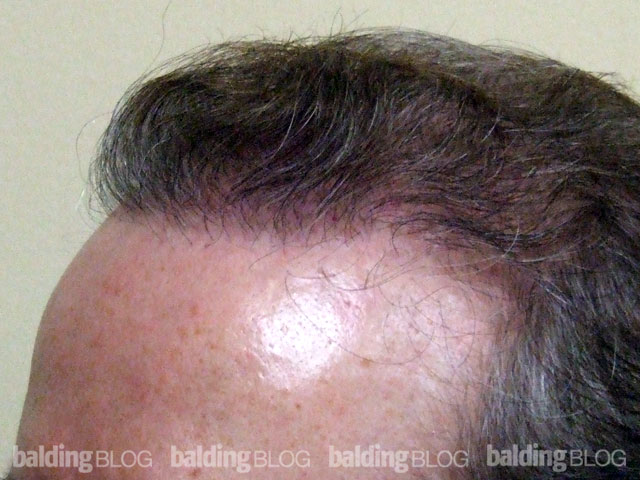
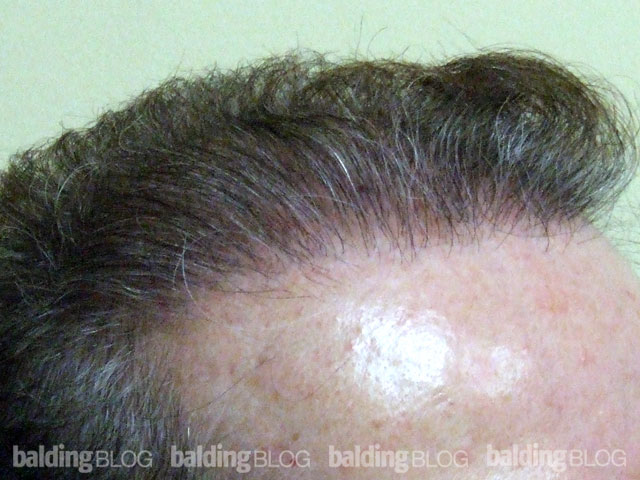
Fat cells moved from thighs grew hair

https://www.dailymail.co.uk/health/article-12804951/Stop-balding-process-injecting-body-fat.html

Although this is not a scientific paper, we know that body fat contains stem cells, so it is not unreasonable to expect that injecting fat cells into a scalp might stimulate hair growth. I would imagine, however, that these hairs will require continuous injections to keep them there. The hair that grows is indeed the original native hairs whose stem cells were still present. Unlike a hair transplant that brings genetically lifetime hairs to the balding area, these hairs will likely require continuous injections to keep them growing.

Father and Son Hair Transplants (with Photos)

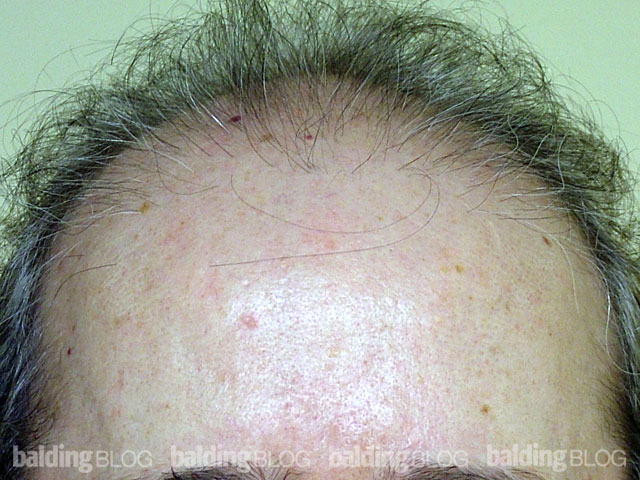
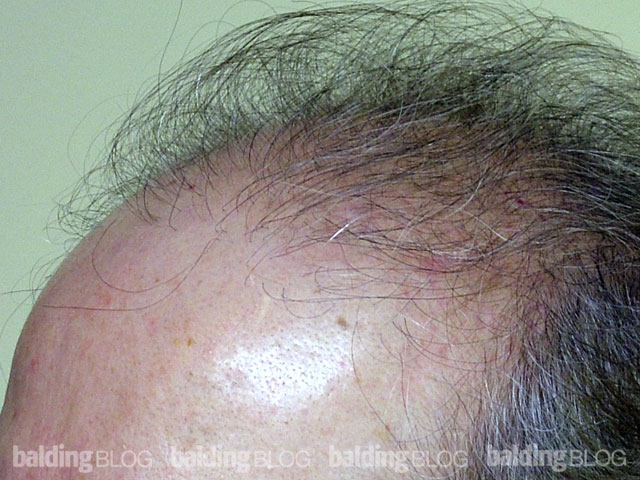
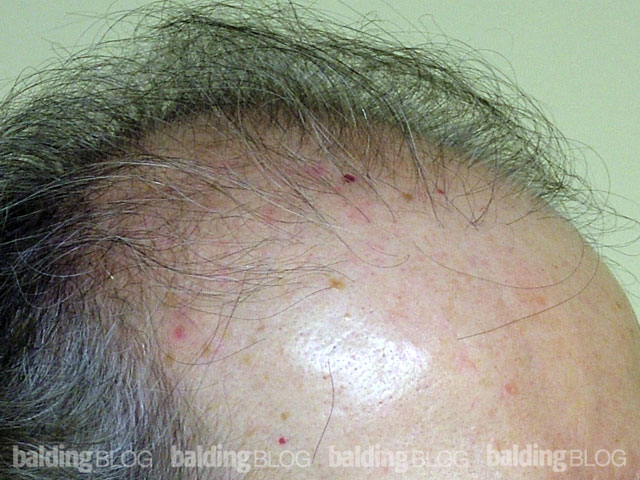
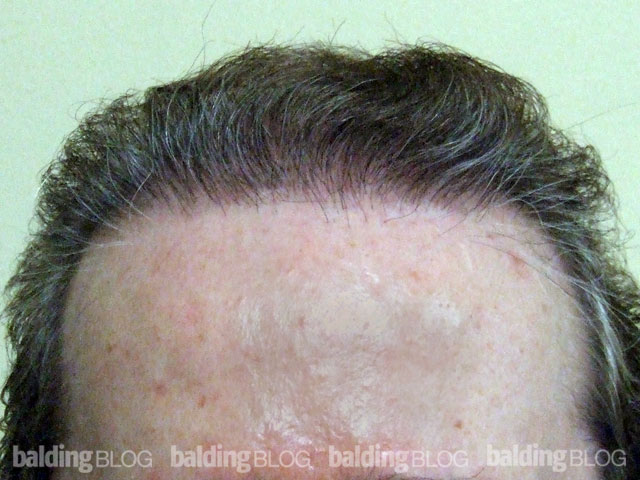
The photos below are of a father and son duo that I treated. The father had advanced balding with fine hair, while the son had early balding. The father got a nice result, but because he lost about 50,000 hairs over his lifetime and got back about 10,000 hairs from me, he could never have the same head of hair like his son. The son started on Propecia and with his average weight hair, he has had wonderful results. Hopefully, with Propecia continuing for years to come, he will hold on to the hair that his father lost in the pictures shown below. Click the photos below to enlarge.

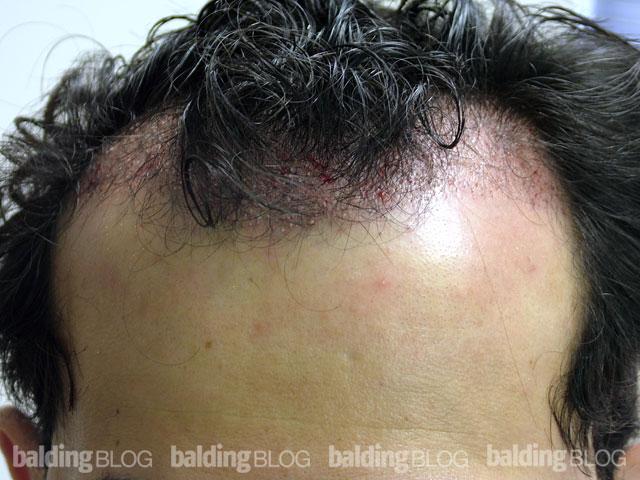
The son’s before photos are here (the first photo was taken immediately after surgery):


The son’s after photos, which were taken after one procedure of 1,295 grafts, are here:


With the son’s use of Propecia, I believe that he will not follow in has father’s foot steps with regard to his hair. Since the son is in the family business, now the new leadership will be hairier than the old one.

The father’s before photos are here:


The father’s after photos, which were taken after two procedures totalling 4,879 grafts, are here:


Since male balding is genetic, it is not unusual that I work on family members, in fact many of our patients are from these extended families. Once I had the privilege of performing hair transplants on three generations of individuals in the same family. Usually, one member starts it off and when they are satisfied, other family members follow. I have done 17 members from one overseas family who flew here every few months after the patriarch was satisfied with his results. Usually, the father has it done first, then the son, followed by the uncles and grandfathers. However, I remember one particular movie producer who sent his son in for a hair transplant ‘test’ and he watched the change occur over the next year. When he saw how great his son’s finial results were, he felt it was safe for him to have the transplant so he came to surgery with the confidence he apparantly needed. We do offer family pricing when they come together, extending the hairy appearance into the balding clans, a few patients at a time and hair by hair.

My Father Has a Class 5 Pattern of Balding. I Am Now 40 and I Am Looking like My Dad. Should I Consider a Hair System?

The hair loss patterns are inherited. The Class 7 pattern is only inherited in 7% of men and most men are there before they are 30. If you are a Class 5 and 30 years old, you are probably going to stay that way. Hair systems accelerate hair loss because the glue and attachment mechanisms produce traction alopecia.


2018-06-22 13:19:05My Father Has a Class 5 Pattern of Balding. I Am Now 40 and I Am Looking like My Dad. Should I Consider a Hair System?

FDA Approval Costs Too Much for the Poor Snake Oil Salesmen

Hi Dr,
first of all thank you for doing this blog. I just wanted to ask a couple of questions and would really appreciate any answers. Firstly I know that you usually recommend FDA approved products in your blogs i.e. propecia and minoxidil and dont recommend any product that is not backed by the FDA. I actually emailed 2 companies (procerin and revivogen) who both make hair loss products and claim that they are really effective in treating hair loss and asked them that if their product is so effective why hasn’t it been approved by the FDA like propecia and minoxidil. They both gave me similar answers which consisted of 2 reasons:

a) getting FDA approval costs millions of dollars i.e. it is very expensive and that is something we dont have, and
b) our products are natural i.e they are not medicines and therefore they cannot be approved like propecia and minoxidil.

Can you please tell me if these answers make any sense?

Secondly I was looking at the revivogen scalp solution as a possible treatment to my hair loss (i’ve tried minoxidil and am allergic to it and am abit worried about the side effects of propecia) and came across a video (on YouTube) which contains an interview of the Dr that developed it, he gives a scientifc explanation of how the product combats the effects of DHT and allows the hair to grow.

I would really really appreciate it if you can watch this video or atleast a part of it and give us your opinion on this Dr’s scientific theory regarding revivogen. Many Thanks

You said it all in the first paragraph above — the makers of those products “both make hair loss products and claim that they are really effective in treating hair loss“. To be sure that this is the case, it MUST be scientifically studied with a good peer reviewed (that means unbiased) process. I agree that there are a number of ways to get there and these are all not necessarily FDA routes, but some analysis must be in hand to really substantiate the claims. If I told you that I have a pill that will make you live to at least 100 years old, would you believe me without proof? Of course when you are 100 years old, I could say “I told you so” — and if 1000 people took that pill, possibly one man will be around to make that claim at 100.

It does bother me that we have such proof with the drug Propecia (finasteride 1mg) and we know the possible side effects (which if they occur you can stop the medication and make the side effect go away) and yet people still seek out the unproven products with slick marketing. We really do not know the side effects of these other products, because it is not in the interest of the various companies to promote side effects, and as there is no FDA involvement they have no legal reason to list all possible side effects. If you are a man with male pattern baldness (MPB) and don’t take Propecia (finasteride 1mg), what you lose while you fool around with these other products is your valuable hair, which will be lost forever.

FDA Warns Lexington About Misbranding and Falsely Marketing the LaserComb

What do you think of these Hairmax Lasercomb FDA warning letters? Does this mean the thing really doesn’t work…though a lot of it is pretty technical reading it sounds as though the thing doesn’t work…am I reading it wrong? What are your thoughts? Can you interpret it better? Here’s the link:

FDA.gov – Lexington International, LLC – Warning Letter

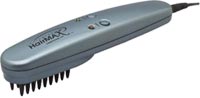
LasercombFrom what I gather, Lexington started started selling other models of their Laser Comb that were never cleared by the FDA, and yet they were inferring that they were FDA cleared. My favorite part of that letter states, “These changes could significantly affect the safety or effectiveness of these devices and therefore, pursuant to 21, CFR 807.81 (a)(3)(i), new 510(k) submissions are required in order to legally market these devices.” So the devices differ with regard to power use and some other parameters listed in their letter, and explains why Lexington’s site says the SE model is not for sale in the US anymore.

Also, the device was cleared for use in men, and Lexington was marketing it to women when they couldn’t legally do so. That explains why Lexington changed their site information to say, “At this stage the HairMax LaserComb is only indicated for male use. A clinical study for use in females has been completed and Lexington has submitted a new 510K to the FDA for this indication.

That letter you sent the link to shows how the FDA monitors such products and processes. Unfortunately, this letter is from May of this year (although it was just made available on the FDA site yesterday), and I’m unable to find any follow-up. I know representatives from Lexington read this site, and they can feel free to respond if they want to clear the air.


2008-10-15 14:26:01FDA Warns Lexington About Misbranding and Falsely Marketing the LaserComb