Fish Once-a-Week May Protect Against Alzheimer’s

Read the following:

https://www.empr.com/fish-once-a-week-may-protect-against-alzheimers-study-suggests/article/365387/?DCMP=EMC-miscellaneous_rd&CPN=cial,flecmpr&spMailingID=9193223&spUserID=MzA3NTI4ODY1ODQS1&spJobID=360741962&spReportId=MzYwNzQxOTYyS0

If fish is good once a week to build the brain and protect it against Alzheimer’s disease, think fish for your overall diet a few times a week. Over and over again, the value of Omega-3 fatty acids has been seen as a strong plus for our diets. Don’t wait until old age to take the correct dietary steps to enjoy your retirement while you are young.

Fish Oil and Hair Loss in Asian Populations?

Great site. I have always thought that large amounts of fish oil can cause diffuse hair loss. The reason I think this is because of observing Asian woman and men. I have notice a LARGE amount of this population have diffuse hair loss, on the sides and back. I’m actually surprised of how many. I live in a major city and live in the ChinaTown section. I understand they have different hair characteristics ect…like skin color and dark hair but am convinced that this group of the population suffer from more diffuse than any other. I am convinced large amounts of Omega 3 can cause diffuse hair loss. It is interesting that GSK’s new prescription fish oil also list hair loss(Alopecia) as a possible side effect.

Lovaza Product Info PDF

Just thought I would get your view.

I do not think large amounts of fish oil cause diffuse hair loss. Are you implying Asians consume large amount of fish oil because they eat more fish and fish products than non-Asians? If we were to entertain your argument, I would think the Eskimos have a very high Omega 3 fish oil diet. I do know that they have less balding than the general population of Caucasians and American Indians. I can not address any suggestions by some manufacturers of fish oil supplements that hair loss is a known side effect, because I have no personal or professional experience one way or the other. The information PDF you sent (linked above) doesn’t have an actual percentage of those that experienced it. It could’ve been 2 people out of hundreds, but I have no way to know.

Asians (non-balding) generally have less hair than their Caucasian counterpart and also have less balding than their Caucasian counterparts according to studies I have researched in the past. Asians also have straight black hair which contrasts with their light colored skin and may look thinner. These factors can sometimes make non-balding Asians look as if they have thinning hair.

First patient identified taking 0.625mg oral minoxidil daily and developed Pericardial Effusion

Dr. Robert Haber had a 67 y/o female patient for two years and she was taking 0.625mg minoxidil/day. She was in a minor fender bender accident with no evident physical damage or harm from the accident and no airbag deployment. She developed chest pain and in the Emergency Room after an extensive examination demonstrated that she has a pericardial effusion (‘water around the heart in the heart sac’). The doctors did not connect the accident and the cardiac problem identified, but knowing that oral minoxidil can produce this complication, her minoxidil was immediately stopped. Slowly the effusion subsided. This is a warning that a is known complication of minoxidil on higher doses. It was previously thought that doses 2.5 mg or less per day was safe from this complication. This may not be the case even at doses under 1mg/day. This is a risk everyone taking minoxidil should know about.

Now with that said, it is possible that this patient could have had Covid which is known to cause pericardial effusion. Even the vaccine has, in rare cases, caused pericardial effusion so maybe, just maybe the pericardial effusion was from another cause other than minoxidil. Here is an article that suggests a connection with Covid and pericardial effusion: https://www.statnews.com/2021/06/10/officials-higher-than-expected-heart-inflammation-cases-covid-19-vaccination/


2021-06-16 12:33:09First patient identified taking 0.625mg oral minoxidil daily and developed Pericardial Effusion

First Step for Teen with Thinning Hair

Hi doctor, I have been recently been encountering certain problems with my hair over the past 5 months, I am 16 years old (male) and currently starting my first year of college. First signs of change were with the texture and build of the hair, as it started to become much drier and thinner. Then the amount of hair that started to fall out naturally started to drastically increase, although I have naturally thick hair the changes that I am experiencing seem too unnatural, one example is the fact that I never really used to be able to see my scalp, now I am really feeling concious about it. I have great foundations of friendship in the school that I go to and the worry of acceptance isn’t preying on my mind too much. I have asked my best friend about it and she seems to see no difference in the appearance of my hair, but I still believe there is something wrong.

My grandfather had troubles with baldness as a teenager and was completely bald on the top of his head at age 20. Confident self image is something that I always like to pursue, I style my hair using straightening irons and using gel based products, which I have been widely recognised at school for, for the past two years. A balding head it something that is not really seen around my social groups, and I’m not quite sure how my friends would react. I haven’t consulted my doctor about it and I would really like some impartial, friendly advice on what to do next, whether I should consult my family or keep it quiet and hope it will go away. I would really appreciate your help in this matter as I have only spoken to one person about this and I haven’t been able to research it myself much. Thank you

Go get your head mapped out for miniaturization, which will show if you are in the early phases of genetic balding. Especially at your age, it is too important to guess or work the answer blindly through the internet.

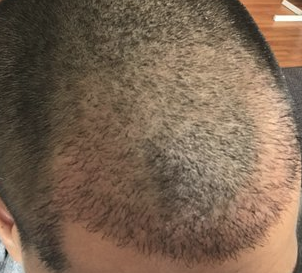
My First Transplant Is Not Thick Enough (Photo)

If your first transplant is not thick enough because you want to keep your hair short, then a second hair transplant will easily double up the density. Only you can make that decision, i.e. is it worth doing?

no thick enough


2018-06-22 13:07:16My First Transplant Is Not Thick Enough (Photo)

Fixing Past Hair Transplant Mistakes (with Photos)

This is a patient who I just performed a corrective procedure on. There were many mistakes made here in the past with his other doctors and I wanted to share those problems with you. Knowledge is power, and I hope this will teach you what to look out for so you can prevent them from happening to you. So let’s jump right in…

The Problem

First, let’s take a look at the “Before” photos (click to enlarge):


  1. The patient had received around 3000 grafts total in three surgeries on the frontal hairline at another clinic.
  2. The hairline is harsh, without single hair grafts in front of the larger grafts. Plus, these were not follicular units, but the old type of minigrafts of 3-5 hairs each.
  3. The hairline was placed too low and too straight, creating an abnormal edge which made the transplants obvious to the patient.
  4. The surgeon made incisions in the scalp that were not kept in the same place, so the patient had two scars rather than one (see arrows in photo above). The second and third surgeries should have been performed at the same location as the first surgery. The location of the upper scar was too high as well, so transplanting into the upper scar made sense to me.


The Solution

Here are the “After” photos, taken just moments after the completion of his surgery (click to enlarge):


  1. I transplanted 1637 grafts total (1391 into the hairline and 246 into the upper scar in the donor area).
  2. I built a wide transition zone with only one-hair grafts to break up the leading edge of the hairline so that it would not look transplanted.
  3. I had to lower the hairline to get in front of the harsh hairline created by the other doctor. This brought the hairline almost back to its juvenile position, something that I rarely do, but was forced to in this situation.
  4. Those 246 grafts transplanted into the upper scar (see arrows in the photo above) should almost completely wipe out its visibility, so he’ll have one scar in the back of his head instead of two.

I find it amazing that this happened recently by a surgeon not far from my office who does a great number of such cases. If this patient had asked to meet some of that doctor’s patients, I am sure that this is the type of work he would’ve seen. People just don’t know or think to ask a doctor to meet with other patients ‘one-on-one’. There is no substitute for meeting patients directly and talking to them about their overall satisfaction. We offer an Open House every month to allow prospective patients the chance to meet up to a dozen of our patients who had surgery. A detectable hair transplant is not what you want and it is easy to see the quality of a doctor’s work by engaging with one-on-one patient interviews.

Five days after 1400 FUE grafts with photos

This patient had an FUE 5 days earlier. What I want our readers to note, is that there is not only no crusting on the recipient area, but the donor area is completely healed, I get emails frequently which show terrible crusting after a hair transplant in the recipient area. I tell everyone our routine, which I will now repeat here:

I don’t like the idea of anyone removing grafts that have scabs on them because we have published a paper in a formal medical journal, that when a person pulls off a scab (crust) from a recipient area in less than 12 days (possibly longer), the risk of losing the graft is very high. See the medical paper we wrote here: https://baldingblog.com/wp-content/uploads/pdf/mp-2006-graft-anchoring.pdf

In FUE or any transplant including a beard transplant it should be treated just like a regular hair transplant with regard to the recipient area, but if the donor area has open wounds (FUE), it requires daily washing with soap and water. Within 3 days of surgery, you can resume full activities, heavy exercises if you wish. The recipient area requires daily washes as well to keep the recipient area free of crusts. I generally recommend the use of a sponge and supply my patient with a surgical sponge to fill with soapy water and press on the recipient area daily in a rolling motion, never rubbing. By repeating this daily, all crusts can be washed off without any fear of losing grafts. IF any crust are present, use a Q tip and dip it into soapy water, and roll it on the crusts and that will lift them off without dislodging them, but never rub them, just roll the Q tip on the recipient crust. I like to see no evidence of any crusting in the recipient area and the crusts from the donor area gone in 5+ days with daily washing.

PAK20057PAK20058


2016-11-22 11:04:58Five days after 1400 FUE grafts with photos

Flax Seed Oil and Hair Loss

I have been taking propecia for over 5 years and have not had a problem with thinning hair, until the past 6 months or so. I started taking Flax seed oil 1000 mg twice a day (which has a combo of omega 3, 6, and 9) one year ago recommended by my eye doctor for a dry eye condition. Now I notice my hair on the crown and front has become thinner and soft, and it seems more hair is falling out daily. Is it possible I’m losing hair due to too much flax seed oil?

I doubt that flax seed oil caused your hair loss. I have not read anywhere that an omega 3,6,9 combo is associated with hair loss, but many people feel that we are what we eat. Simple vitamins in very high doses can be harmful, when in normal doses they are beneficial. The same may apply to flax seed oil, but I really do not know and would only be speculating here.


2006-04-14 09:30:52Flax Seed Oil and Hair Loss