Hair Spray and Hair Loss

Can hairspray damage hair follicles and lead to hair loss?

If you brush or comb through your hair after the hair spray dries, you may pull out hair. In men and women with varying forms of alopecia, the use of hair sprays can be dangerous with rough combing of the hair. Best to wash it out rather than brush it out. Rough brushing can be a cause of hair loss made worse with hair sprays. Otherwise, hair spray by itself doesn’t equal hair loss.


2008-10-01 11:50:15Hair Spray and Hair Loss

Hair Stands Straight Up After Transplant

I had a procedure of 3000 grafts placed in the front and now 8 months later, the hair that grew out stands straight up like toothpicks coming out perpendicular to the scalp. Can this be fixed?

The direction that hair grows after a transplant is determined by the transplant surgeon. Some doctors place the hair straight upward reaching for the sky like you reported, while others place them in a radial direction so that the hair looks like the spokes of a bicycle wheel. Some hair restoration procedures (like those of flaps), have hair that grows 90 degrees off pointing to the side. In all of these situations, the transplants or flaps permanently point the direction of the hair.

These are tricky repairs and most of the time the repairs are not able to correct the entire directional issue. I would advise setting up a consultation with me or a good hair transplant doctor in your area with lots of experience (I’m not sure where you’re located) to ascertain what, if anything, can be done to correct the problem.

Hair Straightener

Hi
i am eighteen years of age and am loosing quite alot of hair. it has been a month since this has been happening to me. i dont really know if it is cos im using a hair strightener 2-3 times a week and m washin my hair at least twice in a week. i am loosing my hair particularly when i am in shower. i am really worried and m not using a hair straightner at all during this christmas hoildays. Do u think that i should use my hair straightener once a week and wash it once too? i will really appriciate it if you write back!
Thanks a million!

I am not 100% certain that a hair straightener can cause permanent hair loss, but if you are concerned, then you should stop its use and see if your problem goes away. That is the easiest and most logical thing to do. Sometime chemicals can cause your hair to become very brittle and break without actually destroying your root, therefore causing any hair loss to appear a lot worse than it actually is. It is normal to lose up to 100 hairs per day.

Hair systems for thinning hair

Hair system for someone who still has hair but diffused thinning like me, will they work well?

Hair systems work well, but they almost always accelerate the hair loss because of the various attachments that are used. Men who use hair systems find that they get balder by the number of years they use them.

Hair System vs Wig

What is the difference between a hair system and a wig or a toupee?

ToupeeIt is the same as the difference between a garbage collector and a sanitation engineer! Everything is in the packaging!

Shakespeare wrote, “What’s in a name? That which we call a rose by any other name would smell as sweet.” I would change this for the sanitation engineer: “That which we call garbage smells the same under any name you choose to give it. Unfortunately, for many wig wearers, there is a smell that comes with chronic use of wigs unless you have replacement wigs that you wash with some regularity.” It’s not quite as romantic, but it fits.

So to answer your question straightforward — no difference, except for the name. Hair system was coined to market fake hair so that it sound better than wig or toupee.

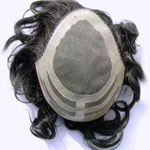
The picture shows a ‘hair system’ from the bottom (you almost can’t see the hair). What you are looking at in the photo above is the part that attaches to the scalp. To get the best fit, the scalp should be shaved and then the device is glued to the skin with some ‘attachment’ compound. Once glued, it stays in place on the scalp until it is removed and reattached. Many wearers do not do this for themselves, but rather pay someone to do it for them. If the device stays on for a week or more, the sweaty scalp produces an odor which then transfers to the ‘device’. Some people remove it at night and this allows them to shower and wash their scalp. They may also wash their device, but washing it makes it wear out earlier. Alternatives to glue include weaves, which use the existing hair around the head to be weaved through the mesh of the device like thread or clips which can attach the ‘device’ to the existing hair around the edges of the ‘unit’. The clips are better, because they can be easily removed while the weaves can not be moved and must be reworked as the hair grows longer. The average weave becomes more and more loose the longer it stays in place and to make matters worse, it moves as the hair gets longer.

The constant movement of the ‘device’ as the hair gets longer, or the pull from the clips or the glue, creates traction alopecia (hair loss from pulling) which is permanent in almost every person. The sad thing in all of this is that these devices will cause permanent hair loss and dependence upon them. This dependence creates business for the life of the customer.

The reason I think that hair transplants are a better solution is that rather than create dependence, it creates independence. Most of my hair transplant patients say goodbye to me after one or two sessions. From a financial point of view there is no comparison, as the wigs run an average of $3000/year for purchases, replacements, adjustments, repairs and services (and more and more services). Just think of the money a person will spend at $3000/year in 10 years ($30,000) — a far more expensive process than two hair transplants that run between $10,000-$20,000 (hopefully with a stopping point at just two sessions). The existence of a good Master Plan with an honest and reputable hair transplant doctor is critical for the hair transplant candidate who wants to ask “when will it end?”

Hair Systems and how to avoid hair loss from them

How fussy do you have to be with placement of it though? If you have a hair system or only applying in certain spots you can’t be too consistent?

You have to be fussy! If you apply the hair system, make sure that the clips are never in the same place or you will end up with traction alopecia.


2021-01-14 09:58:25Hair Systems and how to avoid hair loss from them

Hair Systems at 23

I’m 23 and it’s happening. I’ve always had a poor hairline but now it’s thinning. And quickly (6 months and it’s gotten worse). Money is no object. Are these crappy hairpieces or are they indiscernible from the real deal? Do you shave the rest of your head for them? How do they work? How do you clean them? I want to do it early enough with my current hairstyle so no one can tell. I’m not keen on the medication or rolling.

Be aware that hair systems need to be attached, so most use glues to hold them to your shaved scalp. This causes traction alopecia and more hair loss so most men who make the switch to hair system end up on them for life as their hair loss always gets worse, often from the hair systems themselves.


2021-01-23 10:48:38Hair Systems at 23

Hair Thinning in a Young College Student

I’m 23 years old, male. I was concerned about my thinning hair and my forehead is also very high. I was wondering if my forehead could be lowered along with hair transplant in one session and also a general estimate of what it might cost. Could the surgery be financed?

Another concern that I have is whether my transplant area and donor area would be red and swollen for various number of days. How many days are we talking about here? Since I am a college student I am concerned if people will be able to tell I had a hair transplant surgery after I come home from the procedure. Will the transplanted hair and the hair from donor area shed very badly and leave me looking like I have thinner hair than I used to and how much pain should I expect?

Thanks for addressing my concerns.

Thinning hair in a 23 year old man is usually caused by genetic balding. You should see a good doctor to have your hair mapped for miniaturization and have your hair bulk analyzed to be sure that you have genetic balding. If this is the case, then the use of medications like Propecia will be critical to stopping or slowing the balding process from progressing.

The redness after a surgery depends on two factors — the color of your skin (white skin is more likely to turn red), and the general way your body reacts to a wound (scratch your forehead with your fingernail and then wait 5 minutes to see if it turns red). If and when you become a candidate for a hair transplant by presenting with a clear balding pattern, then you can at the time of the transplant, lower your hairline. Costs vary depending upon what has to be done. Financing is available.

Hair Thickening, Thinning, and Thickening Again from Minoxidil

Doctor

Just read a recent post regarding someone who notices his hair thickens and thins and thickens again. I’ve noticed that for years and just assumed it was from Rogaine. That it was either synch shedding which happened after first using the drug and just continued through the years or that at times realized I’ve been missing areas and after reapplying those areas came back. But again that was Rogaine not Propecia which the previous post was on. Wonder if other minox users noticed this.

After reading your reply made me wonder if TE tends to reoccur in people. It would make sense if it is in response to a stress. People who have physical ailments in response to stress tend to have the same physical responses repeat throughout their life. I wouldn’t be surprised if some people are predisposed to TE under stress. Just as some develop IBS that comes and goes.. acid reflux.. back pain.. IF TE happened once it will probably happen again under stress.

Thanks for your comments. I’m posting this to hopefully get other readers to share their experience with back and forth shedding from minoxidil, as you describe.

To put this all together, a good relationship with a doctor is a good idea. Yes, telogen effluvium can reoccur in some people. See eMedicine for more info.

Hair Thickness vs Density in a Hair Transplant

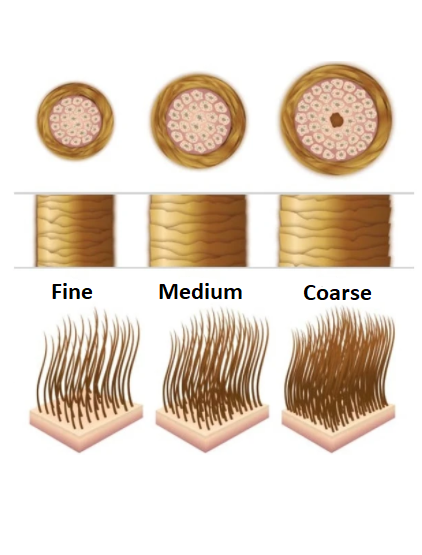
When estimating the number of grafts a person needs, I always want to know the hair thickness (hair bulk) of the donor area. Hair bulk is not hair or graft density. I initially saw the graphic at the bottom of this post on Reddit.com. For a visual representation, the graphic artist kept the number of hairs the same and changed the thickness of the hair shafts to show the value of hair thickness in producing coverage. Dr. Sharon Keene nicely demonstrated this with real hairs and got the same result as the graphic demo below. So you see, if your hair is fine, it will take a lot more hair to get the fullness of a person with medium-weight or coarse hair. This is why people with fine hair often get a second hair transplant. Fine hair is clearly better than no hair, but when a person with fine hair gets a hair transplant, they should accept that they will never have the look of Brad Pitt’s hair, while a person with thicker hair shafts, a Brad Pitt expectation may be realistic. The chart below shows the value of thicker hair shafts very nicely.

Let’s drill down on an example: Look at the chart below; let’s suppose that a balding man has medium hair (50microns thick). His friend had a hair transplant and had fine hair in his donor area, with a hair thickness of 30 microns. His friend had a hair transplant, and it doesn’t look like he has a full head of hair after the transplant despite getting 4000 grafts. He is concerned that he might not be happy with the type of results his friend had. If he does the analysis, he will find that he has 7.1 times the hair bulk as his friend with fine hair whose donor hair thickness had 30-micron hair shafts (50/0.7 = 7.1). I would tell him that if I were his surgeon, he would get much fuller-looking results than his friend, not because I am a better surgeon than his friend’s surgeon but because his hair thickness will produce more hair bulk than his friend’s fine hair gave him. The amount of hair bulk is a simple math calculation reflecting the area of a circle [ Pie (r)² ]. If you want to run the calculations, you will know the value of your hair thickness, and everyone having a hair transplant should do this to establish realistic expectations.

In my 35 years performing hair transplants, I have transplanted many men with fine hair. They were generally pleased because they got back the hair they always had, which was fine hair. A fine-haired man getting a hair transplant for balding doesn’t have the expectation that his hair would look like Antonio Banderas’s hair because they never had it.

In the late 1980’s. Dr. Manny Marritt had a light-skinned Caucasian human volunteer with black, medium-weight hair (~50-micron hair thickness) agree to have half the hairs on one side of his head plucked out. Then, Dr. Marritt brought in independent observers and photographers to see if the lower-density side could be detected. The answer was NO! That told me that in the worst situation possible (black, medium-weight hair on white skin), 50% density produced the same fullness as 100% density. With that being the case, a person with medium-weight hair that is blonde with a blondish skin color or a brown-haired, brown-skin colored man would require less than 50% of their original density to get a full look from a hair transplant. I have found that to be true, and that is the art of what a good hair transplant surgeon offers. When the hair transplant surgeon combines this knowledge with proper hair distribution, the best results are produced with the least amount of hair and cost to the patient.

For those readers who want to know where they stand about hair thickness, to get some realistic expectations for a hair transplant, you can purchase a micrometer for under $25 on Amazon, cut 10 of your donor area (back of your head), and measure the thickness by averaging their width of those 10 hairs. Use the chart below to understand the measurement and consider Dr. Marritt’s simple experiment. The micrometer can be purchased here: https://www.amazon.com/dp/B09964YBMF?ref=ppx_yo2ov_dt_b_product_details&th=1


The illustrations below show the same number of hairs, but the hairs are thicker. Please note the HUGE visual difference between fine, medium, and coarse hairs regarding the fullness each group produces.


You can contact me at williamrassman33@gmail.com