Hair Transplant Review at New Hair Institute of Norwood 4 Patient Before / After Photos

This is a review of a hair transplant surgery performed at New Hair Institute by Dr. Jae Pak.

This is a young 30 year old professional who lost his hair in his 20s. He had a 2100 graft hair transplant surgery that gave him a non-balding “frame” to his face. He will continue to lose his hair on top and may need future surgeries but the transplanted hair in the front in permanent and he now looks his age and feels better about his new look!

Hair Transplant at NHI 2100 grafts

Hair Transplant at NHI 2100 grafts

HT_NHI_28a

Similar results to the TV Reality show Jon Gosselin’s results in terms of number of grafts received and the balding pattern. Both patients did not have follow up surgery for their crown area (for their own reasons).

Hair Transplant Review of Norwood 5 Patient Before After Photos

This is a review of a hair transplant result performed at New Hair Institute by Dr. Jae Pak. This is a patient in his 60’s who looked 70’s before he had a hair transplant. His grey hair actually helped with the overall result. Grey hair on fair skin helps disguise the thinning by the low contrast between hair color and skin color. We think that the hair transplant makes him look at least 10 years younger than his real age!

He is currently thinking about another hair transplant versus a SMP procedure for fullness. There is no right answer or choice. Real hair is always better, but SMP is not surgery and there is no recovery with instant results! He may choose both like this patient HERE.

Before and After 2491 Grafts

Before and After 2491Grafts

Hair Transplant Surgery Risks

I am considering a hair transplant procedure, but I am nervous about doing the surgery. What kinds of things can go wrong?

Hair transplantation is indeed a surgical procedure, and there are risks associated with any type of surgical procedure. The degree of risk, however, is more tied to the type of anesthesia than the surgery itself. With the anesthesia being limited to local and sedation, rather than a general anesthesia, the risk is about the same as a visit to the dentist’s office, statistically a risk of death estimated at less that one in a million people.

Any time one has surgery there is the risk of something rare and serious happening, such as an allergic reaction to medication, or a blood clot to the lung, or even cardiac arrest. The best surgical facilities in the United States are certified for surgery by one of two independent agencies. Our facility is the only hair facility in the United States that is certified by one of these two agencies, ours is certified by the Accreditation Association for Ambulatory Health Care.

The thing that you have to remember is that hair transplantation does not penetrate any body cavities. It is really analogous to taking off a big mole or wart. In 15 years and doing over 10,000 procedures, I have never seen any of the previously mentioned serious things happen. For a hair transplant the surgical risks can be defined well enough. The types of risks that should concern you include: infections, bleeding, swelling, wide scarring of the donor area, nerve damage and poor hair growth. I have never seen any serious infections as the scalp has a wonderful blood supply which prevents and protects against these infections. It is very common to have a few ingrown hairs with localized infections in the first few months as the new hairs grow in, but this is cared for by just keeping the scalp clean. Sometimes ‘popping’ these pimples yourself works, and when we do it we call it ‘draining’ the cyst. Sometimes these ingrown hairs produce a wider infectious problem which might require an antibiotic. Significant bleeding at the time of surgery should not occur in the hands of a competent surgeon, there may be some small drops of blood the first night after surgery but it is almost always handled with a little pressure directly to the bleeding area. If that doesn’t stop it, a suture might be needed, but that is exceedingly rare. Swelling after surgery is common. The swelling may work its way down to the eyes three or four days after the surgery, but the use of post-operative steroids may be helpful at reducing or eliminating swelling. Swelling always goes away after a few days.

Scarring always happens when the skin is cut, but newer techniques of wound closure usually prevent that from occurring at socially detectable levels. The more procedures one has, and the more grafts that are done with each successive procedure may make for a slightly wider scar. Rarely do these scars become cosmetically significant unless one shaved his head and in that case, all such scars will be seen no matter how perfect the healing is. Nerve damage should not occur, provided that you are using a well trained and competent surgeon. Poor hair growth is also something almost never seen, but occasionally happens. If your doctor and his assistants are experienced, and the techniques they use are modern state-of-the-art methods, only rarely is growth a problem.

Your question is important, for we often forget that everything in life has risks. Driving may be more risky than having a hair transplant surgery.

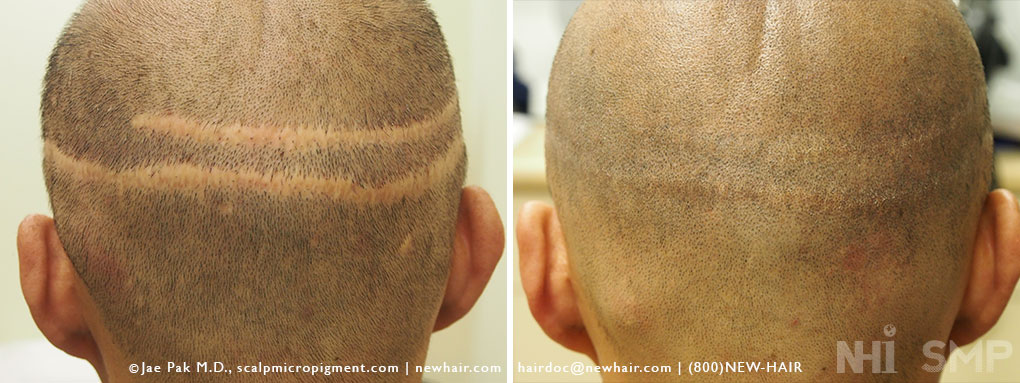
Hair Transplant Scars and Scalp Micropigmentation (SMP) (with photos)

I have had several transplants over the years and have lost about 30-40% of them due to thyroid related conditions. My main concern is if this continues will the transplant scars at the back of my head become visible. Some of the pictures posted on your blog shows promising ways of disguising these scars using SMP. Is this a one-time procedure or something that has to regularly undertaken?

nhi_smp_to scar

nhi_smp_to scar

The photo here is an example of what is possible with SMP on hair transplant scars.
SMP is generally a one time procedure and the longevity is similar to any tattoo. As with any tattoo you may want to have it touched up after several years.
If you would like more information, you can always give us a call to speak to our surgical staff or one of our doctors.

I Had My Hair Transplant, Took Propecia, and Had No Hair Loss

I had my hair transplant and took Propecia. I had no hair loss, so a year afterward I stopped the Propecia and felt secure that I would not experience hair loss. Now 1 and a half years later, I am losing hair. Is this delayed shock loss?

You must remember that the hair loss process is progressive, so even if you get past the hair transplant and the shock loss, it does not mean that you stopped losing hair.


2018-05-09 07:41:10I Had My Hair Transplant, Took Propecia, and Had No Hair Loss

Hair Transplant Surgeon Told Me To Use Rogaine Foam 3 Days a Week for My Hairline

I saw a hair transplant surgeon some time ago about corner recession in my hairline. She said in my situation I could use Rogaine foam three days a week.

I’ve never heard of using Rogaine three days a week. Is there any situation where that dosage might be beneficial and/ or necessary?

I simply do not agree with the doctor that suggested using Rogaine 3 days a week. Twice daily use will give you the best effect from minoxidil (Rogaine), but even then, the medication isn’t likely to do much to treat your hairline corner recession. Any expert in hair loss should know that.

A Hair Transplant or a Wig?

I’m a 26 Male. Been suffering from hair loss since 18. I tried Fin, Minox, Derma, Nizoral, Laser comb. They seem to have worked for a while but not now. I stopped taking fin 3-4 years ago. I was thinking to get a hair system for the past few months but now I’m confused and want to go with a transplant. IThis is the right time for me to a get hair transplant or a hair system. (Cost efficient)

When comparing a wig to a hair transplant you have to think about costs, and what works for you. There is no advice that you can get to make the decision for yourself. Meet as many people with both options as you can to make that decision.


2019-03-19 07:42:32A Hair Transplant or a Wig?

Hair transplant while recovering from surgery?

Have you had patients get a hair transplant while recovering from surgery? I’m having surgery on my shoulder soon and was thinking about taking advantage of the time off work to get a transplant? Not sure if this would be too much for my body.

Obviously I know my doc will have the final say. However just wanted to ask here prior to asking him, as my next appointment isn’t for a few weeks and he’s a while away

Many of my patients who have had orthopedic surgeries will do a hair transplant during the recovery period because they have the time to do it then.


2021-03-02 08:35:41Hair transplant while recovering from surgery?

Hair Transplant with Zero Detectability?

Hello Dr. Rassman (and contributing doctors),
I have a question that I believe is something most of your readers might wonder:

For us hopeless (hair) romantics, what would you say is the best possible scenario for someone undergoing a HT procedure? Put another way, is it possible for someone with limited (or even moderate) balding to realistically expect to repair their hair loss to the point of zero detectability? …Hypothetically of course

Absolutely! Non-detection for a hair transplant is a reality on most patients who get them, provided that the densities are brought up to enough of a level to produce the fullness that normal densities will have. Without knowing more about your hair loss pattern, hair characteristics, color, skin, etc, it would be difficult to give you realistic expectations. If you visit me in my office in Los Angeles, I’ve got plenty of patients (and some on my staff) that have the type of transplant which is completely undetectable. I mean, who wants their hair to look transplanted? Nobody! As I always say, seeing is believing and our Open House events show this on many of the patient models who visit us from time to time.

Hair transplant, no artistic feel, not normal looking hairline (photo)

This is an unfortunate example of a young man who had a hair transplant by a doctor who did not have a sense of either art nor a sense of what constitutes a normal hair transplant. The grafts are all lined up and they appear equal in size. What should have been done is that the grafts should be more randomly placed and the leading edge should have been created with single hair grafts (usually 400 or so) to create a transition zone in front of the hairline so that the patient ends up with a no-hairline hairline instead of a discrete hairline as this unfortunate person will have. This is easy to fix but it requires another small surgery.


2020-09-01 10:00:49Hair transplant, no artistic feel, not normal looking hairline (photo)