I Have Been Using Finasteride Inconsistently, And I Continue To Lose Hair – Hair Loss Information – Balding Blog

Hi,

I’ve been reading your blogs for a while now but have finally got the nerve to send you an email to ask a question. I’m 28 yr old male. I have been taking Propecia since I was 24 yrs old. Actually I first started taking Propecia, I was told by my dermatologist to take it just three times a week because he felt that my hair loss was very minor. I did that for about 3 months or so then I went on one pill a day from the time I turned 25 and took a pill a day for about 1 year and a half. By the time I was 26 and half, I was reading that Propecia could affect my ability to have children so I stopped taking the pill. I started to see heavy amounts of shedding of my hair but I thought it might be due to the amount of stress I go through. However, after a six month stint off Propecia, I met with a doctor and decided to go back on it until now. Since the time I started back on it last February (2007) I’ve noticed my hair is substanitally thinner than it was last year even though I’ve been taking Propoecia. Its thin to the point where I can see my scalp in most angles of light. Does this mean that Propecia is not working for me? I’m actually going through a stressful time in my life right now, does that have anything to do with it or cause Propecia not to work? I lose about 30 hairs everytime I shampoo my hair and there is basically hair everywhere over my pillow case. Are there any suggestions you may have for me?

Thanks

Block Quote

You cannot expect results when you take a medication inconsistently. The recommended regimen for Propecia is to take the medication daily. You need to stick with a knowledgeable doctor and maintain taking the drug daily if you want a chance at some results. Taking Propecia is also a lifetime commitment so you need to understand this before embarking on taking the medication. Anything less will eventually push you into what I have discussed many times on this blog — “catch-up hair loss”. There is also no comparable “catch up hair growth” that equals the value when you first started to take the drug and during the first full year of treatment. Today, doctors have an instrument which measures your hair bulk and hair miniaturization so you can see, over time, if you are winning or loosing the hair loss battle. My best advice has always been to go see your doctor in person to address your concerns.

Regarding whether Propecia is working for you, you should be able to ask your prescribing physician, who I hope has measurements of your hair loss at the time you restarted the drug over a year ago to be able to compare them to now.

Avodart Vs Finasteride – Hair Loss Information – Balding Blog

just to share something and also post an enquiry. January this year, after seeking advice from a dermatologist, I decided to take the plunge and switch from propecia to avodart. It has got to be the worst mistake I ever committed. since the time I stopped propecia, hair shedding started about close to a month after switching. In a matter of 5 months, my hairloss progressed drmatically and I have now a very noticeable receded hairline. I should have stayed on propecia, although it didnt regrow a lot of hair I have expected, but It did regrow decent amount and most importantly, maintained what I had. Looking back, I could only blame myself for all reports that supported Dutasteride were either small scale, or short-term. I have since switched back to propecia a week ago after seeking a 2nd medical opinion.

My question would be that, is my shedded hair all lost and not returning? Notice I am not like the typical propercia user who quit due to side effects, I switched to a more powerful anti-dht and am not switching back propecia. Bearing in thought that all the while I had decreased DHT in my body, and during that 5 months, decrease up to 90%.

Thanks!

Block Quote

Thank you for sharing your experience with Propecia (finasteride) and Avodart (dutasteride).

To answer your question in perspective, there is no magic pill or drug to cure or reverse hair loss. If you are genetically predisposed to hair loss, Propecia will only postpone it as long as possible. For some men this may be many years. For other unlucky men this may be a few months or a few years. This does not matter how much DHT you block. Most men who do this also get a drop in their sex drive as Avodart has a higher sex drive suppression than Propecia.

Is Propecia / Finasteride Causing My Anxiety and Depression? – Hair Loss Information – Balding Blog

I posted this one in another forum to no avail. I am a 5 year user of Finasteride 1.25mg ED. I have never noticed any sides but in the past 6 months I have had a downward spiral of anxiety, mood changes, depression and negative thoughts. I know that it may not be the finasteride but something is not adding up. I’ve tried everything (except anti depressants), my life is great minimal stress, financially sound, supportive family etc. but the feelings and thoughts are overwhelming even at the best of times. I have read a but recently about the effect of fin on allopregnanolones and it made sense to my situation. Problem is that in order to test whether finasteride is the cause I have to undo all it’s hard work which could leave me feeling worse than before – that is unless there is another way of testing whether finasteride is the cause. Is there a way of testing progesterone, allopregnanolones, DHT etc. to find if fin is causing this imbalance before I give up fin? Are there alternatives to fin which I can try if I was going to give it up? Thanks!

Block Quote

I cannot help you here. You need to see a doctor in person for your problem.

I will try to be more clear with facts:

1) You are having anxiety, mood changes, and negative thoughts.
2) Internet is not the right source for self diagnosing psychological or medical issues. There are abundance of information on the Internet but they can be overwhelming and confusing with misinformation or misinterpretation.
3) You are trying to make a correlation between a drug you have been taking for 5 years with a mood change you’ve been experiencing in the last 6 months. If you look hard enough on forums and Internet sites, it may seem to justify your case, but that does not mean it is correct.
4) There have been rare reports of mood changes with finasteride, so talk with your doctor (not look on the Internet) for a possible solution.

The best solution is see your primary care doctor or a psychologist in person.

Why Doesn’t FDA Do Something About Hairmax? – Hair Loss Information – Balding Blog

If that’s the case then why doesn’t FDA do something about hairmax openly claiming that their device was tested by FDA for EFFICACY and safety? FDA did mind when hairmax stated that their device was APPROVED instead of cleared. So why dont they mind now? Such devices cannot be approved but only cleared.

Why dont you put this subject to rest by contacting FDA and asking them if they tested efficacy as well?

What about the recent peer reviewed published materials in the scientific journals that you were asking for so badly a couple of years ago?

What about your laser hat trials??

I respect you very much doctor, but when you talk about LLLT, you seem to be against it without any substantial basis.

Block Quote

Our laser cap trials were inconclusive with mixed results. The subjective view of some patients suggested benefit, but when we measured the hair bulk on these patients we saw not benefit. Patients had mixed reviews. One can argue that the trials were inherently flawed because we gave the laser caps away as a compensation for their time.

It is not my job to contact the FDA and my opinion of laser light therapy for hair growth is just that: my opinion. If you disagree with my opinions here on BaldingBlog, then I am ok with that! I want to correct one of your statements: The FDA does not, nor does it ever, test these devices. They rely on the manufacturer for the tests and review their data in submitted applications.

Our 16 Month Baby Girl Lost Hair From Scratching, Will The Hairs Grow Back? – Hair Loss Information – Balding Blog

Our 16 month old baby girl has eczema and also dealt with scalp itching quite a bit. When she was little she had a really full head of hair. But, she did scratch her hair quite a bit to where we would find spots where there was some superficial cuts and bleeding. Her hair is pretty thing now. Do you think it’s going to be permanent or will it come back? We’ve gotten her scalp itch quite a bit under control from what it used to be.

Block Quote

Please follow up with your doctor. In general hair lost from trauma or excessive scratching or ecema may take over a year for hairs to grow back.

Hair Loss InformationScalp MicroPigmentation of FUE Combo Review for Norwood 5 Patient – Hair Loss Information – Balding Blog

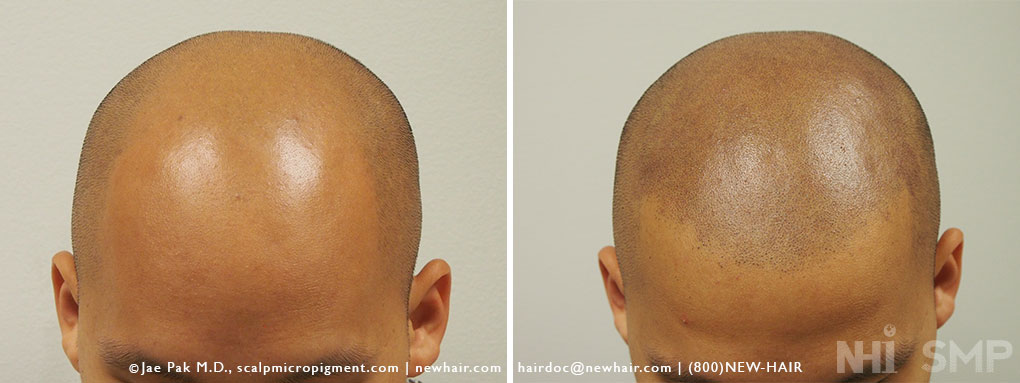
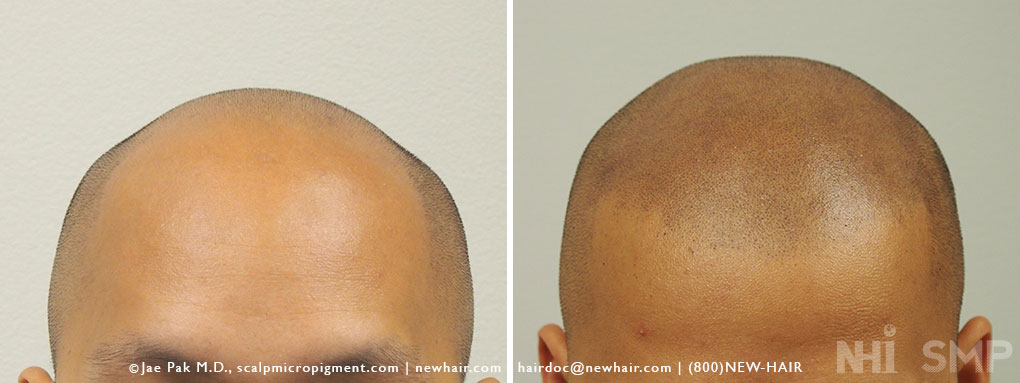
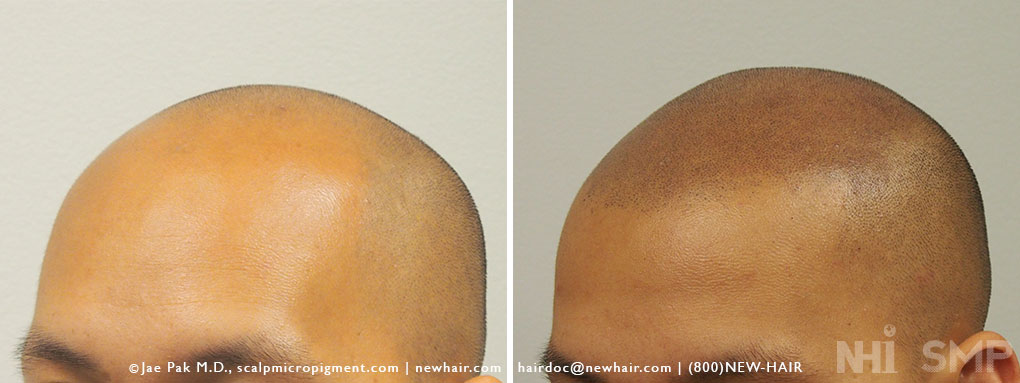
This is a review of what is possible when you combine Scalp MicroPigmenation (SMP) with a hair transplant surgery using the Follicular Unit Extraction (FUE) technique performed at New Hair Institute by Dr. Jae Pak.

The following patient is in his 30’s and always wore hats. Even in the house with the family or with friends he wore hats because he was not happy with his balding pattern. He eventually decided on a FUE procedure because he didn’t want the linear scar on the back of his head in case he wanted to shave his head in the future. If all else fails, he thought at least he can shave his head without any worries about scars. He eventually went on to have 3 FUE surgeries over the years as his hair loss progressed and received about 5000 grafts. Despite the new look and the permanent transplanted hair, he wanted fullness and even wanted to shave his head for a buzz cut look.

Eventually, he had the Scalp MicroPigmentation procedure and he had the best of all scenarios: He can cut his hair long or short and he will always have the look of fullness.

Note that hair transplant procedure is a great option for those who are balding. But you will never get full thick hair since the basic concept of a hair transplant surgery is just relocating hair from one location (back of head) to another location (front and top of head). There is nothing new being added. Hair transplant is basically artistically rearranging the hairs around. Scalp MicroPigmentaion is used to augment the limitation of a hair transplant to provide the look of fullness by minimizing the contrast between hair and scalp.

This patient finally threw away the hat he wore for so many years.

FUE immediate after/  FUE scars hidden by SMP

FUE immediate after/ FUE scars hidden by SMP

Before and After FUE Hair Transplant (NO  SMP)

Before and After FUE Hair Transplant (NO SMP)

Before and After FUE Hair Transplant (NO  SMP)

Before and After FUE Hair Transplant (NO SMP)

Before and After FUE Hair Transplant (NO  SMP)

Before and After FUE Hair Transplant (NO SMP)

Before and After FUE Hair Transplant  AND Scalp MicroPigmentation (SMP)

Before and After FUE Hair Transplant AND Scalp MicroPigmentation (SMP)

Before and After SMP - BOTH photos are after hair transplant surgery (NOTE: shaving does not make hair transplant look as full)

Before and After SMP – BOTH photos are after hair transplant surgery (NOTE: shaving does not make hair transplant look as full)

Before and After FUE Hair Transplant  AND Scalp MicroPigmentation (SMP)

Before and After FUE Hair Transplant AND Scalp MicroPigmentation (SMP)

Before and After FUE Hair Transplant (NO  SMP)

Before and After FUE Hair Transplant (NO SMP)

Before and After SMP - BOTH photos are after hair transplant surgery (NOTE: shaving does not make hair transplant look as full)

Before and After SMP – BOTH photos are after hair transplant surgery (NOTE: shaving does not make hair transplant look as full)

Before and After SMP - BOTH photos are after hair transplant surgery (NOTE: shaving does not make hair transplant look as full)

Before and After SMP – BOTH photos are after hair transplant surgery (NOTE: shaving does not make hair transplant look as full)

Before and After FUE Hair Transplant (WITH  SMP)

Before and After FUE Hair Transplant (WITH SMP)

Before and After FUE Hair Transplant (NO  SMP)

Before and After FUE Hair Transplant (NO SMP)

What Are Your Thoughts On Low Level Laser Device For Hair Growth? – Hair Loss Information – Balding Blog

Thank you for the great blog. Can you kindly comment on the study of the hairmax laser comb? There was a study published on the American Journal of Clinical Dermatology in 2014: Efficacy and Safety of a Low-level Laser Device in the Treatment of Male and Female Pattern Hair Loss: A Multicenter, Randomized, Sham Device-controlled, Double-blind Study

Block Quote

It seems like a good study but the results and conclusions from the study is plainly states: “A higher percentage of lasercomb-treated subjects reported overall improvement of hair loss condition and thickness and fullness of hair in self-assessment, though the results did not always reach statistical significance.”

It means the subjects felt improvement but the results did not always show statistical measurable significance. In fact, it states Rogaine and Propecia worked better overall in the end.

The report ends by stating: “Further clinical trials are needed to define the optimal duration of treatment, the duration of response, and the use of the lasercomb in other alopecia conditions.”

This reflects what I’ve been saying and seeing in my office. I personally do not think that the laser therapy for hair growth works. I have seen many patients over the years and some say it helped a bit but they cannot see the gross cosmetic difference (a real change someone can see). I have not been able document the results in numeric terms or objective terms even with our recent laser trials here either. It doesn’t mean patients were not dissatisfied but I did not find a documented benefit. I still remain unconvinced that it works. As for my opinion, it’s a free world and a free market. Any one is welcome to spend the money to try it for themselves. It’s apparently declared safe by the FDA.

We’ve written about it here, here, and here.

Does Propecia Stop Hair Loss in 90% of Men? – Hair Loss Information – Balding Blog

Dear NHI Team – your blog is one of the most informative and professional online resources.

In the past you have written that of a belief that Propecia works for all men. Dr Bernstein in NYC, Dr. McAndrews in LA have made similar statements. The Merck claim is that it stops hair loss in 9/10 men. Perhaps you are saying that the one man left will go on to lose hair but a slower rate?

Could please elaborate on your opinion?

Block Quote

Propecia is for the treatment of androgenic alopecia in men. I’m not sure if Merck claims it “stops” hair loss, but I think Merck is claiming it works in 90% or 9 out of 10 men. The degree of how well it works on the individual is variable. Over the long term, even if you do take Propecia, you will continue to lose hair, albeit at a slower rate. For example, instead of losing most of your hair in your 20’s you may be able to prolong that fate to your 40’s. To some that may be worth it.

Finally, unless you’re doing this for research or intellectual purposes, the statistics don’t matter when it comes to personal experience. No matter what the percentage of successfully growing or slowing down hair loss, men may try the medication in hopes it will work. Likewise, no matter what the percentage of negative sexual side effects, men may not try the medication due to fear of it happening to them.