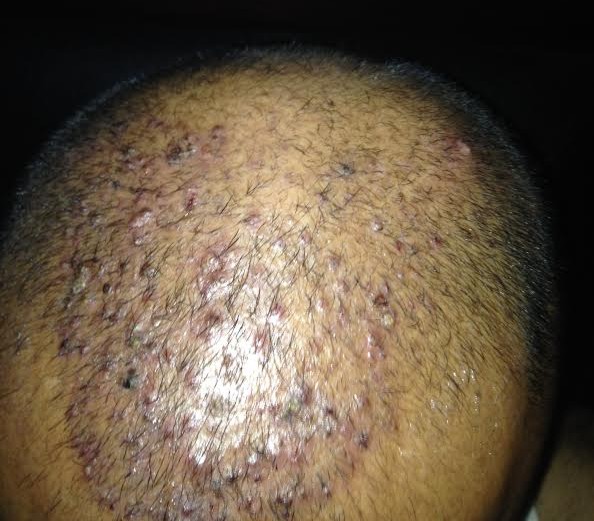
I would like to share my concern with you and could you please explain why is this happening and what is the solution. I have had an FUE transplant done on me. After the first week of my transplant I started to use minoxidle. But recently(two weeks back) I start noticing some irritation on my scalp and small pimples started to appear on my scalp. Could you please explain to me if this is normal in some cases or should I go see the doctor. Also i would like to know if I should avoid using minoxidle for now until my scalp heals. I am also attaching picture for the reference. Thank you.
You obviously invested a significant amount of time and money to have an FUE surgery. You need to see your doctor for a follow up. Your photo of your scalp doesn’t look right and my guess is that it probably is a significant infection! It should not look like that after surgery. Please call your doctor.
I know this question has been asked before, however, it seems it has been quite a while since last asked. Is it safe to father a child while on Dutasteride? Specifically, I’m talking about conception, while utilizing a condom for the duration of the pregnancy? I would assume some information regarding this would have been seen by now, since Dutasteride has been FDA approved for quite some time.
Personally, I take dutasteride once a week and use Finasteride for the
remainder of the week.
We don’t usually endorse the use of Dutasteride for hair loss due to this type of issue on male fertility and fathering a child. There are some discussions of male infertility with dutasteride, but these are not scientifically presented in a clinical study. I am not aware of any studies that pertain to conception while on Dutasteride. I suspect that Dutasteride, like Finasteride, is not found in sperm in any significant quantity, The absence of good scientific and clinical studies is is probably one of the many reasons why FDA has not approved its use for hair loss in men. I don’t think it has much to do with using condoms after your partner conceives. It’s more about conceiving while on the drug. With Finasteride, I am unaware of any reports of abnormalities in children who were conceived with the man on Finasteride and considering the many millions of men who have used this drug over the past decade or so, I would imagine if it were a problem, the ‘law suit’ nature of our society would have brought them forward by now.
I am a 30 years old male, I found my two temple peaks are different, one is gradually disappearing, i had quite thick temple peak before, but only one side of the temple peak receding/disappearing, is that normal? The disappearing side has actually had some receding in temple as well, but not that obvious, so does that mean one side temple receding will cause its temple peak receding? Cheers
The bad news is that you may be in the process of losing hair in a classic male hair loss pattern.
The good news is that hair loss in the temple peaks will likely even out as it recedes. Temple peak recession does not necessarily follow male pattern balding in the classic sense.
If you’re concerned please see a doctor for an exam and possible ways to correct it with surgery if it bothers you enough.
I have been taking finasteride for the past eight years. My question is regarding people who are not going bald. Since finasteride blocks 70% of DHT levels leaving only 30%, are those non-balding people’s DHT also blocked at 70% that is why they are not going bald or do they have complete blockage of DHT that is why they are not going bald?
The reason why some men do not go bald is because they do not have the genes for balding. It has nothing to do with their DHT levels.
I’ve been using minox 5% once a day for 2 mos recently i developed constipation. Can i attribute it to minoxidil use? Do you get reports like this. Thanks
I doubt minoxidil or finasteride causes constipation. Try a fiber rich diet.
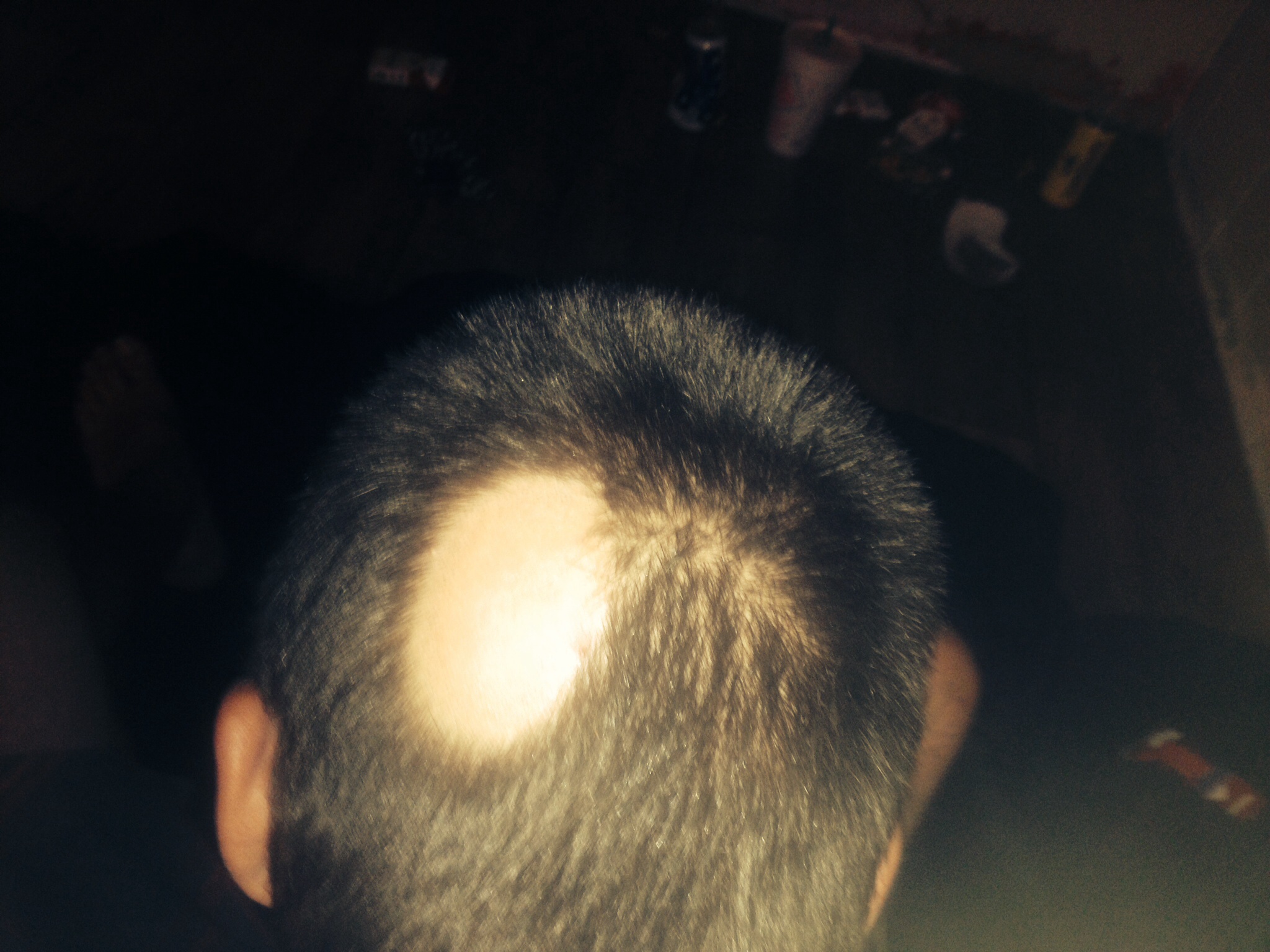
I got a hair cut in May and all my hair was growing except one spot
not its july and it’s getting bigger.
I would see a doctor about this. It may be alopecia areata from just the photo alone. If it is alopecia areata your hair will grow back over time without any treatment. But it may also return and it even can progress. See a doctor and get a definitive diagnosis.
Hello. Is it possible for a man’s hairline to recede to a certain
extent, then stop receding and remain that way for the rest of his
life? For example, can the hairline recede just slightly and then
never recede any further, or will it always continue to progress into
full male pattern baldness? If it’s possible for it to recede slightly
and then stop, I’m guessing that only a small area of the scalp would
contain the genetically susceptible hair follicles, as opposed to the
large area seen in full male pattern baldness?
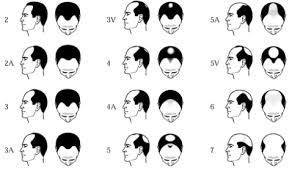
Men’s hair loss is mostly genetic in nature and it follows a “pattern”. That is why it is called Male Pattern Balding (MPB). You can see from the diagram where you fit in. You most likely fit into one of these “patterns” and that is it. Only 7 percent of men progress the Norwood 7 over their life time and they get their fairly young (like in the 20s).
Hello Dr Rasman
hope you are doing well.
i am seeing a doctor who prescribes propecia for me. its been 3 years now am taking the drug. last time when i went to see him to prescribe the drug for me, he told me to stop using it as it may affect my future and give me erectile dysfunction, less desire for sex and maybe not getting children. i told him but am feeling fine and he said that it happens gradually and the longer you take the drug more likely the sides occur and maybe permanent. what should i do now? please i need your advice. thanks
First and foremost, I am not your doctor and I do not give personal medical advice on Baldingblog so this is not a place for you to obtain answers for your medical issues. If you do have erectile dysfunction, and you need to have that checked out as it probably has little to do with the drug. I always recommend that you ASK YOUR DOCTOR. If you have an issue, get a second opinion. This is not a place to get a second medical opinion.
Propecia does cause sexual side effects in 1 to 2 percent of men. It is reversible as far as I know from my 20+ years of experience. I realize you will read about this topic on the Internet but the ultimate factor is your decision and what your doctor recommends. I also realize doctors are human and each have their own recommendation and reasoning for treating their patients.
Finally Propecia does not cause sterility as far as I know. If you believe this may be an issue get a sperm check and consult with a urologist or a fertility doctor.
I had 3 old plug style treatments, and am in the process of having the old bullet like scars removed from the back of my scalp, and grafted into the top of my head. I had the first procedure done in October 2012, which did the front half of my scalp, and a second in Januarey 2013. The first procedures, the plugs were taken above the donor site. My last procedure, they will finish removing all the plug scars, and take out the front hairline and re-graft it into a normal hair line. The facility which I had it done at is one of the best in my state,
and said it could take up to two years for the grafts to break through the scar tissue. Is this correct information, as I have read the same thing researching different sites on scar tissue. What are for thoughts?
In general it takes 6 months to start seeing growth from a hair transplant surgery (even on the scar). It can take as long as one year to get full results. Two years is rather long and misleading to say that the grafts need to “break through” a scar. In general hair transplants to scars do not completely cover the scar adequately and do not grow at the same success as hair grafts in the front, top and crown of the head.
I often get emails for hair cloning and hair multiplication from people around the world who want to believe:
READER COMMENT 1:
Um, doc, there is a working model in place. Not just Aderans and Histogen, but Dr. Gho’s hair multiplication at HSI. Yes, say what you will about Dr. Gho’s history, but his clinic is performing daily procedures without depleting the donor — I’m not surprised that this continues to be ignored or laughed off because the procedure is patented and would render every other FUE/FUT procedure obsolete. But the truth won’t stay hidden from the wider populace forever.
MY REPLY:
I’ve already written about that HERE. Proof is in the pudding.
READER COMMENT 2:
Yes, doc, and you can eat pudding every day in their clinic if you just went over there and saw the results for yourself as I did. The donor regrows. Every day they’re doing it and they’re booked through the fall of 2011. Here’s an idea: why don’t you call them or email them and ask them to send you photo-doc proof of one of their patients as I have? Aren’t you curious? Don’t you as a peer want to reach out to them after they published a peer-reviewed article in the journal of dermatology about this procedure?
I saw Dr. Gho’s presentation at the ISHRS medical convention and read the journal article. He was doing FUE and I believe that he was splitting the follicular units in the scalp, removing a hair from the follicular unit. That would allow him to leave some hair behind and remove others producing the illusion that the hair was regrowing at the point of extraction. I would embrace what he is doing if he was actually regenerating/multiplying hairs, but as far as I could see, this was not the case. If he is splitting follicular units, I would think that telling the world that he solved the hair multiplication challenge would be less than honest. Of note the published study in 2010 was on only five individuals. After four years, I would think it would have revolutionized the world of hair transplant as we know it, if it really worked.