Hair Loss InformationI Bleached My Hair at 15 Years Old and It’s Been Falling Out Since – Hair Loss Information – Balding Blog

(male)
I’m 17 and I’ve noticed that the hair on the top of my head has been thinning and falling out alot in the past two years. I strongly think that the problem was caused when I bleached my hair unprofessionally two years ago. After I bleached it and washed it off, I felt irritation and burning sensations on the scalp for about half an hour to an hour or so. What has happened to me and what can I do to prevent my hair loss? Also what products can I use to help?

Block Quote

Maybe the bleaching was coincidental to the natural genetic male pattern balding. Do you have a pattern to the thinning? In general, bleaching your hair doesn’t cause hair loss. If it did cause your hair loss, I wouldn’t expect it to reverse now that it has been 2 years since the insult happened. I don’t know of any products that will regrow hair that fell out from chemical damage.

I also can’t advise you without seeing you, or at least a set of good pictures.

A Thank You Letter From a Patient – Hair Loss Information – Balding Blog

Hi Dr. Pak and Dr. Rassman
I’m writing a thank you letter to thank everyone at NHI, from you Dr. Pak who has done my procedures (FUE hair transplants) to Dr. Rassman who invented the procedure. Also to your amazing staff who are so kind and nice human beings. To tell you truth I don’t have word to describe how I feel, because everyone at NHI is so nice and are willing to go out of there way to help out. I truly appreciate what everyone at NHI has done for me and giving me hope to feel about myself.

One last thing Dr. Pak and Dr. Rassman, I truly applaud you Dr. Pak and Dr. Rassman and your staff from the bottom of my heart for being so nice, polite and knowledgeable in what you all do.

Block Quote

There is no better reward for a doctor to have a patient reflect upon our caring. It is the core of what we, as doctors, are about. Everyone who goes to medical school, does so with the intention to address human suffering as best we can. Our staff must be organized to rally that mission.

A simple thank you is the greatest reward we can hope for. We are so blessed by people like the man who sent the above email, that they put their trust and confidence in us to work through their problems. We get thanks every day, because we genuinely care.

We appreciate comments like this more than anything. What a great way to make a living.

Hair Loss InformationMyotonic Dystrophy and Hair Loss? – Hair Loss Information – Balding Blog

Hello, I am currently a 20 years old male, with extremely fast paced MPB in the front region. There is no extreme history of MPB in my family, although my dad and his brother are both above 50 and both thinning.

Anyways, my question is, my father has miatonic dystrophy, which of course is a genetic disease effecting muscles. I have never been tested for the disease, however I was looking up symptoms and one was listed as possible frontal hair loss at an earlier age due to hormone changes. My dad of course, did not experience this. I had just got a prescription from a dr for proscar, and was wondering IF this was the case, would there even be a point to taking it? I write to you because none of the physicians I’ve seen seem to know what they are talking about.

Block Quote

Hair loss in the great majority of men (especially frontal hair loss that occurs in a specific pattern) is due to genetics. It does not matter if your father or uncle didn’t see male pattern baldness until their later years, as the gene can also come from your mother and can even skip generations.

Though myotonic dystrophy can cause hair loss, I am a bit worried if none of the physicians can explain this to you before you were prescribed a medication to treat genetic hair loss in the first place. Was your doctor not aware of your family history?

In the News – Teen with Alopecia Crowned Beauty Queen – Hair Loss Information – Balding Blog

Snippet from the article:

A Salt Lake City woman is preparing for the next round of a beauty pageant, after winning a crown in a competition last weekend. The catch, she has no hair.

19-year-old Angelica Galindez was diagnosed with a condition called Alopecia, when she was 12. “The hard part was just looking at myself in the mirror,” says Angelica, who is now completely bald.

Alopecia is a type of hair loss that occurs when the immune system mistakenly attacks hair follicles. Angelica lost nearly all her hair by the time she was in high school. “It was very challenging, I cried a lot, I slept a lot, just to sleep away the pain,” says Angelica.

Block Quote

Read the rest (and see the video) — Bald SLC Woman Crowned Beauty Queen

This young lady proves that beauty shows through even without hair. I applaud her for her courage.

Hair Loss InformationMy Hair Stopped Growing 4 Months After My Transplant – Hair Loss Information – Balding Blog

Dr,

It’s exactly 6 months since my hair transplant. I have plenty of hair that came through at month 4 but it hasn’t changed for 2 months! It’s the same weak, whispy hair that looks awful. I was hoping the transplanted hairs would match my forelock but no luck.

Why is it taking so long?

Block Quote

Maybe it was a bad hair transplant. Maybe you still have have to wait 6 more months. I do not know. You may see results as early as 2 months and as late as 18 months. In general, it takes 6-10 months to see results from a hair transplant.

You also must consider that you may be losing your non-transplanted hair in the area where the transplant was done as a natural progression of balding (which has nothing to do with surgery). You will learn much over the next couple of months. In the meantime, you should follow up with your doctor.

Vellus and Miniaturized Hairs in Genetic Balding – Hair Loss Information – Balding Blog

I know you get bombarded with inquires and can not answer each one. I figured I’d give it another shot. You answered my general inquiry about what is a “follicular unit” (1-4 terminal hairs including 1-2 permanent vellus hairs). This isn’t really another question, more a clarification on some of your other blog posts.

On your site you stated non-balding men and women have miniaturized hairs, and these hairs fall out eventually and a new hair grows in its place that most likely will be miniaturized as well. The percentage of these miniaturized hairs in non-balding men and women are low (under 20%). And if one looks at these hairs they are the vellus (short hairs) found in the follicular unit. Further.., (In every hair follicular unit there are one or two vellus hairs which are short and thin. They go through the hair cycle like their big brothers in that follicular unit.)

1.) I was curious.., say the < 20% miniaturized hairs in the FU for non-balding men / women, “Example (10% – 15%)”. Given the average 100,000 scalp hairs for an individual, a non-balding person would have 10,000 – 15,000 vellus hairs within their follicular units…give or take? Using the (10%-15% example) being less than 20,000 -20% figure.

2.) I also read on your blog in response to another inquiry that these “FU vellus hairs will always stay as vellus hairs”. Why would propecia / finastride not have an affect on these FU vellus hairs? Are they just genetically programmed to only grow to 1cm-2m? I know what it is supposed to do to the factors it is to affect. I didn’t know if the drug caused all hairs to grow and thicken / strengthen.

And by vellus hairs Im assuming this is what you referring per the definition from adermatology website (vellus hairs are in 1-2 cm length, light colored, occasionally pigmented and tiny shaped. They either have no pigments or have a little). Ranging in length of between a few mm – 2cm or so.

Block Quote

Vellus hairs are present in all follicular units, as are miniaturized hairs. As you stated, that vellus hairs do not grow long, have less bulk, and are without sebaceous glands attached to the upper shaft, typical of the “terminal hairs” that are the majority of hairs in the follicular unit.

There are many things I just don’t know about the subjects you raised. I don’t know what the effects of finasteride are on vellus hairs, but I do know that when the follicular units dies under the influence of the apoptotic “death” of genetic balding, the vellus hairs go with it. Miniaturized hairs cycle from anagen to telogen and will regrow, but the cycle is longer and the miniaturized hairs are those that are most impacted by the balding process. I see some miniaturized hairs in normal people, but the total count of these hairs is under 20% of the total. Many miniaturized hairs, when they go into telogen, just never return into another anagen cycle when genetic balding is present.

Under the influence of finasteride, I believe the miniaturized hairs return stronger with more bulk, particularly in younger men. When miniaturization is reversed in the few patients where I have seen almost full reversal of the balding process, the miniaturized hair must have gone through a hair cycle and come back as strong terminal hairs, but these converted miniaturized hairs probably will eventually suffer their final fate and die. When this happens, the vellus hairs almost certainly come back with the rejuvenated follicular unit under the influence of finasteride. I believe that whatever happens to the terminal hairs, happens to the vellus hairs and the miniaturized hairs in the presence of finasteride in the young man.

I Was Adopted, So I Have No Way to Look at Family Balding History – Hair Loss Information – Balding Blog

Hello Dr.Rassman:

I am thirty years old and balding. I have frontal recession and slight thinning in the middle forelock but I can cover it up pretty good because my hair has a slight curl to it. My crown is relatively thick. As of yet, nobody has really mentioned that I am going bald even though I know I am and my GP has told me that I am that is why I am currently on finasteride and have been for the past seven years.

I was adopted when I was a baby so I never had a chance to meet my biological parents or see them in pictures let alone see my father or real grandfathers hairlines. At this stage of the game, what do I use or who do I use to assess how bald I will become? Is there a particular age (ex. 35 or 40) where I can say I am safe from completely becoming bald or thinning out anymore then I am? I am sure there are a lot of people in my situation who are adopted and going bald and don’t know where to turn to or what the future holds for us in terms of how bald we will become.

Regards

Block Quote

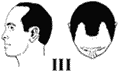
Norwood 3Generally, balding can be assessed with a good examination by a knowledgeable doctor by the time you’re 35 years old. Most advanced balding patterns appear in a man’s early 20s, and stability of the patterns are evident by the mid-thirties.

Even Norwood class 3 patients will show their pattern by the late 20s (see here). With the advent of bulk monitoring of hair mass, the ability to detect early balding has been greatly increased.

Dexpanthenol and Minoxidil? – Hair Loss Information – Balding Blog

I heard that if I apply dexpanthenol before using minoxidil makes it more absorbable on the scalp…therefore i can use minoxidil once daily instead of twice daily. Thanks

Block Quote

I realize there are many anecdotal claims and reasonable sounding methods, but I do not know of any shortcuts that really work. Some people believe that dexpanthenol will increase the absorption of minoxidil; however, I have no experience with the agent. Try at your own risk.