Hair Loss InformationNot Hair Loss News – An Effective, Permanent Treatment for Intractable Pain – Hair Loss Information – Balding Blog

Snippet from the article:

Although medicine has advanced far enough to treat basic headaches, strained muscles and the agony of having a cavity filled, inflammatory pain—the kind that results from osteoarthritis, bone cancer and back injuries—has proved to be a far more elusive target. Current remedies, including morphine and other opiates, flood all the nerves of the body, causing dangerous side effects. More localized remedies, such as steroid injections, wear off over time. Recently researchers have begun working with a toxin found in a Moroccan cactuslike plant that may be able to deliver permanent, local pain relief with a single injection.

The compound, called resiniferatoxin (RTX), works by destroying the neurons specifically responsible for inflammatory pain. These neurons extend from the body’s periphery (including the skin and internal organs) to the spinal cord, carrying pain signals along their axons. The signals eventually travel up to the brain.

Block Quote

Read the rest at Scientific American — Prickly Painkiller

This toxin specifically kills only those neurons that produce a specific protein that transmits the “sensation of noxious heat and inflammation“, while leaving other nerves alone. We have known for many years that a single nerve carries many sensations, pain being one of them. We use this in our local anesthetics, where we can block pain, but not sensation.

Considering that pain accounts for many of the visits to doctor’s offices, such a treatment sounds miraculous; however, pain can be our friend as well. Using acute pain prevents us from doing things that could harm us, like running on a leg that has a crack or a fracture present.

The article concludes with a quote from David Maine, director of the Center for Interventional Pain Medicine at Mercy Medical Center in Baltimore: “When you can streamline where a drug acts and avoid consequences outside of that, you potentially have a winner.

Hair Loss InformationAfter Gastric Bypass a Decade Ago, I Essentially Became Bald – Hair Loss Information – Balding Blog

(female)
I noticed in 2002 slow traction alopecia I was able to have use a few tracts to cover up. After having gastric bypass in 2003 my hair started falling our to near baldness. My sister also had gastric bypass and same results. I want to be able to wear my hair in ponytail and other styles. I have a very small frame — 5ft, size 6 shoe, 110lbs. If I have to be bald I do not want to look like I am wearing a wig. What can be done?

Block Quote

Acute weight loss is a known cause of balding in both men and women. Men bald in patterns and rarely bald in the donor area, while women get a diffuse balding that does not occur in patterns. You need to send me some photos of you so I understand what you mean by balding.

If what you’re seeing is advanced thinning, it can be treated with SMP as shown here. If you’re indeed seeing “near baldness” all over the entire scalp, I’m not sure what I could suggest over the internet without a physical exam and knowing more about your medical history.

Hair Loss InformationWhat Could This Growing Bald Spot in My Facial Hair Be? – Hair Loss Information – Balding Blog

About 3 months ago I found one little spot on my chin which was bald. I asked my dermatologist about it and he told me that hair will grow there by 2 to 3 months. But the spot is now increasing its area and it looks very odd. Also I don’t have any sign of fungal/bacterial growth in that area. Can you give me some idea of what it could be? Disease? Allergy?

Block Quote

Without seeing you, it would be a complete guess. Alopecia areata is a possibility if there is no fungal infection present, such as ring worm. If your dermatologist was dismissive, you can try seeing another dermatologist.

I Had a Hair Transplant with Trichophytic Closure Technique – What Does My Scar Show? – Hair Loss Information – Balding Blog

Dr. Rasmann

I want to thank you for all the information you provide on here to help educate everybody looking into a H.T.

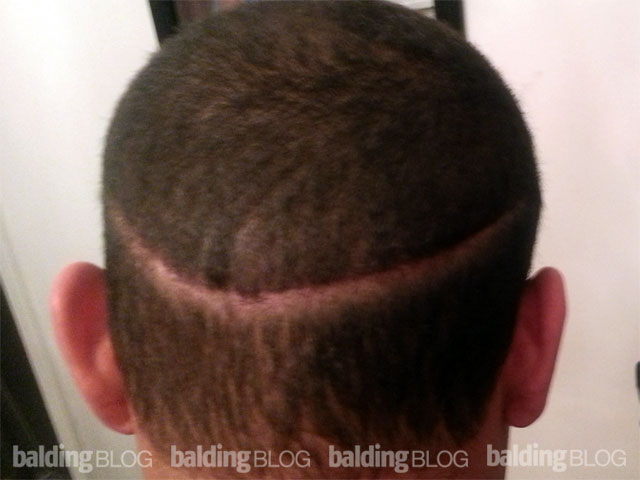
I recently had a procedure using the trychophytic closure technique. I am 10 days out and the staples have just been removed. Is what I am seeing in the donor the hair that will permanently not grow? or is this just a result of the donor area being shaved and the hair still having to grow in. thanks in advance

Block Quote

Click the photo to enlarge:


Having a trichophytic closure technique used is not a guarantee you will have a nice, thin and neat scar. The photo isn’t clear and I can not tell what is shaved from what might be an early stretch of the scar. You will have to wait it out.

If you have a visible scar after 5-6 months, it can be successfully covered with Scalp MicroPigmentation (SMP). This is a great option and we have a photo gallery of examples here.

Hair Loss InformationWasn’t Finasteride Developed Based on Research in the Dominican Republic? – Hair Loss Information – Balding Blog

Wasn’t finasteride created based on the research DR. julianne imperato-mcginley did in the dominican republic where she followed pseudohermaphrodites that had the alpha 5 reductase type 2 deficiency. I have not read anything regarding an aboriginal tribe in the Amazon. the research that I have read on the internet is that merck created finasteride based on DR. julianne imperato-mcginley research. it doesn’t say anything regarding aboriginal tribes in the Amazon

Block Quote

From this article in the LA Times: “In the early 1970s, Dr. Julianne Imperato-McGinley, an endocrinologist at Cornell Medical College, traveled to a remote mountain village in the Dominican Republic to study a group of children with a unique condition.” DHT was identified as a cause of the problem of ambiguous genitalia. Of course, this led to the development of DHT blockers.

You’re right, though. I guess I misremembered that one. I’ve posted in the past that it was tribe in the Amazon instead of mountain village in the Dominican Republic (that post has since been updated).

Hair Loss InformationCan I Prevent Hair Loss Following Giving Birth? – Hair Loss Information – Balding Blog

I am 25 years old, had a baby in 6 months ago, and since lost about 30 pounds. My scalp is also itchy. I know with pregnancy and weight loss you can lose hair. I am just wondering if it is reversible or what I can do to stop my hair from falling out before it is too late.

Block Quote

You must wait it out, at least a year. Hair loss often returns by then, especially if you are not breast feeding. There really isn’t any way I know of to prevent it, as there are many hormonal changes occurring that cause this telogen effluvium.

Hair Loss InformationMy Scalp is Red and Itchy, So Does That Mean I’ll Start to Lose Hair? – Hair Loss Information – Balding Blog

Dear DR.

I’ve been following your blog for a while now and finally worked up the courage to email in. I approached my doctor a short while ago about hair thinning and a red and itchy scalp but was brushed off with some anti-dandruff shampoo and told it was “just the weather”. I have a history of psoriasis and eczema, plus some dandruff but don’t recall my scalp ever being so itchy.

Following the itchiness, I began using the shampoo recommended but still no real benefit, to make matters better I decided to go for a buzz cut and get a number two over. It has since grown out a little, but I noticed afterwards some red patches on my scalp particularly around the crown and itchiness, the hair also looks like it’s begun to thin but I’m unsure if this is just the crown and way the hair grows or the start of balding. I was wondering if the itch could mean the onset of thinning? I’ve also fairly light hair and skin so was unsure if that makes a difference to the appearance plus the fact this is the shortest my hairs been in a long time as it used to be quite long and is still thick.

Any help regarding the possible thinning and or itch would be most appreciated.

Yours faithfully

Block Quote

The itch you’ve experienced could be related to the hair loss you’re seeing, but it’s not a common thing to have an itchy scalp because of genetic hair loss. I haven’t been able to pinpoint a link, but some people have told me they’ve experienced itchiness during thinning.

You should try seeing another doctor, perhaps someone that specializes in skin disorders (like a dermatologist), if you felt that the doctor you saw was too passive. You could have an allergy, a fungal infection, or something else entirely. It could even be scalp psoriasis or eczema, which you do have a history of.

Scratching the itchy scalp would produce the redness, and if you are aggressive you could end up causing traction alopecia, where the hair falls out due to the constant scratching.

Hair Loss InformationWould Anything Help to Fix a Thin Patch from a Chemical Burn Years Ago? – Hair Loss Information – Balding Blog

hello. i got a minor chemical burn a few years ago which left a thinning patch close to the back of my head. im in the military and every once in a while i get my head shaved but the thinning patch doesnt grow as much as my other hair. is there any solution to fix this like rogaine foam or something?

Block Quote

If the chemical burn was a few years ago and the hair is still thin, chances are it’s not going to regrow on its own. If the loss was temporary, I would’ve expected it to regrow within a year or so.

Rogaine might provide some hair growth, but it has to be used for life. Scalp MicroPigmentation (SMP) is a non-surgical process that will address the thinning area very nicely. We have performed this process on many patients with a very high satisfaction rate.

Hair Loss InformationGrowing Bangs After a Hair Transplant? – Hair Loss Information – Balding Blog

Is it possible to style your hair with bangs after undergoing a hair transplant? In most “after” photos, the men dont have any bangs. Is this just because they want to show off the new hairline or does the new hair tend to not want to lay flat?

Block Quote

Hair normally grows forward, so bangs are not a problem. When I perform a hair transplant, I point the hair in the forward direction at an angle almost horizontal in the first 1/8th inch and then slowly lift the angle. This is the way all the hair grows in normal men and you can see it when you clip the hair short.

Hair Loss InformationWhy Are BPH Patients Prescribed 5mg Finasteride if 1mg Suppresses the Same Amount of DHT? – Hair Loss Information – Balding Blog

I’m considering upping my dose of finasteride. When I began taking it 18 years ago I took the full 5mg daily. About 6 years ago I started taking 1mg Propecia, and I feel it has not maintained my hair as well.

Now, I’ve read the argument, and seen the graph explaining that finasteride suppresses DHT at a rate that platoes at about ~70% DHT for 1mg to 5mg. So the suppression rate of DHT is no better for 5mg of finasteride than for 1 mg. My question is this, if the amount of DHT suppressed by 1mg – 5mg finasterde is virtually the same, why BPH patients proscribed 5mg instead of 1 mg? If purpose of the medication is to reduce the amount of DHT wouldn’t 1 mg be as effective in the treatment of BPH, if dosages of 1mg – 5mg produce the same effect on DHT concentration?

For this reason I’m skeptical of doctors who say that increasing my dose of finasteride won’t produce better results (as I believe I’ve had before). Can you tell me where my reasoning is wrong?

Thanks a lot.

Block Quote

When drug doses are assessed, they are tested against large, statistically valid populations who have symptoms. The effectiveness of a drug is determined by balancing the safety of the drug.

In the case of finasteride, huge populations of balding men were given graded doses from as small as 0.25mg to as large as 5mg, and the researchers looked for what dose produced the best response with the least side effects.

For balding, although the drug worked well in ranges of 1-5mg, the 1mg dose produced essentially the same results as the 5mg dose with the least side effect. The same approach was done for those with benign prostatic hyperplasia (BPH) and the conclusions were that the 5mg dose was the most effective dose for that disease.