
Hair Loss InformationCan I Have Several Smaller Scars Along Langer’s Lines Instead of 1 Large Linear Scar? – Hair Loss Information – Balding Blog

Dr.Rassman/Dr.Pak,
Is it possible for an FUT patient:-

– to have several small (5cms) donor-strip scars rather than the normal one large scar, and would such scars heal better if they followed Langer’s lines?
– to have donor-strip scars incorporated into existing scars (in permanent zone)?
– to have, using your experience and artistry, donor-strip scars with the appearance of naturally-occurring scars: the normal scars that most people receive from the everyday knocks and bumps of an active childhood/adulthood (falling out of trees, falling off bikes, sport injuries, fisticuffs, etc.).

I appreciate that all surgery inevitably leaves scarring and even with the standard of your work some compromise is necessary. But, perhaps like many men, I’m uncomfortable with the thought of having scars that are so obviously due to hair transplant surgery – even though such scars can be covered by wearing longer hair and/or camouflaged by SMP. However, if the scars could be disguised as accident-related scars much of the anxiety of having FUT surgery would be removed and, within reason, any amount of scars would be acceptable.

Thank you.

Block Quote

Multiple small scars were offered in the past, all placed horizontally in Langer’s lines (the lines in the skin where collagen fibers are naturally oriented). Some were significantly less detectable; however, they may not be very efficient if a lot of hair is needed (as in the Norwood class 6 or 7 patients) and multiple small scars often have some hair loss associated with them.

I frankly do not know of any doctors offering this approach. If for any reason, you are a person that widens scars, this approach would leave your head full of scars.

I had three strip surgeries all in the same place for my balding crown, but only one scar remains that is so small, few can see it. In my situation, having only one scar was the right decision and I did not need Scalp MicroPigmentation (SMP), as I did not need to hide what was already hidden.
Testosterone Shots and Transplanted Hair – Hair Loss Information – Balding Blog

This email came from a transplant patient of mine from years back…

About eight or nine months ago, I had a low testosterone test result and began taking testosterone shots to respond to this. My urologist assured me that the shots would not cause hair loss, but I’d appreciate knowing from you your thoughts on the subject if possible. To my viewpoint, my hair seems to be thinner, but I am not objective (or rationale) on the subject.

Block Quote

If you have been taking testosterone for 9 months and have not seen an impact causing hair loss, then you should be safe with regard to this potential problem. I would assume that those hairs which are genetically impacted by the balding process are all gone by now and all you are left with is hair that will not fall out with testosterone. Your transplanted hair falls into this category.

If you were a young men and still had active balding, then you would have seen hair loss by this time from the testosterone.

Transplanting Patients with Vitiligo? – Hair Loss Information – Balding Blog

As far as I know vitiligo patients are at increased risk of developing alopecia areata, alopecia totalis and alopecia universalis. Obviously if a vitiligo patient who has male pattern baldness goes on to develop alopecia totalis or universalis then they would lose all scalp hair and any scarring from a hair transplant would be visible.

I appreciate that any hair transplant candidate could go on to develop alopecia totalis or universalis but in most cases the risk seems to be too small to be a serious factor. I am however wondering whether the increased risk associated with vitiligo patients is something that should be considered particularly where young men with male pattern baldness are concerned. It would be good to have your expert opinion on this matter.

Block Quote

The appearance of a secondary skin problem (alopecia areata) in patients with vitiligo, although possibly linked and possibly at increased risk, has not been a problem in my experience. The decision to transplant should not be a concern in patients with vitiligo (as we at New Hair Institute have had successful hair transplants on patients with vitiligo) .

In the News – Grandma Tattoos Entire Scalp Instead of Dealing with Wigs to Cover Her Alopecia – Hair Loss Information – Balding Blog

Snippet from the article:

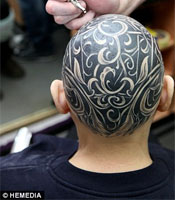
GrandmaA grandmother left completely bald by alopecia has ditched her wig in favour of something a little more permanent – a tattoo covering her entire head.

Ann McDonald, 60, suffers from alopecia and also has a thyroid problem which resulted in all of her hair falling out three years ago.

The grandmother-of-three was inspired to get the overlapping floral design which cost a £720 after becoming fed up with having to wear wigs and hats.

Block Quote

Read the rest — Grandmother-of-three faces up to her hair loss in an unusual way

Wow! That is some dedication. Click the link above to see more photos.

I’ve Taken Finasteride for a Year, So Is it Too Late to Map for Miniaturization? – Hair Loss Information – Balding Blog

Hello Doc,

Within the next days, I’ll map my own scalp for miniaturization for the first time. However, I have been taking finasteride for one year. (It kept most of my hairline but didnt regrow anything.) So without having done the test before, how accurate can the results be after such a long time?

Besides, currently only my left corner is receding (between NW 1 and 2) and the whole side is more see-through than other, where my hairline has already receded 3 years ago and then stopped at a Norwood 2. Is it common to see one side go up because of maturation, while 2 years later the other catches up by MPB? Or do hair characteristics (such as curliness or color) vary in diff areas, create the see through appearance, and will these hairs thus look differently under a microscope? Thanks again

Block Quote

A miniaturization study is an attempt to objectively quantify the degree of thinning and place a metric to different areas on the scalp so that you can compare one spot to another, as well as compare the measurements over a period of time. It is better than just looking in the mirror or running your fingers over your hair to judge the degree of thinning.

Ideally, one should get a baseline miniaturization measurement and even a photograph before starting on any hair loss treatment. If you have been on finasteride for about a year, I would at least get one objective measurement to record for comparison at another date.

If you are categorizing yourself as a Norwood 1 or 2 and the degree of thinning is on the front corner hairlines, I would point out that finasteride is taken mainly for men with thinning on the top / crown areas. Any hairline asymmetry will likely even out eventually. I generally like to get bulk measurements in people like you to establish a baseline from which future comparisons can be made.

I seem to repeat this theme over and over, but you need to follow up with the doctor who is prescribing you the medication and understand your treatment goal and Master Plan.

Acne in the Recipient Area After a Hair Transplant – Hair Loss Information – Balding Blog

Would getting acne in the recipient area in the days and weeks post-op have any effect on the grafts? If so, for how long after? Thanks.

Block Quote

Sometimes hair transplant patients may experience folliculitis weeks to months after surgery, which looks like acne. It is generally advised to follow up with the surgeon and use warm towel compresses to address the area. Some doctors prescribe a short term oral antibiotic for it as well.

The cysts that form reflect the sebum production of the transplanted hair that can not exit the skin, because there is no pore present. It generally does not affect the grafts.

I Clipped Some Hairs for a Homemade Miniaturization Test – Hair Loss Information – Balding Blog

Would alternating between different shampoos help stop hair loss?

Also, I recently did a homemade minaturization test. I clipped some hairs from my donor zone, and they were thicker than the hairs I clipped from just above my crown. Is that a sign of MPB?

Block Quote

Clipping your hair in different areas will tell you just how much miniaturization you have. The donor area should have the thickest hair, but if you do not have male pattern baldness, the same hair thickness should be every other place (front, top and crown).

As hairs miniaturize, the thickness in some of the hair shafts is finer. This creates a see-through appearance if there is enough miniaturization present.

Is Itchy Scalp a Symptom of MPB? – Hair Loss Information – Balding Blog

I have an itching scalp in the area where I experience hair thinning. Could this be a symptom of MPB, or could it be a symptom of something that is unrelated to MPB but causes hair thinning?

I also have dandruff, if that matters. Although I use Head and Shoulders, there are still flakes when I itch my head.

Block Quote

Some people have reported an itchy scalp when they are balding. I often wonder if what these people are complaining about a scalp that gets more sun, more air movement, and gets exposed to more drying.

Perhaps in your case it’s just the dandruff causing the itch and the location of the loss is coincidental.

Do Thin Eyebrows Mean a Thyroid Condition? – Hair Loss Information – Balding Blog

Hi doctor, I see that you mention that a thyroid condition may cause balding. I’ve read that one of the symptoms of a thyroid conditions is thin eyebrows. If I’ve always had thin eyebrows since I was a kid (especially on the outer edge), does that mean I have a thyroid condition – or that I just had naturally thin eyebrows?

Block Quote

Thin eyebrows just means you have thin eyebrows, especially since you report having this as a child. It doesn’t necessarily mean you have a thyroid issue. If you think you have a thyroid condition, then you should see your primary care doctor. It is a simple blood test.

If you want thicker eyebrows, you can always consider an eyebrow transplant, which takes hair from the back of the scalp. We’ve successfully transplanted eyebrows for many patients with great results, but the patient has to remember to trim their new eyebrows regularly since the hairs will continue to grow like it would on the scalp.

There’s some examples of eyebrow transplants here, here, and here.

Massive Hair Loss After Eustachian Tube Inflammation – Hair Loss Information – Balding Blog

Dear Dr,

Im 31 years old, went ill with an eustachian tube inflammation and had 1 month off work, with severe pain and insomnia. A couple of weeks later, I had a massive shedding with incredibly rapid and notorious miniaturization of all my hair. I even clogged the drain, losing approx 40% of all my hair. The remaining hair changed its architecture, looked curly (my whole life have had straight hair). I assume this is hair degeneration. I started dutasteride 0.5mg/day immediately.

Is it possible for DUPA to behave like a massive TE? It looks like DUPA were stress triggered, and acted on onsets rather than progressive. Thank you.

Block Quote

This does sound like telogen effluvium, since the shedding started after your stress from the inflammation, pain, and subsequent insomnia. I would hope that if you started dutasteride, you’re already under the care of a doctor that prescribed it to you… but if not, you need to see your doctor for an examination.