Hair Transplant from Non-Permanent Zones? – Balding Blog

Hi,

I’m in planning stages of surgery to fix some Norwood Class 3 corner recession, probably not more than 2000 grafts. Taking the grafts from the permanent zone has the disadvantage of setting me up for more surgery in the future, if finasteride doesn’t keep my hair, so I’m considering having the grafts taken from the midscalp instead. I will then have little to no need for additional surgeries, even if I keep thinning on top, as the transplanted hair will thin out along with
the rest of the hairs.

I understand that some might have a problem with a scar on the anterior mid scalp, but I already have a long scar there. It’s from an accident.

You need to discuss these issues with your surgeon and have a good basic concept of the Master Plan and future consequences. Mid-scalp harvesting can cause more scarring and an unnatural outcome. I do not know exactly what you are planning, but it does not sound realistic.

If the surgery is planned out well, you should not need more surgery because you continued to bald. You may look thinner over time, but it should still look natural, not prompting the need for another surgery. Wanting another surgery is a different story. Every surgery should stand on its own… at least, this has been my philosophy.




Related Posts Plugin for WordPress, Blogger...

Balding Forum - Hair Loss Discussion

In the News – Identical Twins, but Only One Has Alopecia Universalis – Balding Blog

Snippet from the article:

As girls, they insisted on matching outfits, right down to the ribbons in their blonde pigtails. And as teenagers, identical twins Gwennan and Elin Thomas were inseparable, even going to the same university.

‘We were, and are, best friends,’ says Gwennan. ‘I had a freckle on my forehead as a baby – which disappeared – and that was how our parents told us apart. Looking at some childhood photos, we still argue about who is who.’ Yet, in 2002, a shocking, inexplicable event would mark the sisters apart.

That year, Gwennan, then 25, was diagnosed with alopecia, a condition that causes hair loss. She suffers from the most extreme form, alopecia universalis, and has lost all body hair, including her eyebrows and eyelashes. Ten years on, she can still remember the morning she woke to find clumps of hair on her pillow. ‘I burst into tears,’ she recalls. ‘My hair had been thinning for a while but then it started falling out in clumps pretty much overnight.’

Read the rest — One sister has alopecia and the other has a full head of hair

Identical twins… yet one has alopecia universalis and the other doesn’t. One of the leaders in alopecia research is Dr. Angela Christiano, and the rest of the article talks about how this case is causing her to rethink how this might occur in just one twin. Dr. Christiano said, “There may be something, for example reaction to stress, that causes the gene to express itself in one twin but not in the other.


Related Posts Plugin for WordPress, Blogger...

Balding Forum - Hair Loss Discussion

Hair Loss InformationI Take Excessive Retinoids and Have Hair Loss – Hair Loss Information – Balding Blog

I’ve been taking excessive retinoids for quite some time now. I started coincidentally thinning (just a little bit to the point of being 100% unnoticeable) around the end of last summer. I stopped taking the acne medications towards the end of the first semester of college (which was right around October/November). Then I went back on the retinoids in February, but developed a full, thick head of hair. I eventually upped my dosage and went on a more intense medication.

Side note: I also went vegan right before college. Second semester I ended the veganism. I was also taking a medication called doryx, which had reported side effects of hair loss, on and off. My slight hair thinning continued throughout the rest of the semester. I went to a dermatologist who didn’t really look at my hair, but prescribed propecia and rogaine. It completely ruined my hair and made it 70% thinner, more brittle, and with bald spots within 2 months. I took propecia and rogaine together for a total of 29 days.

My hair is still falling out rapidly. I also was taking acne medication throughout that period, but stopped in the middle of my propecia dose. I am no longer a vegan and no longer take retinoids or doryx, but my hair is still falling out severely. My dad started having thin hair in his 40s-same with my grandpa. I am only 19 years old. What exactly is going on?

Block Quote

Oral retinoids have been linked to hair loss if you take excessive doses (source), but there’s really no way for me to pinpoint what the exact cause of your loss is considering the medication you took, the change in diet, and your age. I don’t know your complete family history, and just because your dad lost hair in his 40s, it doesn’t necessarily mean that you would too.

You may have the genes for balding and the diet change or medication caused the loss to begin sooner. Or your genetics alone could be responsible for the hair loss starting at 19. Or you don’t have genetic male pattern balding, but the medication or supplements are causing it.

There’s just too many variables that make it impossible to come to any definitive cause.

Does Fine Hair Recede Faster Than Thicker Textured Hair? – Hair Loss Information – Balding Blog

Hi! I’m just curious to know….
Let’s say that hypothetically, 2 men have the same balding pattern BUT one has fine hair and the other has thicker hair texture. Would they recede at the same rate because of genetics? Or will the fine hair textured man recede faster?

Block Quote

It is not about hair texture. It is about genetic predisposition. Having fine hair would make the balding look worse (because it does not provide coverage as well as thicker textured hair), but the hair character isn’t going to determine the rate of your hair loss.

Hair Loss InformationGraft Anchoring After a Hair Transplant – Hair Loss Information – Balding Blog

Hi,

I am confused by some of your answers in the forum relating to graft anchorage.

Specifically, in your study with Dr. Bernstein, you conclude that from the 6th day, it is not possible to dislodge a graft by pulling the hair. Similarly, this is not possible by the 9th day by pulling a scab attached to the scalp/hair.

However, on some of your answers to questions related to graft integrity, you mention that as long as the scab is present, there is risk to the graft coming out (e.g. you advocate not wearing a hat until scabs come out, etc.).

So, are you saying that from the 9th day onward, the graft will not come out even if the scabs are scrubbed off, wearing a hat, etc. and the only time to worry about losing grafts due to scabs is in the first 9 days? Or is it possible to still dislodge a graft after the 9th day?

The reason I ask, is that I have a lot of scabs and started trying to remove them on the 11th day, and am wondering if the grafts would have set permanently by then, scab or no scab.

Thank

Block Quote

The graft pull study (PDF file) was done to determine when the removal of the graft, really meant that the entire growth center of the graft was removed.

We found that in the first six days, although the physical graft could be pulled out, the graft growth center probably remained (reflected the sleeve of the graft itself). We generally felt better when the graft pull was done at 9 days, but that did not mean that the graft growth center could be removed at the 9th day.

We are big on post-operative correct washing to minimize the scabs present. Some doctors do not give the patient the instructions on proper washing and scabbing may remain for very long periods (as long as 3 weeks). Although pulling out the grafts (at say 20 days) would still have what appears to be graft material in the pulled samples, there is little doubt that the graft growth center did not come out with these pulled grafts at 14 or 20 days.

Hair Loss InformationShould I Have a Transplant Now or Wait Until My Balding Is Worse? – Hair Loss Information – Balding Blog

Hi Doctor,

I am considering a hair transplant and I just wanted to ask you a question. I’m 30 and a Norwood 3. I am thinning in and around that part of the hairline but maybe alittle on top. It’s thinner than my crown and sides let just say that. My back and crown is thick and untouched by the mpb gene. I’ve got very thick hair where it is not thinning and more than able donor supply. 2.0 cm hair count.

I’m just thinking in general should I do one now to get my hairline and thicken the front. Then 1-2 for the top over the next 10 years then done. Or wait 2-3 years and get a larger one done then another 2 years after? Just thinking in regards to scar and the lifetime master plan? Thanks

Block Quote

Only YOU can answer this question. A hair transplant is an elective cosmetic surgery to enhance your appearance. It is not a necessity. If you want to look better now with a fuller, hairier look, then it is your choice. If you want to wait until you have more hair loss before going ahead, that is also your choice.

Planning out how you may bald in the future and coming out with a life long strategy is also known as a Master Plan (something that I strongly advocate in my practice). The Master Plan is something you and your doctor need to discuss one-on-one.

Hair Loss InformationMy Wife and I Both Started Losing Hair At the Same Time – Hair Loss Information – Balding Blog

Both myself (49) and my wife (47) had very very thick hair. Our parents in the late 70’s still has most of their hair. And no baldness in both of our family. But we noticed in the last year both of our hair is getting very thin and showing sign of pattern balding.

The perplexing question is why is it happening to both of us at the same time?

Block Quote

I am not sure what you meant by pattern balding and the overall information you supplied is scant. To do a proper investigation of the coincidence, would would want to look carefully at what this hair loss pattern is, what are the possible environmental factors involved and give both of you a very thorough hair and scalp examination, as well as take a very careful, detailed medical history.

Hair Loss InformationNot Hair Loss News – Walnuts Appear to Improve Semen Quality – Hair Loss Information – Balding Blog

Snippet from the article:

Healthy young men with a Western-style diet may be able to boost their sperm quality by eating a small packet of walnuts a day.

These are the findings of a new study that shows healthy American men in their 20s and 30s who ate a 75g (2.5 ozs) packet of walnuts a day were able to increase the vitality, motility and structure of their sperm compared to counterparts who did not eat walnuts.

A report on the study appeared online on 15 August in the Biology of Reproduction journal’s papers-in-press section.

Infertility and subfertility is a common problem that affects about 70 million couples worldwide. Between a third and a half of cases are due to poor semen quality in the male partner, with scientists giving a number of reasons for this in industrialized societies: pollution, unhealthy lifestyles and the Western-style diet cited amongst them.

Block Quote

Read the rest — Walnuts May Improve Sperm Quality

The study included 117 men (between 21 to 35 years old) and was partially funded by the California Walnut Commission.

Results After 3365 Grafts Transplanted About 15 Years Ago (with Photos) – Hair Loss Information – Balding Blog

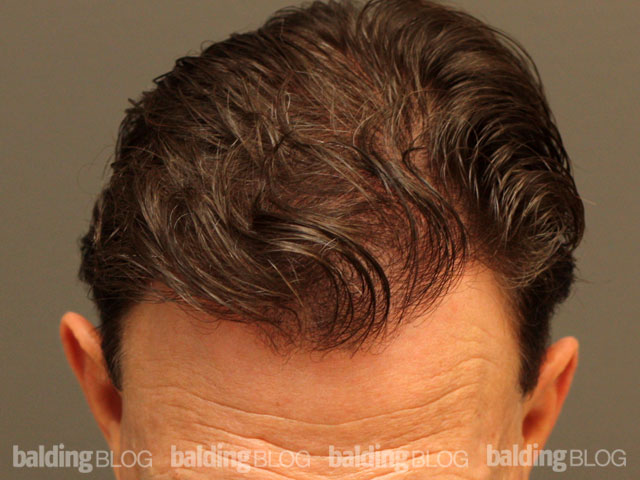
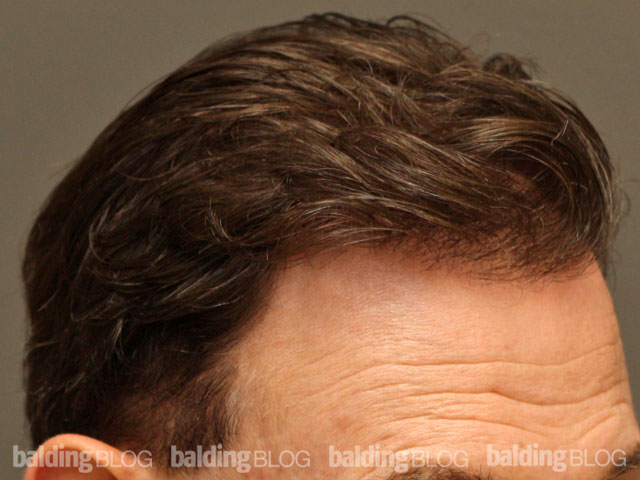
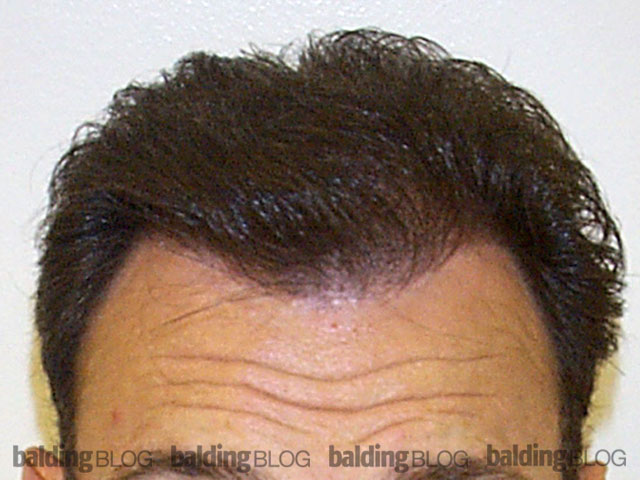
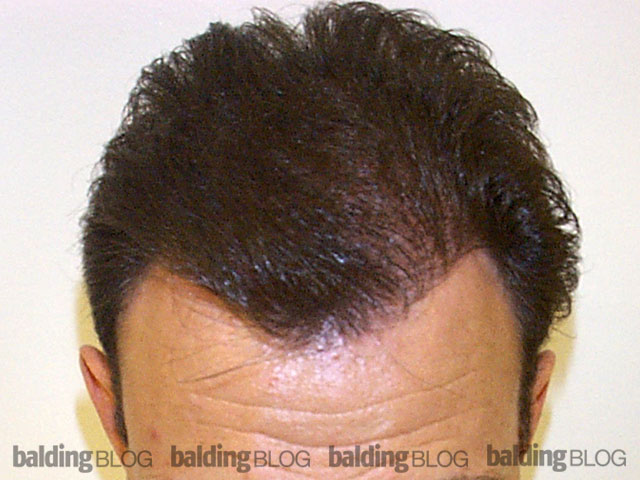
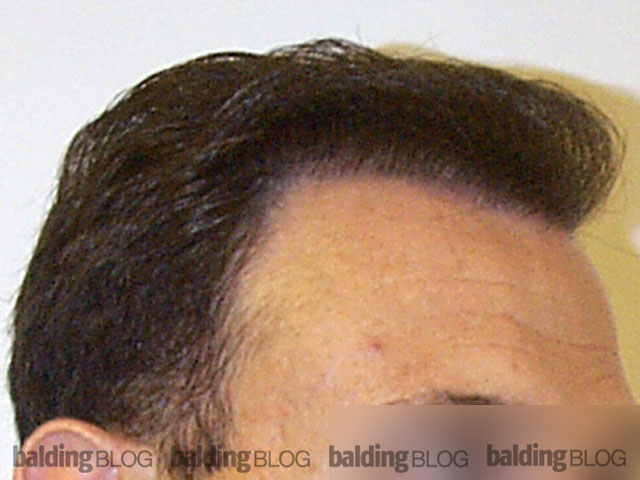
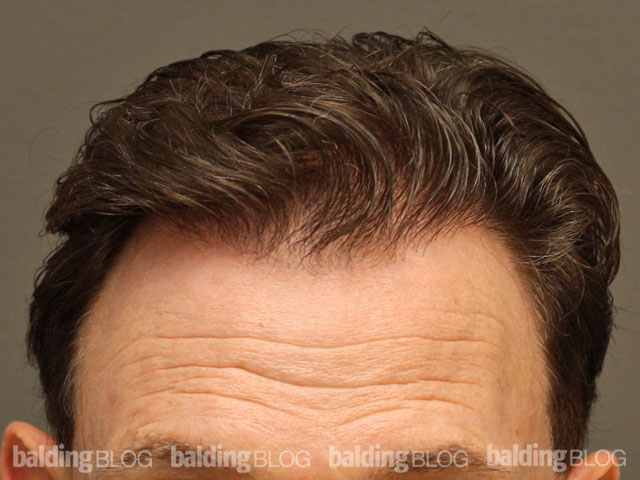
This patient came back to see me some years after he had his last transplant with NHI. He had 3365 grafts transplanted over two procedures in 1995 and 1998 (grafts placed throughout the frontal hairline and top of the scalp).

This patient visited the office recently to ask about some thickening in the area behind the transplants where he believed he is thinning. He has been on Propecia since the transplants were done, and although most of the hair has been held, the genetics has been persistent at taking some of his hair away.

Click the photos to enlarge.

2012 (after):


1998 (before *):


* Note that the “before” photos above were actually from just before his 2nd procedure in 1998. The photos from before his 1st surgery in 1995 are not available (they weren’t digital), and although the quality of these 1998 photos isn’t the best, I really just wanted to show how the transplant looks after a lot of time has passed.