
Hair Loss InformationTransplanting Very Bald Patients – Hair Loss Information – Balding Blog

how much “coverage and density” can a norwood 6 patient actually achieve? All your photos of men with 6 or 7 norwood, all have “comb over” type hair styles? How come u never show any pics of the back of the finished product(or crown)?

Block Quote

A person with a Norwood Class 6 pattern will have lost 50-60% of his natural hair. A person with a Class 7 pattern will have lost between 70-80% of his natural hair. If you move half of the permanent zone of an average man, the most you can yield would be about 15,000-20,000 hairs (or 7,500/10,000 grafts in a series of about 3-4 surgeries). That would mean the coverage mathematics, of let’s say 60% of the total area of originally hairy scalp, can only receive maximally 20,000 hairs in an area that originally had 60,000. This is at best 1/3rd of the original density. In actuality, one rarely ge’s out that much and more likely 12,000-15,000 hairs is maximal. In the person with a Class 7 pattern and 80% hair loss by count, the maximum overall density in the recipient area is 80/12 or 15% of the total original density. We usually weight it to the front so that there is a comb-back effect, moving more density to the place where the greatest impact will occur. We could weight it to the front and sides, with a good comb-over produced (front to back or side to side). Either approach works. The crown is often sacrificed with the lowest densities placed there favoring the front or the sides, as the case may be. So you are correct, the densities in the less favored areas are ‘covered’ with some type of comb-over.

I posted these photos a few months ago here, but it is worth displaying them again to show that the results of weighting the frontal hairline can be very good, even though the crown is not as dense. Patient ZU is in his mid 60’s and had multiple procedures totalling 6,036 follicular unit grafts transplanted. “Before” is on the left, “after” is on the right. Click the photos to enlarge.
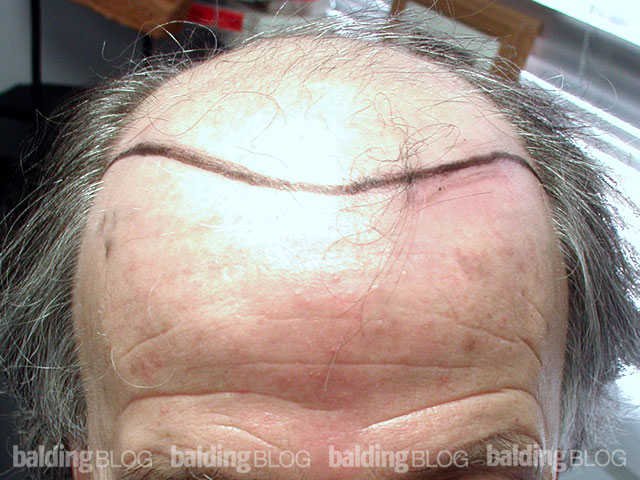
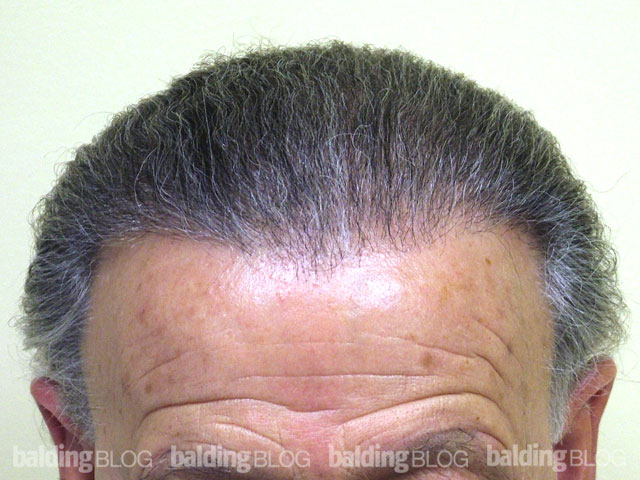

You can see more of his before and after photos on the NHI site: Patient ZU

Hair Loss InformationFUE After Strip Surgery – Hair Loss Information – Balding Blog

I had a few strip surgeries, decent results but still a bit thin for my liking. I have realistic expectations and don’t think I need that many more grafts to achieve satisfaction (about 500 3-hair grafts perhaps?), but I’m done with strip (my doc said I shouldn’t have any more and I wouldn’t want to anyway). My donor hair on sides and back is decent, not real thin or see-through. Given my thumbnail profile does it sound like FUE can get me to the promised land of being satisfied? Have you seen cases of other guys who could only get down to the 10 yard line with strip and FUE got them into the end zone? I know you’d have to examine me for a full and accurate assessment, but I would appreciate your best answer based on the info I have provided.

Block Quote

When the scalp is too tight, the only option to extract hair is by using the FUE technique. I have done some patients with FUE as the last option with good results, but it is very difficult to evaluate you without at least some photos (personal consultation is always best). Since you’ve indicated that you are in New York, I highly recommend that you contact my colleague Dr. Robert Bernstein in Manhattan at 1-866-576-2400.

Hair Loss InformationHair Transplant Density – Hair Loss Information – Balding Blog

what is the most you pack per cm2 when you do a transplant????? please let me know .. thanks

Block Quote

Density of the average person is about 200 hairs per square mm. A doctor can transplant as high as 10-50% of the original density. It is important to focus more in the issues of fullness. This is not a ‘weight lifting contest’, which is unfortunately what some doctors are pushing for. I could transplant as much as 50% of the original density, but the real issues are:

  1. Will it grow? There are many factors that will determine this: the health of the skin, the amount of atrophic changes in the skin caused by sun damage and the advanced level of balding, scarring that is present, etc. We generally expect that growth will approach 100% of what is transplanted, but that is only true when everything is right-on — and that rarely happens.
  2. What is needed? This is the most important question that must be asked. People with low hair to skin color contrast, good texture, good hair thickness, etc. do not generally require the greatest densities to achieve the look of fullness.

Hair transplantation is as much an art as it is a surgical process. The judgments of a good surgeon with years of experience will make the correct decisions that are in the best interests of the patient.

Hair Loss InformationFUE Harvesting Limit? – Hair Loss Information – Balding Blog

What is the approximate limit for FUE harvesting, e.g. at what point does taking out individual grafts one at a time start to noticeably thin the hair in the back?

Block Quote

The answer here varies with the many attributes of hair that include:

  1. density
  2. hair thickness
  3. hair character / texture
  4. hair color and contrast to skin

You can use possibly 90% of the donor hair if your characteristics from the above are good. If they aren’t, the actual number may be well below 50% of the donor hair before you start to look noticeably thin. We have had a few patients who have had as many as 25,000 hairs taken from the donor area without any detectability. These were fairly bald men or those who were perfectionist. I recently saw one of these men and even though the original donor density was reduced by significantly more than 50%, the donor area looked good, even under close inspection.

Hair Loss InformationLowest Donor Density? – Hair Loss Information – Balding Blog

What is the lowest donor density a person can have in their late twenties, in order to have a successful transplant?

Block Quote

There is no simple answer to this question on donor density. First, I would want to make sure that the person should not have Diffuse Unpatterned Alopecia, which would reflect a depletee donor area in a young man (1-2% of the male population). Then, the size of the balding area (the area of the demand) and the eventual pattern of balding that would have to be maintained must be balanced in a well defined master plan with a worse case scenario put together. A good doctor can make a judgment on the value of the donor density.

Hair Loss InformationMaximum Number of Transplanted Hairs – Hair Loss Information – Balding Blog

HI DOC, what is the average number grafts a person has to transplant from the donor area???

Block Quote

This is a difficult question, because it depends upon donor denity and donor laxity (assuming the strip method of harvesting). On average, I would suspect that the total number of transplantable hairs is between 15,000 – 20,000 assuming an average density and average laxity. Those with high density and laxity may push these numbers to double (30,000-45,000 hairs). I gave this answer in hairs not grafts, so based upon an average of two hairs per follicular unit, that number may be half in grafts.

If the FUE technique is perfected, then this number might change, but without more clinical experience, I could not answer this part of the question as the technique changes.

Hair Loss InformationDensity and Scalp Laxity – Hair Loss Information – Balding Blog

In an earlier entry, you were asked to talk about the ability to expand the lower donor scalp. Could you tell me more about why this is important.

Block Quote

The ability to move hair from the permanent zone around the side and back of the head to areas where it may be needed are dependent upon two factors, which are:

  • the density of the hair in the donor area. The normal density measures 1250 hairs per square inch. The more the density, the more is the movable hair
  • the number of square inches of scalp that can be moved depends upon the looseness of the scalp (something we call Scalp Laxity). The more square inches we can safely move, the more hair we can transplant

The ability to move more square inches of scalp with a strip excision also depends on the ability of the surgical team to place them safely into the area of need. Of course, it is important that the need for hair reflects the size of the bald area. For small bald areas, either less hair is needed or more density is needed. The ability for an experienced and skillful surgical team to place the highest density into the recipient area safely is core to the results that one can expect after a hair transplant. This varies between doctors offices and that is why the wide offerings are promoted on the internet. Some physician teams promote 5000 grafts in a single session in a fairly bald person, while other state that a lesser number is the only safe number. The safe number varies with the skills of the surgical team and nothing else.

Hair Loss InformationHuman Hair Density – Hair Loss Information – Balding Blog

i am a student at State University of New York College at Geneseo. i am doing a reseach and it requires me to find out the density of human hair, in terms of kg/m^3.

i know that human hair density might have a range. if you have that stat., please also give me.

thank you very much for your concern.

Block Quote

In the Caucasian, human hair density averages 2.2-2.3 hairs/mm square. In Asians, the density averages approximately 1.6 hairs/mm square and in Africans, is averages apprxomately 1.3 hairs/mm square. In the head of an average male with a hair bearing area of approximately 80 square inch area, the density is approximately 1250 hairs per square inch (rounded) bringing the total count to 100,000.

You must keep in mind that this is center point in a Bell Curve, and standard deviations overlap heavily between the races. The highest densities I have measured were in Caucasians at 4 hairs per mm square and the lowest numbers are not trustworthy because they may reflect diseases or some form of genetic balding.

Hair Loss InformationDensity and Supply of Donor Hair – Hair Loss Information – Balding Blog

How many hairs (grafts) does a person have to transplant?

Block Quote

I assume that you are talking about the donor hair supply. The supply is calculated by using the most bald person you can find. Assuming normal density of his hair, a person with the Norwood Class 7 hair loss pattern (the worst case) will lose 70% of the total hair he was born with. This will leave him with a 3 inch by 14 inch wreath of hair around the back and sides of his head. Assuming 100,000 original hairs averaging 2 hairs per follicular unit, that would mean that such a person could theoretically move half of the permanent wreath of hair (15,000 hairs or 7,500 grafts). There are other factors involved such as the looseness of the scalp and healing factors. We have a number of patients with Class 6 and 7 hair loss patterns than have moved between 15,000-20,000 hairs. The ones with the very high numbers generally had higher densities of the hairs on the head. One patient comes to mind had a birth hair population of about 150,000 hairs. He had 50% more to work with and he took advantage of that supply with wonderful results.

Generally, that is a lot of hair to move and unless you are very, very bald and have a very ‘perfectionist’ view of your need for fullnesss, most people get away with moving less hair.

Hair Loss InformationBalding Crown – Hair Loss Information – Balding Blog

I have followed your work for years, and believe me when the time comes, you are the one I will be going to. How come the crown continues to be so challenging? Most photos seem to show sparse coverage. I have taken proscar for several years, and my crown has filled in nicely. The front filled in a bit with rogaine but not at the density I would like. I am intrigued by the FOX and Mega sessions, but is the donor area so large that you gain hair in one area and lose it in the other? What happens in the large donor area?

Block Quote

Everyone is different. I try to imagine and plan for the worst case hair loss. Depending upon age and family history, I can often make a reasonable intellectual guess on what the worst case hair loss pattern will be. With Propecia, the worst case is usually ‘less’ worse. The crown is usually slower to bald for many people so Propecia works better because it is usually started before the crown goes bald enough to notice.

The size of the donor area is determined by the density of your donor hair, your scalp laxity and the size of the non-balding area. You are correct, that once you move most of the available donor hair, then there may not be enough hair available for future hair loss. If you have good scalp laxity and your density is high, then there could be enough hair to cover the entire head, even for the baldest of men. A good surgeon will make sure that the donor area is the appropriate size and take into consideration future balding and how the donor scar can be hidden by existing hair (if it should scar). I would have to see you to determine where you are in the balding process and where you might lose more hair. As you are in Los Angeles, a free visit to my office will help. We also hold monthly open houses, so you might want to come and see patients for yourself, watch a surgery and let us examine you all at the same time. In fact, our next open house even will be held next Thursday, July 7, at our LA office. Please see the NHI Events page for more details.