 Yesterday, I received some sad news when I learned about the passing of one of our hair transplant patients just 5 months after his procedure. He had complained to his local doctor about chest pain and was told that it just was indigestion. This patient complained a number of times about the chest pain to his physician and each time he was tagged with the diagnosis of reflux. He recently had a heart attack and died.
Although the outcome was different, this reminded me of a similar case that I wanted to share. A female hair transplant patient had complained of periodic chest pain when I took her medical history. It sounded like cardiac pain (angina), so I had her see her doctor. He took an electrocardiogram (ECG — also known as an EKG) and told her that the pain was reflux (stomach type pain), not heart pain. She came back to me for a hair transplant, but I did not like her doctor’s diagnosis since it sounded like classic angina (pain coming on with exertion, climbing stairs, and fast paced walking), so I sent her back to her doctor. Again, he reassured her that the pain was not cardiac in nature, as her ECG was normal. I then got into her medical care and called her doctor, suggesting that he perform a stress ECG. He told me that it was unnecessary and again insisted that the pain was not cardiac. This lady wanted a hair transplant and was unable to persuade her doctor to get further testing, so because her doctor had cleared her and she wanted to proceed, I transplanted her.
During the surgery, she began experiencing chest pain, which I then treated with nitroglycerin, fortunately relieving her discomfort. This happened twice during the procedure. After surgery, I called her doctor and told him of the events at surgery. He saw her again after the transplant procedure and told her that she did not have cardiac pain and was upset with me for interfering with his medical care of her. I suggested to her that she see another doctor for a second opinion, but she liked her doctor and wanted to stay with his opinion. Three weeks after the surgery, she had a heart attack, and fortunately for her, she survived.
Being right is not a consolation from my point of view. We know from the anesthesia literature, that for people with heart disease and outpatient surgery, the risk of a heart attack in the 30 days after the surgery is higher than in the average person without surgery. Undergoing any surgery is no small matter and although I have never experienced any cardiac problems with my patients that I could not manage in surgery, risk clearance for anyone over the age of 45 years old, a good and thorough physical examination should be a medically necessity. We must all be on guard for detecting heart disease early and there are many good ways to do this today. The sad reality, however, is that in nearly 50% of cases, the first sign of heart disease is death.
 I received this email from a patient of mine and I have reposted it below with his permission (removing any identifying information, of course). This was not solicited, and it serves as an example of those men out there that are looking into hair systems (otherwise known as wigs or toupees). The price chart at the end of this post could be a wake-up call to many that think hair systems are cheaper than
 Last week we attended a lecture at
  My first cousin just had a diagnosis of prostate cancer. With my help, we explored his options. He is 67 years young and his father lived to 96, and many on both sides of his family lived into their 90s and 100s. This is important, because the decision on which treatment to take for the cancer depends upon your life expectancy. Many men over 70 are pointed to non-surgical treatments, because their life expectancy is in the 10 year range so the value of surgery over radiation (radioactive seeds) or “watchful waiting” is not clearly defined compared to the risks of surgery. You don’t want your surgeon to use actuarial tables alone in deciding whether surgery is right for you.

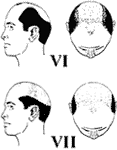 Alternatively, some men create bouffants, a puffed up hairdo which is made up by very long hair that is wrapped around the top of the head to look like a normal head of hair. Some of these bouffants are truly amazing and they have often fooled me when they came into the office. Most of these man are either Class 6 or 7 patients and they work the frontal hair, hair by hair, to stick to the upper part of the forehead and combing the hair from behind to a forward direction so that the actual hairline does not show. I remember one man who took it one step further — he cut his hair and let it settle on his bald scalp. I am not sure how it started, but when I saw him, he had a pile of loose hairs, held by the dirt and grime of Los Angeles, to the bald area of his scalp. It worked, at least for the top and crown of his head, but not for the front of his head. This poor man never washed his hair, because the hair would all go down the drain. He used a type of perfume to neutralize any odor from his hair, which actually smelled musty.


 Thanks for asking this great, insightful question.