
I had a hair transplant 2 months ago and have now developed pimples where they put the grafts. The doctor prescribed an antibiotic, but never explained the cause of the problem.

If you look at the anatomy of the hair follicle, you will see that this is a complex structure that contains skin, a hair shaft with a bulb, dermal papillae, outer root sheath, dermal fat, arteries and veins, nerves, muscles that hook up to the hair that makes it erect when you are cold or stimulated… and with regard to your question, the sebaceous gland.
 |
| Above: Schematic drawing of a two hair graft with all elements of the anatomy labeled (on left). The photo on the right shows an actual mirror image of this schematic drawing. Note the similarity between the diagram and the photograph. |
After a hair transplant, everything you see here disappears, and when the new hairs finally grow, these structures are rebuilt by the body to complete the newly growing hair organ. The sebaceous gland may not die and often survives after the hair transplant. When that happens, it is still a functioning gland — and what do glands do? They put out sebum. If the gland survives the initial transplant, it will still be functioning, pumping out the sebum that normally came out through the pore in the skin that the hair exited from.
With the pore gone (because there is not hair to maintain it open), the glands secreting sebum has no where to go. It will be attacked by the body as a foreign body, and in this attack, it may be walled off from the surrounding fat, forming a cyst. Most often these cysts contain sterile sebum, but this is very irritating stuff and the scalp often does not like it. If the walling off is successful, you may never know it ever happened and the body will remove the sebum as it would remove any foreign body, but sometimes it can not wall it off successfully and instead propels it out of the body, breaking through the skin on occasion (forming what we often refer to as a zit or pimple).
With proper warm soaks, the body is encouraged to get a cyst near the surface of the skin to expel it and then when it breaks through, it often appears yellow and thick (occasionally tinged with blood). If you saw me in the office, I would probably drain it with a needle under sterile conditions and if there were many of them, I might put you on an antibiotic. When we culture the ones that look “mean” to my medical eye, the culture is often done, but rarely do they show any bacteria when the culture reports are returned to us from the laboratory.
There are other causes of this condition to include: People who pick on the hair graft area and cause folliculitis (common), remnants of the hair shaft from the transplant (common), autoimmune reaction short term (probably common), autoimmune reaction long term (rare), etc…
If they persist, you should see the doctor who did your hair transplant and let that doctor determine what is causing it, and this is especially important if the problem continues.
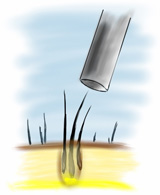 There is a question arising out of the hair transplant community which is becoming polarized and lining up for a fight: Which is better, FUT (Follicular Unit Transplant with Strip) or FUE (Follicular Unit Extraction)? Some doctors have already specialized in performing FUE alone, so their opinion is already made up. Some doctors new to the business entered the FUE market having never done an FUT strip procedure. That means that the nuances of quality control have not been learned (tricks to prevent graft damage from manipulation and drying).
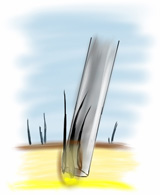 The long term results with FUE (particularly on donor area damage in extensive FUE grafting) is not yet in. When
 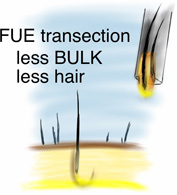 I predict that the history of FUE will parallel the history of the FUT strip procedure, which we pioneered in the early 1990s. As the FUT strip surgery caught on and as more and more doctors offered the procedure, performing the surgery on patient after patient, they too found that the initial results produced a high failure and complication rate. It took years to learn (1) how to get growth, (2) how to increase the number of grafts extracted and implanted safely in one session, and (3) how to avoid the terrible scar and donor wound complications (the worst being gangrene of the donor area). These three “HOW TOs” are the same issues with FUE that we are now confronted with. Only time will tell us what results we will get and only doctors who do both procedures will be in the best position to judge this comparison today.
 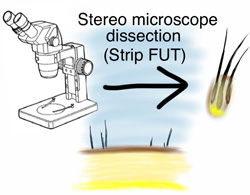 Dr. Bernstein, like the editors of this blog and other good doctors, focus on quality care, safety, integrity, and discussing a balanced view of the FUE vs FUT discussion with the patient. When presented to the patient considering this decision, we call this “informed consent” and it not only reflects basic courtesy and respect shown to the patient, it is a requirement of the laws of most states and countries.

