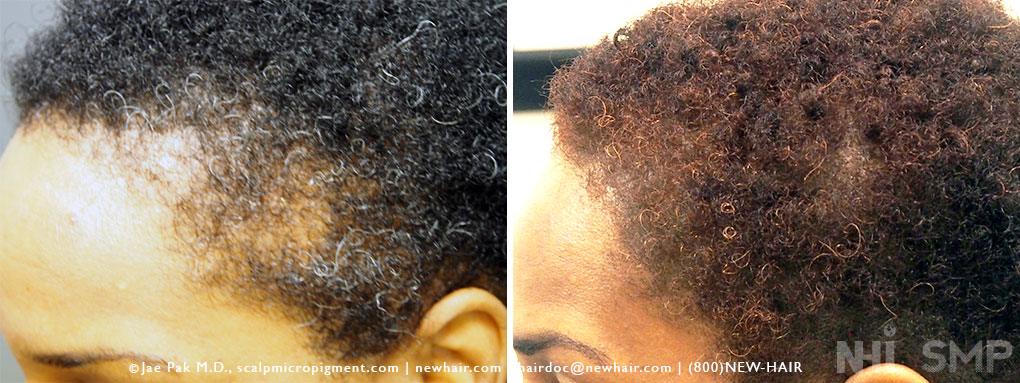
This is a review of a SMP procedure performed at New Hair Institute Medical Group. This is a female patient who had traction alopecia from wearing her hair pulled back too tight. She also had a component of triangle alopecia. SMP diminished the contrast between skin and hair. Note: patient also colored her hair on the after photo.
Dutasteride Injections for Hair Regrowth (Photo)
Scalp Reduction Slot Deformity
I had scalp reductions many years ago, about 7 such surgeries. I have this long narrow straight defect in my head that looks crazy from the back. Many people think that I had brain surgery and ask me about my brain operation. Can this be fixed?
Thousands of men have had the bald spots of the scalp removed in a procedure called a scalp reduction. There was a naïve view by many doctors that bald areas could simply be excised surgically. When this was attempted, the surgeon might be able to remove about 1 inch per procedure and therefore some patients would have many procedures done to tackle extensive balding of the ‘Top and Crown’ that might be as much as 7 inches wide. What the patient found out, however, was that after 7 surgical procedures, they might have only reduced the bald area by 3 inches or so. The match did not add up.
That meant that the bald areas came back by stretching (“stretch-back” was the term used), and the patient was subjected to a never ending battle to remove all of the bald spot. Rarely was this ever successful for any large bald spot, but what was successful was the appearance of a slot in the back of the excision area which joined the two sides of hair that normally was on the side of the head, growing towards the ears. It was like a aprt in the middle of the head with a bald slot in the center of this slot that often measured 1/2 inch wide or so. This abnormal hair direction moved to the top of the head accentuating the slot deformity that appeared.
There have been many attempts to get this fixed, but only one surgery really works well. It is a triple flap procedure where scalp is moved around on the two sides of the slot. The hair direction is changed. The scalp reductions themselves are well exemplified in this article by Dr. Patrick Frechet, where the slot deformity as well as Dr. Frechet’s newer methods to remove the bald areas are shown.
You might want to go to France and consider having him do the surgery, as he is one of the few doctors world-wide that can achieve consistent results from this surgery with minimal risk of scalp necrosis (a common problem in inexperienced hands).
For more information, please see:
Early Diagnosis of Alzheimer’s Disease
The following report came from the Alzheimer’s Association International Conference (AAIC) 2014 by Medscape Medical News: “A Simple Eye Tests to Detect Alzheimer’s Disease in the Works”
COPENHAGEN, Denmark — Two novel, noninvasive, and relatively simple eye tests show promise as potential screening tools for early Alzheimer’s disease (AD).
“Preliminary results from 2 studies presented here at the Alzheimer’s Association International Conference (AAIC) 2014 show that beta-amyloid detected in the eyes significantly correlated with the burden of beta-amyloid in the brain, allowing investigators to accurately identify individuals with AD
In the first study, researchers at the Commonwealth Scientific and Industrial Research Organization (CSIRO), Australia’s national science agency, used curcumin fluorescence imaging to highlight beta-amyloid in the retina and correlated these results using Pittsburgh compound B (PiB) positron emission tomography (PET) imaging findings in the brain.
“Every single person who tested positive with high levels of plaque in the brain tested positive to the retinal test as well, so we had 100% sensitivity and no false negatives, which is a crucial component on a screen for Alzheimer’s disease because we don’t want to leave anyone behind when it comes to the early signs,” lead investigator Sean Frost said at a press briefing here.
This is a very important medical breakthrough as Alzheimer’s disease (AD) will impact tens of millions of Americans in the future, possibly your own family. There are strong suggestions that changes in lifestyle (diet, regular daily exercises, no smoking) can reduce the timing of these changes and possibly reduce the incidence of this disease in the tens of millions of people who are highly likely to get it.

What can I do about this terrible scar from a strip hair transplant?
The best treatment for scalp scars is Scalp MicroPigmentation. I have extensively published on this technique and on the website you can see many examples of patients who had this done for scars of all types. Below is a typical example of a patient who had a scalp scar treated with Scalp Micropigmentation and you can see more examples of this here: https://scalpmicropigmentation.com/scar-covering/
Elated with Finasteride After 3 Months in 20 Year Old (from Reddit)
Men under the age of 25 have a better chance of getting these type of results. The younger you are, the better the chances.
Scotland Doctor Recommendation?
i am a 26 year old female from scotland, and i would like to know if you could recommend a clinic in the UK who do the hairline lowering procedure. Please say there is one!
I don’t have any personal Scotland-based recommendations, but I would check the International Society for Hair Restoration Surgeons (ISHRS) site at ISHRS.org. Use the physician search section to look up doctors in the UK. You can then call and get a direct referral from someone within the United Kingdom.
Eqyss MegaTek
Hi Doc:
I am so sorry to bother you again. Can you please tell me if you ever heard of Eqyss Megatek? It is a conditioner & Shampoo for horses that folks claim grows hair stronger & faster. As I have mentioned before, I recently thinned rapidly and I need some help. I am hoping you have heard of this and can comment.
Interestingly, this is the second question I have received on horse hair products (see also: Mane-Tail-Groom Hair Products). I have no practical experience with horse hair products in humans, but from the inquiries I have made, some Europeans who had association with horses know about these products and swear by them. I would add horse hair grooming to what I offer my patients, but they may think that I am a horse’s ass for doing so.
I See Cyclic Changes in My Hair and Do Not Understand Them
Doctor can this happen on propecia. Ive been on it for 2 and half years with good results, maintained and thickened a bit, but my hair is weird. the first year on propecia it looked like it was getting worse, then into the second it started getting better over all. then again half way through the secong it looked bad again, and then a few months later it thickened again. I take pics, and that’s how I can tell. also there is a single hair that I excluded from the other hairs to follow and look at to see how it progresses, and to give me an overall picture on how the other hairs might be responding and growing. the last month or so that specific hair thinned and looked like it was gone, and then a few days a go I see It growing and thickening again. I know this is a weird email lol, but from you experiences does hair go through diff stages?
To be exact I started propecia in june 2013. from june 2013 to june 2014, it looked like I lost ground a bit, so I still stuck it with propecia. then around January 2013 my hair started looking good, and was thicker and the pics I took started to show a difference from the baseline. around april of 2013 my hair looked thin again and looked like I was reverting back to baseline. around august till about now my hair has looked its best. I started noticing new hairs sprout from the hairline that were not there before, and the looked so much thicker, and way different from baseline. its basically at its best. my question is why does it go through these stages? bad, good, bad, good, etc? is that normal?
Our hair will cycle and grow in different stages, so some hairs fall out while others grow from a stem cell that regenerates the hair follicle. You may be noticing some changes, but you cannot really say with scientific objective certainty what is really happening with just subjective observations or pictures. For example, dry frizzy hair in dry fall weather can make your hair seem voluminous, where oily damp hair in the humid summer days can make your hair seem flat and thin. Even different shampoos or hair products can affect how your hair may look and feel. For a more accurate analysis, we try to quantify it with measurements such as a miniaturization study and hair bulk measurements and compare the values on a yearly basis.
Finally, you need to understand that being on Propecia does not mean your hair loss will stop. Based on your genetic predisposition you will continue to lose your hair to the predestined hair loss pattern. Taking the medication (Propecia) means it will probably slow the process of hair loss down but each individual’s response to the drug is different. There may be some variations where you may notice less hair loss and more hair loss over the many months to years. We generally lose about 100 hairs a day (on the average), but this number is also highly variable with time for the individual. So I think what you are experiencing is likely normal.
Simply put, what you see may not reflect what is really happening. That is why we measure hair bulk with the HAIRCHECK instrument and also a microscope for a Miniaturization Study. The metric (numbers) what they instrument tells us, will allow us to compare a year ago to today and determine if you are really losing hair or not.
Even If Propecia Doesn’t Cause Permanent Side Effects, Isn’t Propecia to Blame?
Hello Dr. I have often seen you say that those who claim that Propecia has ruined their sex drives in a permanent way are really suffering from something that is all in their heads. Even if this happens to be true, does it really matter? Take a converse example with the placebo effect. I’ve heard some people suggest that if, for example, an anti-depressant makes someone feel better that it doesn’t really matter if it’s just the placebo effect or not. So why not have the same standard for Propecia? If it’s all in someone’s head after they quit the drug, did not the drug still cause it in some way? Thank you
I didn’t definitively say that those claiming side effect persistence were just suffering from something in their own heads, but it’s a possibility. In fact, I don’t think I’ve ever said the claims of persistent side effects from Propecia are completely false. I did say that the medical literature and my own experience hasn’t shown any permanent side effects among my patients. I’ve also said that those with sexual issues should see their doctor and have a proper, complete history and physical exam to make sure that there are no other causes that can be identified, such as testicular tumors. I do not diagnose medical problems on BaldingBlog. I do not medically treat or give medical advice to people here on BaldingBlog. I just give my opinion and write about hair loss issues.
I feel like I’m beating the same drum over and over here, but I do not force medications on people and have always left the decision to my patients, as they are not sheep that are herded into a direction. Most come to me prepared after doing their research via the Internet.
The placebo effect is well documented in the research studies and appears almost as high as the actual reports of sexual side effects. I suspect that many of the negative writings about Propecia contribute to the psychological effect that produces a placebo impact. There is a small group of disgruntled readers that want me to acknowledge a possibility of permanent side effect associated with taking Propecia (even one dose)… and while it’s not likely, perhaps in extremely rare cases it could happen. I just don’t know. The science isn’t there, but anything is possible. Correlation does not equal causation.
2011-04-08 14:57:332011-04-08 09:52:49Even If Propecia Doesn’t Cause Permanent Side Effects, Isn’t Propecia to Blame?