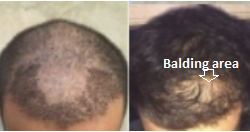
Most of the Transplanted hair was lost 10 years after the hair transplant (photo)
This is a condition called Lichen Planopilaris (LPP) which is a form of a scarring alopecia that destroys the hair follicle and then replaces it with scarring, resulting in permanent hair loss. The skin is shiny and mottled (this does not show well in the photo), and the hair ostea have some plaques around them. All this is typical of this disease. This man is 62 years old and had two hair transplants (1994 and 2006 totaling 2300 grafts in the frontal hairline). Three years ago, he had a nice frame to his face and a good hairline, but that hairline slowly disappeared. I am concerned than another hair transplant will likely fail. I recommended that he see his dermatologist and get an appropriate biopsy which will likely confirm the diagnosis. These biopsies require a skilled dermatopathologist in the microscopic evaluation of the biopsy.
If the patient has LPP, then any hair transplant would fail.
2019-11-22 03:20:372019-12-02 13:28:30Most of the Transplanted hair was lost 10 years after the hair transplant (photo)
Hair Loss from Cancer Drugs
Dr. I am currently in the Star study and taking either tamoxofin or reloxofin and a placebo. I am having ample hair loss every time I brush or wash my hair. One of the questions on the form that I am to answer every year (this is my second in the program) is regarding hair loss. Within the past few months I have also started taking Glucosamine and Condroitin. I think the hair loss has increased in this time. Is this a conincidence or which drug, if any is causing the hair loss and is there anything I can do about it other then stopping the meds?
Many drugs that attack potential cancer cells because of their high metabolism, will also impact other cells with a high metabolism such as hair (one of the highest metabolic organs in the body) and the lining of the intestine (these cells have a high turn-over) with symptoms of loose stools and general ‘stomach’ troubles. Also, some of the other sensitive cells to anti-cancer drugs are the blood cells in our body, some of which live only a short time, even under normal circumstances. That is why many cancer patients have frequent blood tests and are monitored for side effects so closely. Hair loss is not one of the points that have become the focus of anti-cancer drug treatment by doctors, yet hair loss is often the most worrysome side effect from the patient’s perspective.
Unfortunately, there have been no effective medications that have been shown to protect against hair loss. That is the bad news. The good news, however, is that the hair in women that falls out from the impact of these anti-cancer drugs, always comes back within a year or so in most women, that is, unless they have genetic hair loss. Those with female genetic hair loss and hair loss from anti-cancer drugs in combination, find that although the hair usually returns, it does not come back as strong hair. Show patience, and the hair will probably return to its pre-treatment quality, again as long there was not genetic hair loss prior to the commencement of treatment.
Transplanting Hair Between Fraternal Twins?
I’m worried that the combination of continued balding and my very fine hair will make it difficult to naturally and densely cover my scalp via transplant. In the case of having a fraternal twin, female family members, or maybe even friends with hair to spare, is it ever possible to retrieve grafts from a donor that is not the patient? Would grafts from a female donor be viable on a male MPB scalp? Thanks!
Unfortunately, transplanting hair from any person other than an identical twin will fail and get rejected. Hair is like any other organ transplant, which would require anti-rejection medication that could lead to further health complications. I’ve written about this process and the medication required before.
Hair Loss from Steroid Use
Your office is not that far from the famous Muscle Beach. Do you get many of the hardcore bodybuilders in for hair transplants? And taking all of those steroids…wouldn’t it be courter productive or should I say maybe a waste of time to get the hair transplant for those prone to baldness anyway or do they just take of more and different drugs of the estrogen blocking nature?
The reason I ask is that when I was in my younger days when I first really started loosing my hair( after two knee surgeries by the way???)I started weight lifting/bodybuilding to conpensate for my emotions concerning my hair loss, I had a rough time dealing with it. So I was tempted to take them (back when they were legal)but after reading about the hair loss side effects I changed my mind. Does the transplanted hair suffer from heavy steroid use or does it stay protected? Thank you
I believe that the permanent zone hair (the hair we transplant) is protected from steroids. The other hair that is not the rim hair around the sides and back of the head can be ‘killed off’ with steroids in those genetically prone to balding.
Yes, we see many, many weight lifters who have accelerated their hair loss and like you, panic when they see it falling out. The high they get from the steroids and the benefits in the sport, seem to offset the liability for most of them.
Transplanting the Crown
Greetings,
After seeing Steve Hartman of CBS/AM570 in person I am amazed at the process of his hair restoration. My situation is the typical male pattern baldness on the top and back of my head, not the front. How do you handle that?
Steve Hartman’s hair transplant procedure is what I like to refer to as the fast-track approach. With his situation, one surgery did the job he needed and if he stays on Propecia, hopefully he has seen the end of any more than this one surgery. For transplanting the crown, I have general reservations in the very young men (under 30) unless there is very good donor hair density and good laxity (looseness) of the scalp in the back of the head. Other elements of the supply/demand formulae must also be accounted for and those men with good quality hair and skin color tend to do better than those without either when the hair must be distribued to cover a wide balding crown. I am always worried that the crown will take all of the donor hair and when the front balds, then the patient may run out of donor hair. There are many times, however, that crown transplants are appropriate. In those men over 35 (for example) with a 3 Vertex balding pattern (frontal corners and crown only balding) or those with pure crown (vertex) balding in people like me. I had 1600 grafts into the crown and my frontal hairline is normal without any balding. I use Propecia to maintain any further hair loss and I have been stable for years since my transplants were done in the late 1990s.
Propecia is the mainstay for hair restoration in the top and crown (particularly for the younger men whose final pattern is not predictable), so you should first get assessed for miniaturization and then go on that drug if appropriate. Transplants rarely will be needed if you catch the top and crown loss early enough.
2006-01-10 13:46:432006-01-10 14:43:58Transplanting the Crown
Hair Loss in UK
Everything in the following article is not completely accurate, but worth reading if just to get another cultural variation to discussing hair loss. In reference to comments in this piece about Elton John’s hair transplants, I believe that he does wear a hair system (wig) and did not have a successful outcome for hair transplants as he received them in the early days when the technology was deforming. They call him a toupee wearer, but also say that his transplant was effective. I guess it could be weaved into his hair system to keep it on his head, thereby being effective in that way. Aesthetically though, it can’t be good.
- From Mirror.co.uk on May 4, 2006 – Keeping Your Hair On
2006-05-09 09:33:442006-05-09 09:14:02Hair Loss in UK
I Was Treated For Tuberculosis and Now I Have Sudden Hair Loss
I am a 22 year old man.i underwent treatment for tuberculosis for2 year but now iam ok.the problem is now i have sudden hair loss with circular type.
Hair loss for men in general is caused by genetic factors. In other instances illness or medical conditions which cause stress to the body or adverse effects from medication can also be responsible for hair loss.
Treatment for tuberculosis (TB) sometimes can mean you tested positive and were once exposed to tuberculosis and doctors gave you a long course of antibiotic. It does not always mean you have an active tuberculosis infection. Either way, you were treated and it should not impact the hair especially after two years. Even the medication you took for TB should not be a factor after two years.
The best advice is for you to see a doctor for an examination. Circular type of hair loss (patchy circles) can also mean you may have a condition known as alopecia areata (AA). AA is not related to TB.
Hair Loss on Top of Head, Hairline is Fine
I am 29, male. Recently I got my hair cut rather short, and it has kind of spiked up, somewhat resembling a porcupine, i guess you could say. I notice when looking at my head from above that my hair seems thinner, like there are some areas not as full as others. Is this a sign of hair loss? My hair line is not receding, and my hair is fine at the crown/point at back of head, where you usually see bald spots in people going bald. Do you have any idea what I am seeing in the mirror? Is there a pattern of baldness where you start to lose hair on the top or in the middle of your head? Thanks in advance for your comments.
Some people will develop thinning behind the hairline, leaving a normal hairline. We also see thinning in the crown with no problem in the frontal area as well. The first 3/4 inch from the highest crease or the wrinkled brow is the juvenile component of the frontal look. Behind this first 3/4 inch starts what I call the mature hairline.
The shorter you cut your hair, the more you will see of any thinning that is present. To find out what this means, map out your hair and scalp for miniaturization so that you can know if this is a genetic pattern for you. If it is genetic, Propecia works well in the crown.
Trichophytic Closure Questions
When the strip harvest method is used, a linear scar is produced, but what if the doctor uses a trichophytic closure, would the scar be “virtually undetectable”? Would I be able to buzz-cut my hair without the scar being noticeable?
And also, does the number of hairs that grow through the scar vary by the person? And for my last question, if I felt the back of my head for the scar, would I feel it even if I couldn’t see it? (Would there be a bump where the incision was made)?
Good judgments in determining the size of the donor area is the best determinant of the size of a donor scar. When the incision is too tight due to the piece of excised scalp being too large, then the enemy is tension. The use of special closure techniques minimize the scars and the tension, but a bad judgment at the time of surgery can not be offset with a repair process.
The readers interested in the subject of scars, may conclude that special techniques can make the scar disappear. Many surgeons would like you to think that their wonderful skills guarantee that the scars on their patients are either non-existent or non-detectable. I believe that the only surgeons who have never seen scars from strip harvesting are those surgeons who have never done the surgery. If any surgeons give you this line, then that surgeon is not honest, for scars (much of the time) have little to do with the surgeon and much to do with the patient’s healing capabilities, when proper techniques are used.
The use of trichophytic incisions do not offset bad judgments or poor surgery, but when used, they can close the gap in a 2-3 mm scar that usually accompanies a donor wound. The scar will still be present even if it is covered by hair, and yes, you may be able to feel it.

2006-08-11 15:33:222006-08-11 17:10:29Trichophytic Closure Questions


I am 29, male. Recently I got my hair cut rather short, and it has kind of spiked up, somewhat resembling a porcupine, i guess you could say. I notice when looking at my head from above that my hair seems thinner, like there are some areas not as full as others. Is this a sign of hair loss? My hair line is not receding, and my hair is fine at the crown/point at back of head, where you usually see bald spots in people going bald. Do you have any idea what I am seeing in the mirror? Is there a pattern of baldness where you start to lose hair on the top or in the middle of your head? Thanks in advance for your comments.