Micro-needling results after 14 months – photos (From Reddit)

Unfortunately, there is no reference to the use of other supportive therapies by this man. Many people who get such results, use minoxidil and I suspect that he may have done so.

Comment: This man wrote back and told me that he is using finasteride and minoxidil as well as the micro-needling. This is what I would have expected with the combination treatment.

Big 3 + Microneedling 14 Months Update from tressless


2019-03-08 09:56:24Micro-needling results after 14 months – photos (From Reddit)

Bald Spot After a Large Bump on Head

My son hit the side of his head a few months ago and got a rather large bump. I have noticed a bald spot right where he hit it and was wondering if this has anything to do with that?

Direct trauma can sometimes cause hair loss. If you are concerned I’d take him to see doctor, but otherwise I would give it 8 months or so to see if hair will grow back.


2008-01-28 14:33:47Bald Spot After a Large Bump on Head

Miniaturized Hair All Over, But Same Hairline As When I Was 16

I have miniaturized thinning all over my head (top, sides, back, sideburns and facial/chin hair does not seem as thick either) which began about 2-3 years ago. At the same time my thinning began it was accompanied by depression, fatigue. I have been thinning with every growth cycle and feeling depressed, fatigued ever since until this day. I have had my thryoid tsh checked 3 times (TSH- 1st-1.98 2nd- 2.28, 3rd- 2.36) I had testosterone checked 3 times as well (1st- 320, 2nd- 385, 3rd- 360…… ref 250-850) LH hormone levels were all on the very very low side when checked w/ all 3 testosterone testes. I had ferritin checked 105 (ref 22-322) I had knee surgery about 4 months ago (left knee bone graph w/ arthroscopy). Is there anything that is causing my total hair thinning/follicle shrinkage? Is it possible to have shrinking follicles/ thinning diameter hair that is not MPB related? I have absolutely no balding, no recession at all, my hairline is the same as when I was 16! whats the matter with me? should I use minox or propecia? I once tried saw palmetto when I first noticed my thinning about 2 years ago and it gave me ED! so I know I would probably have a tough time using prop or fin! thank you

Simply put, you need a caring doctor and a good doctor/patient relationship. That is the start of surrounding your problem. There is no easy way to get this over the internet.


2006-08-16 08:56:08Miniaturized Hair All Over, But Same Hairline As When I Was 16

Balding and Hair Characteristic Genes?

Hello doctor. I was wondering, are the genes for balding and hair ‘type’ independent? For example, if a bald person has straight hair as does their son, is their son at a higher risk of losing their hair since they have the same hair type. I guess this could be similar for curly hair too.

As far as I’m aware, hair characteristics and balding aren’t linked. For example, a son might have the same hair type as his father, but the son didn’t get the father’s balding pattern. There’s also nothing showing a link between hair color and baldness.

Minoxidil and aging

Hi doc, sorry for bothering you but would be thankful for a reply. Do you think there is any credence to the theory that minoxidil causes premature signs of aging in the face?

There is no evidence from various research studies to suggest that minoxidil impacts collagen anywhere in the body, including the face.

Does Balding Start At The Hair Whorl?

I have a question regarding to human hair whorl, if we talk about the hair loss on the top for men, does it normally begin to thin from the whorl area? Cheers

Genetic hair loss in men have a certain “pattern” as described by Dr. Norwood. That is why it is often called Male “Pattern” Balding. For those patterns that start on the top crown area, it starts around the whorl, but I do not think you can say it starts exactly at the whorl as it often appears as general thinning of the entire area around and including the whorl. It certainly looks like it may start at the whorl because that is where the hair changes direction and looses its ability to overlap hair on hair, so it looks the thinnest and it is a focal point that draws the eye to the center of the whorl (even for non-balding men).

Minoxidil Applicator Brush?

I just saw a commercial for the Minoxidil applicator brush. Do you(or your patients) have any experience with this product. Do you consider it an advancement in terms of effectiveness or ease of use?

Link: Ultra-Mox Applicator Brush

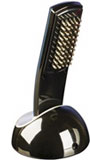
Minoxidil brushI haven’t seen this one before. So from what I gather, you load the brush with the minoxidil and then comb it through your hair to dispense the medication. It’s a clever idea, but I don’t really consider it any advancement in the drug arena or a game-changer in the effectiveness of minoxidil. If it’s worth $100 to you to not apply the minoxidil with your hand, I suppose this is an item you could use.
So while I don’t have any experience with this minoxidil brush product, I wish the makers well. It is a free economy. For the record, I also don’t own automatic tie rotating hangers or other extraneous late night TV gadgets. Any readers out there use this applicator brush? If so, we’d love to hear your thoughts on it.

Minoxidil Foam Without Glycerin — Wouldn’t It Just Dry Out The Scalp?

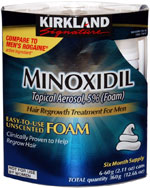
Kirkland FoamKirkland brand Minoxidil foam has no glycerin like Rogaine Foam, but seems to just have extra alcohol. Wouldn’t this just dry out the scalp and hair defeating the purpose of using the foam?

Glycerin is an alcohol. I really don’t know if there will be a difference in scalp dryness from Kirkland Foam or Rogaine Foam. The ingredients in each medication are similar enough, but the differences might cause someone to see dryness or other irritation. If you don’t like one, try the other.

Balding Blog – Dr. Bessam Farjo – Hair Loss Information

Dr Bessam FarjoDr Bessam Farjo graduated as a doctor of medicine in 1988 from the Royal College of Surgeons in Ireland. He spent 5 years working in the national health scheme (NHS) hospitals in Ireland and the UK training in the field of general surgery.

In 1992, he travelled to Toronto, Canada, and joined a training course in hair restoration surgery at the office of Dr Larry Fremont. He started practicing hair in Manchester later that year. In 1993, he co-founded the Farjo Medical Centre with his wife, Dr Nilofer Farjo, exclusively practicing hair restoration surgery and medicine in Manchester and London. They currently operate a busy practice to the tune of over 300 hair restoration surgical procedures a year.

In 1993, he joined the International Society of Hair Restoration Surgery (ISHRS) and has served on its Board of Governors since 2002. He was ISHRS President in 2007-2008, the first from Europe. He is one of a handful of doctors who have attended every annual meeting since the society’s inception.

In 1996, he co-founded the British Association of Hair Restoration Surgeons and served as President during 2002-2004. In 2001, he was granted fellowship of the International College of Surgeons and in 2003 fulfilled the requirements and passed the examination of the American Board of Hair Restoration Surgery (ABHRS). He has served as ABHRS Board Director since 2006.

In 2002, Dr Farjo was host, program chairman and congress organiser of the 5th Annual conference of the European Society of Hair Restoration Surgery in London, England. He served as Board Governor and Vice-President until 2005.

He is a registered member of the Institute of Trichologists (est. 1902) and has been a Board Governor and medical advisor since 2000. In 2006, he was bestowed with the title of Fellow of the Institute of Trichologists in recognition of contributions to the Institute as well as his involvement in the in research and field advancements. He is also the Editor the Institute’s Trichologist journal.

Other affiliations include member of the European Hair Research Society, Fellow of the European Academy of Cosmetic Surgery and Founder member of the Trichological Society.

He has to-date over 25 different hair and scalp presentations/publications to his credit at more than 40 different meetings, workshops and conferences around the world. Along with Dr Nilofer Farjo, he is the only British hair transplant surgeon recognised by his peers as regular educational contributor at international meetings and congresses. During the last few years alone he has lectured in the USA, Canada, England, France, Germany, Ireland, Italy, Spain, Austria, Switzerland, Egypt, Turkey, Mexico, Australia, Romania and Poland. In addition to his clinical work, he is involved in several hair research projects including collaborations with University of London, University of Bradford, Intercytex plc and Unilever plc.

See www.farjo.com for more details.