
This is a nice review of Topical Finasteride, which so many men ask me about. This is available through our offices.
2018-04-10 10:49:322018-06-21 09:21:21Topical Finasteride (Video from Reddit.com)
This is a nice review of Topical Finasteride, which so many men ask me about. This is available through our offices.
2018-04-10 10:49:322018-06-21 09:21:21Topical Finasteride (Video from Reddit.com)
Dear Dr. Rassman,
Im a 22 year old male from San Jose. I went to your NHI office when I was 22 and I was told to start taking Rogaine and propecia. It worked. However, in november of 2006 I had eye surgery under general and local anesthesia. Since then my hair has been falling out like mad. I was wondering what is the average time for this fall out to cease and will the hair I regrew on rogaine and propecia come back?
Hair loss is caused by four factors:
Your surgery and anesthesia cause enough of a stress to accelerate your hair loss. If you are on Propecia and it still happened, you are now entering another phase of the hair loss process. It may not come back, but you should come back to see me and we will analyze this together.
2007-02-12 12:32:502007-02-11 15:03:33Hair Loss After Anesthesia
I am 19 years old and I used to tie my hair up very tightly in high school and I wore hats which made me lose a lot of hair. My hair currently looks like (https://imgur.com/a/Rw7qVdf). I went to a dermatologist (looked at my head for 2 minutes), who prescribed me 2% ketoconazole and 100 mg minocycline, which helped for a while, but stopped working. I just ordered a months supply of: DHT shampoo, finasteride (1 mg), minoxidil, biotin gummies. I was wondering what your advice would be on taking each of those and what you think wouldn’t help me that much based on my circumstances. I believe I am/had suffering/suffered from traction alopecia. I completely stopped wearing hats and I shaved my head bald a few months ago. My hair grew back but it’s noticeably thin on the top and extremely thin in the crown area. Again, I appreciate you taking your time reading this.
Let me know if there’s any other information you need, or anything that would help you come to a conclusion on what I should use.
This doesn’t look like traction alopecia to me. It is very hard to get traction alopecia in the top and crown. In the frontal, it is a different story but your frontal hairline is good. I would suspect that this is early but quickly advancing male pattern balding and at 19, with this much balding, you should commence treatment immediately with finasteride, which is the only medication that might stop it.
2020-05-11 04:00:292020-05-11 08:51:50Traction Alopecia or Something Else? (Photos)
I have been taking LisinoprilHctz10/12.5 and ziac 2,5 together for high blood pressure i recently stopped the ziac and increased the lisinopril to 20/12.5 my hair started coming out ,my question does a beta blocker block dht to some fashion, because from what i have read it should make my hair fall out when taking it not when stopping it.I thought it was my imagination but it has happened 3 times now, or maybe its the shock of getting off the drug,, any ideas!!!
You are on some medications for controlling of your high blood pressure. I am gathering that you have stopped Ziac, one of these medications, a few times and every time experienced hair shedding afterwards. The medication Ziac combines two antihypertensive agents; a synthetic beta1 selective blocking agent (bisoprolol) and a diuretic (hydrochlorothiazide). There is no report of enhanced hair growth with any of these components. Although physical and emotional stress can enhance hair loss, I don’t believe that getting off medication qualifies as one. Think back and see if there was any other factor enhancing your hair loss, besides changing medication.
I had a hair transplant in November of 2004. The doctor was a member of IAHRS and had many good patient photos, and the procedure seemed to go very well from my standpoint. But I still have seen no significant results. I was a Norwood 3 with thinning in the frontal forelock. Now, my hair is significantly thinner on the sides, and while about 20 hairs grew in very quickly (about 2 months after the procedure they began to grow) no other hairs have grown in and my front is thinner than it was at the time of the procedure. I was wondering at what point can i be sure that no new hairs will grow in, and that the procedure did not work? Soon I will be 7 months post-op, and I still have no significant growth of the 1700 grafts I had.
Thanks for your time.
Generally I tell patients that by 8 months, fully 80+ % of the grafts should have reached styling length. That means that the growth should be well underway by now. On rare occasions, I see delayed growth, but that is not common. IF the procedure failed, speak with your doctor directly and ask him why he thinks this is happening. If he is a good person, then I would expect honesty and some reflection on his experience with this type of problem. He should be forthright and direct with you.
As a side note, many times when a patient tells me something is wrong, I make a point to focus on what the patient is saying, adding my observations to the mix. That is why a good doctor/patient relationship is important. Things can go wrong at the time of surgery that could cause this, but more often it is things that are not evident that need to be addressed. For a complete failure to occur, something bad happened at the time of surgery. But alas, doctors are not always in 100% of control of all variables. Pass me your doctor’s feedback and let me know.
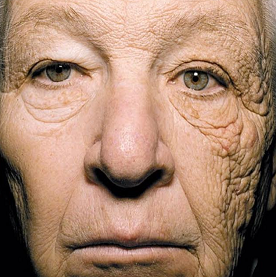
This happens when a person drives a car or truck for a living, the side on the window gets more sun exposure than the other side causing damage from to the skin and more hair loss. We can see this very well in the photo below, of a truck driver whose face aged more on the drivers side of his face. For people who drive in Australia, the opposite occurs because they drive on the other side of the road.
Dear Dr. Rassman,
This matter has become quite stressful to me. I went for a hair transplant a month ago, when I had a bit less than a 1000 grafts transplanted on my crown area. It was an FUE procedure. Most say that grafts should fall in 2-3 weeks following the procedure yet most of the grafts are still there on my head. They are not growing and they are not falling, period. The shaved donor area has grown but the recipient area still shows these tiny hairs with no significant change. I am becoming very worried about this matter. Is this normal ? I contacted the doctor and he said to give it more time, as hairs are supposed to fall. Any opinions/advice from your side would be very helpful.I am starting to feel that I wasted 1000 very good grafts (as the doc said the quality was great, I had many 3-4 hairs follicles). Many thanks and best regards.
I will say every surgery is different and the hairs will probably fall out eventually, especially when the new hairs grow in. It’s not “normal” to have them stay in your head. Even if it does (or doesn’t) fall out, the success of the surgery is still not related to the initial hairs falling out. You will only know how successful your surgery was in about 10 to 12 months.
You already spoke to the doctor who performed your surgery, so I’m not sure what kind of assurance I can provide. I don’t know you and I did not perform your surgery, so I have no way to know about your healing. It’s possible that there was a problem with the surgery, but it’s also possible that it will all turn out fine and you’ll be pleasantly surprised. I wish I was able to provide some real info, but I’m limited without knowing more about your surgery or even having an examination.
Think positively, be patient, and good luck.
Hello Doctor. I’m a 31 year old male with a receding hairline. I’ve been using Propecia for 2 years now and I believe it has stopped the recession. I would like to start exercising again to get back in shape, but I’m afraid the increased Testosterone levels from exercising will put me at risk for further balding. Now, I don’t want to lose any more hair, but I don’t want to remain out of shape either. Are my fears well founded or is hair loss and exercise not related. If my fears are well founded, what can I do to exercise yet not cause any further baldness. Also, since Propecia effectively cuts the levels of DHT in the body, will that inhibit any gains from exercising? Thank you.
Exercise will not cause you to lose hair, so I think you’re safe to start working out again (unless you have some injury or underlying condition that you haven’t mentioned). What I mean to say is — don’t let fears of hair loss stop you from keeping in shape. To my knowledge, there will be no impact on your muscle mass caused by Propecia (finasteride 1mg).
2008-01-09 10:34:502008-01-08 10:05:05Hair Loss from Exercise?
Would a body hair transplant work for just facial hair, like sideburns or even eyebrows
I would imagine that body hair transplantation (BHT) would work, but why not use scalp hair? I would match the hair and see what is best.
No question this time, but I wanted to share a quick story…
A 58 year old patient of ours was transplanted in the corners of his frontal hairline. He had used minoxidil for years with what he thought was no effect. After his corners were transplanted, he stopped the minoxidil and in time, lost hair behind the transplanted corner on his right side. In hindsight, this complication could have been avoided had he gone back on the minoxidil, but neither he nor I realized the dependence of the minoxidil over the previous years.
As a rule, men in his age range do not suffer from shock hair loss (very, very rare), but in this case, minoxidil was far more effective than we thought. He is now only 2 months post surgery and was immediately restarted on the minoxidil. I am hopeful that the drug will regrow the hair he lost behind the transplants on his right side, but only time will tell us. The lesson here is that when you are a long term user of minoxidil, you really do need to stay on the drug for life.