Could a Hair Transplant Cause Tinnitus?

Hi Doc,

I suffer from tinnitus due to tension in my neck. I am unable to figure out anything about it besides that when I am nervous or I am slouching for a long time, it comes.

My question is – Is there any swelling in the neck area or behind the ears or in the sinuses from a hair transplant? If so, would there be anyway to avoid it? Have you heard of a transplant causing tinnitus? I’d like to get a transplant but the thought of it worsening my tinnitus makes me nervous!

I’ve never heard of a hair transplant causing tinnitus. Tinnitus generally has to do with the inner ear problems or even certain brain pathology. I would follow up with a specialist.

With hair transplant surgery, you may have swelling of the neck and ear area. I would follow up and raise these concerns with your doctor before having any surgery.

Patient diary undergoing Scalp Micropigmentation (SMP) procedure written by patient

Background
I have had 4 hair transplants (three strips and one FUE) sum totaling north of 10k grafts over the last 10 years. I was also on Propecia. I was pretty happy with my hair post HT #3, however I always had the jitters in public. Due to a temporary health issue I had to stop Propecia because it significant diminished ability to recollect memories while on the medication and I decided to stay off completely. Fast forward to today and I again was not happy with my hair. I have always hated the balding look; I want either a shaved head with no hair, or hair. Due to the strip scar shaving my head was no longer an option. I have been wearing a hat 90% of the time when going out of the house for the past 3 years.

I had seen pictures of SMP and did some casual research a couple of years back. However, in January, I decided to go forward with SMP. I live in San Diego so I visited two clinics, a non-medical place and then Dr. Pak at New Hair in Los Angeles and both a few miles from each.

I visited the non-medical place and spoke with practitioner there, a very nice guy who actually sold me on the procedure (he had it done himself). He did remind me more of a tattoo artist than a medical professional. He instructed me that there would be two 4 hour sessions to achieve good results and also gave me a price.

I also saw Dr. Pak, who was also very pleasant, but wasn’t necessarily positively on SMP. He answered my questions, showed me some results, and told me that it would take 2 to 3 sessions to achieve good results. Unlike the first place, Dr. Pak’s sessions took 6-8 hours each.

I was really leaning toward the non-medical place because of the years they have been in the business. However, I decided to go with Dr. Pak (even though he was more expensive) because of two reasons: (1) it was a medical office (vs a nice tattoo parlor) and (2) I have the option of anesthesia.

I shaved my head a few days in advance and one of my daughters commented that I looked like I was wearing a bald cap (even with 10,000 grafts placed there over many years). Honestly, I was really shocked by the width of my scar.

SMP Session 1 (02/07/2014)
I arrived at the office at 7am (had to leave San Diego around 4:30am to get there). Christine took me in, had me sign some forms and a lunch order. Pulse and BP were done. Versed was an option, but only if I stayed in LA for the night. I had to get back to San Diego that evening as my daughters were coming home from school in the afternoon. So Dr. Pak gave me nitrous oxide (so I was unaware of the injections) and then the Lidocaine injections. I remember the injections from the hair transplants years before while waning off of Versed, they can be really painful.

Dr. Pak did the front hairline back to mid scalp himself; he has an amazing attention to detail. Christine (Dr. Pak’s SMP assistant) worked on me almost continuously for 8 hours that day (excluding a 30 minute lunch break). She was amazing, always making sure I was comfortable, anesthetic was still working, etc. She brought me my lunch order on a nicely appointed tray.

Dr. Pak and another assistant, worked on me on and off during the day. As Dr. Pak came in telling me he would do sections himself or instruct Christine to blend more here and there (this happened many times throughout the day). Things I thought looked awesome, he was clearly very demanding on hard to please.

They have an internet enabled TV to keep patients occupied (Netflix, YouTube, and so on), it really did make the time go by fast.

I read in the non-medical group’s hair forums, that getting SMP done without anesthesia was common place and easily tolerated. There were points and time where the Lidocaine would wear off a bit. Christine and Dr. Pak would ask if I wanted more anesthetic when they noticed that I was starting to feel the pain. At points I would say I was fine and to continue on, I started to feel that I could have probably have done it without anesthetic, however, as I let the anesthetic wear off it got more and more painful. I really wanted to be the guy who could say he got SMP without anesthesia, but thats not me. I can tell you now there is absolutely no way I could have done SMP without anesthetic.

SMP Session 2 (02/14/2014)
Much of the same as procedure 1, except that the day went much longer, I arrived at 7am and left at 4:30, another 9 hours of treatment. At the end of the day he told me he wanted me back faster than the front office schedule would allow (early March), so he made time for me on what appeared to be a busy schedule for him.

SMP Session 3 (02/20/2014)
I brought my 11 year old daughter (as she was out of school that week), she played Minecraft on her laptop the whole time (Dr. Pak gave me the office WiFi password). My daughter commented on the service that they gave her. They had bought her lunch as well (she loves sushi), had a candy tray available for us, and gave her ice cream after lunch.

At the beginning of the day, Dr. Pak told me if I am unhappy with anything to call him, come back, and he will fix it. At the end of the day (after another 9 hours of work), he told me I know you are not a big fan of traffic (as I had complained about it on each visit, but it is a 3 hour drive home at 5pm), but I want you to come back as Dr. Pak was still not happy.

SMP Procedure 4 (04/03/2014)
My daughter had such a good time last time, she decided to join me again (and save me a bunch of time by allowing me to use the car pool lane). It was another 8 hour session (7am to 3pm), traffic difference from Los Angeles to San Diego was much better leaving at 3pm (only took about two hours to get home).

Only real difference in this session was another assistant named Tran performed the SMP instead of Christine. Tran was on vacation for my first three sessions. Tran was also very kind and always made sure I was comfortable. Dr. Pak went over my hairline and scar personally. Both Tran and Dr. Pak kept up the amazing attention to detail that NHI had showed me in the previous three sessions.

Dr. Pak mentioned in the previous sessions that I had a bit of shadow created by the unevenness in the scar on one side of my head. He said that a collagen injection should fill the area out. Again with his commitment to the final product and a satisfied customer, he did the collagen filler gratis.

Reactions
The first night out after session 3 (last Friday), I got near a 20-something waitress and a very large bouncer. I noticed that I had a much better reaction from this women , not sure if it was the look or the confidence associated with the look.

One of my friends (also a dual HT recipient) who now shaves his head, said you should shave a little closer. I think this is a great testament to the fact that SMP (when worn correctly) looks natural.

Another one of my close friends is a dermatologist (also on Propecia) was very impressed with the results.

Conclusion
If you are counting, we are talking about 34 hours in the chair; this doesn’t include the 6 hours of two needles going at the same time. All the shots and the sitting in place is somewhat grueling, however, I would do it again in a heartbeat. In fact, if I would have to go every month to achieve the final result I got.

I was completely enthralled with the results, as soon as I saw the results in session 1, I wanted to go hatless in public for the first time in 3 years.

In comparison to a hair transplant, SMP is an overnight miracle. I have been through the pain of the hair transplant (staples and sutures in my head) and then the 6 months of waiting, hoping to have hair like Brad Pitt and at the end of it I only became disappointed.

Dr. Pak, Christine, Tran, and all of the NHI staff had an amazing attention to detail, they worked hard to keep me comfortable and the overall customer service experience was excellent.

Could I Die During a Hair Transplant Procedure?

What’s the risk of dying from hair transplant procedure?

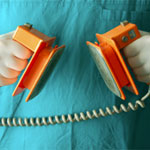
CNN – What really killed the beauty queen?

DefribrillatorShort answer — the risk is extremely minimal, at nearly zero. Hair transplants are a surgical procedure and if your doctor did not know what he is doing, you could die. There is one case report of a death during a hair transplant from a couple years back, which I wrote about before.
Not only could you die from the local anesthetic that is normally safe in proper doses, but you can have an allergic reaction, an arrhythmia of the heart, a stroke or heart attack at the time of the surgery (possibly the same risk as if you were home doing regular house work), or you could die of infections, amongst other things. Then again, you can also die at the dentist for similar reasons.

In the 19 years that I have been doing this surgery, I have never had a complication that could have produced death. The risk factor is incredibly low (statistically zero), so your chances of death are essentially none. You should also read these more in-depth posts if that doesn’t set your mind at ease:

  1. Hair Transplant Surgery Risks
  2. With the Death of Kanye West’s Mom After Plastic Surgery, I Wonder How Dangerous a Hair Transplant Is?

Patient’s Guide — How Many Grafts Will I Need?

Reprinted from the New Hair News, Vol. 12, 2007.
Click here to request your free copy, included with the “complete information package”.

—

People always ask, “How many grafts will I actually need to have transplanted?” Time and time again, that graft number answer will vary by doctor. When a doctor recommends a certain number of hairs/grafts, the doctor’s experience and his/her artistic skills are used to estimate what it might take to fill in the balding area with enough fullness to meet the person’s needs. I have seen estimates that could be a four fold difference and when you are shopping for a hair transplant, the differences in the estimating abilities of the doctors can be very unsettling. Who do you believe? Clearly you want to believe the doctor who has the lowest estimate for hair moved (transplants are priced by the graft), but then you are locking yourself into what might become a never ending series of hair transplant surgeries with an unrealistic amount of hair transplanted that may not meet your goals.

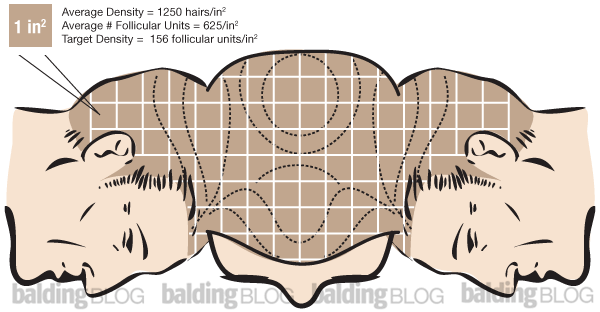
Does your doctor have the necessary artistic ability, not just to estimate the number of hairs/grafts, but also to take advantage of the hair supply to create a distribution that maximizes the value of the transplants for the most fullness? We have put some factors together to address how a surgeon actually calculates the numbers of grafts. These factors may not apply equally to all people. No two people are the same. The various factors like the thickness of the individual hair shafts (coarse vs. fine hair), the character of the hair (curly vs. straight hair), the color of the hair and the skin (the closer the match, the more full appearance of the hair), and any special needs defined by the patient, make us very different. On white skinned people, those with blonde hair have a fuller look while those with black hair will have a more ‘see through’ appearance. The blonde haired man, the very fine haired man, or the very bald man who has a hair supply that might not be adequate to cover the bald area will be different in their needs for fullness. When the calculations are not clearly evident, it is the doctor’s art that saves the day to maximize the value of the hair transplants that are received. We generally try to restore 25% of the original hair density in a ‘typical’ patient. Some people may require more than 25% of the original density and if you are one of these people, you should understand what you need and why you need it. Even if the overall achieved density is 25%, some areas may require more and some less than 25%. In people with fine or dark hair and light skin, a higher density than 25% of the original density is often required. In blondes with fair skin, less than 25% of the original density might meet the ‘fullness’ requirement. This is critical, because you look for fullness in the end result of the transplant process and it is the doctor’s art that addresses just how that fullness is to be achieved. Keep this in mind as you look to the analysis below.

The math for estimating number of grafts needed for a bald area:
We have proposed a 25% rule, which means that the balding person can go from a completely bald area to 25% of the original hair density that was there prior to the balding. The following calculation also assumes that the person used in this example has an average density of 2 hairs/mm2 (average density of a Caucasian). Every person is different, so the final number of grafts that will produce the fullness that a person wants to achieve (and can afford to purchase), are independent variables. These calculations were originally defined in a classic medical journal article written by Rassman in 1993 (Rassman, W.R.; Pomerantz, M.A. Minigrafts, the art and science. International Journal of Aesthetic and Restorative Surgery. 1(1): 27-36; 1993).

by William R. Rassman, M.D. and Jae P. Pak, M.D.

Could Putting On / Taking Off Hat Over and Over Cause Hair Loss?

Hello doctor. Thank you so much for taking the time to loo at and answer this question.

I know a question like this has been answered many times before, but I have a slight variation in the question concerning baseball caps and hair loss. My job (part-time) requires me to wear a hat and I have to wear it for about 5-8 hours straight each shift. I keep it a little bit loose so it doesn’t cause a cut off in circulation, but my question is, sometimes I adjust my hat, for example take it off and put it back on or shift it around a little bit.

I’ve read on other sites that putting your hat on/taking it off if you do it often/a few times can cause hairs to pull out/fall out. I do not know if there is any truth to these sources, so I am asking a professional. Is there ANY risk of thinning by wearing a baseball cap for long periods of time 3-4 times a week?

Also, how about hair nets, do they cause any damage/thinning to your hair?

Thank you so much and I hope this question doesn’t cause any irritation as it is a common one.

If the hat is not pulling on your hair, taking it off and putting it on over and over again should not cause any impact. Same goes for hair nets.

Basically, if something is tugging on your hair for extended periods of time, that is when you run the risk of developing traction alopecia, which is commonly seen in women with tight braids.


2010-08-10 09:27:06Could Putting On / Taking Off Hat Over and Over Cause Hair Loss?

People on Forums Swear by RU58841

I hear about a substance called RU in a bunch of the forums on the internet.Many of the people using it swear it helps the hairline. Do you have any on this at all?

I assume you’re referring to RU58841, which I still don’t know much about besides that it is an experimental anti-androgen out of Europe. I mentioned it earlier this year in a post, but I can’t comment on forum members swearing something works or doesn’t work. I prefer published proof in peer-reviewed medical literature, which I haven’t seen yet.

Could you imagine your hair transplant might look like this (photo)

Make sure that the doctor you choose is well credentialed and experienced. Always ask to meet some of the surgeon’s patients and then, if you meet someone like this, you know to run for the hills. Anyone can tell this is a bad hair transplant. This is a female whose doctor tried to create a rounded female hairline with mult-haired grafts in an even distribution without any sense of the needed quantity, the need for single hairs in an irregular irregular pattern in the frontal area and a shape that is normal appearing.

Petroleum Jelly Clogs Pores, Causing Hair Loss?

Two questions. I was at CVS and looking at the back of an olive oil hair conditioner product. It said that product, unlike petroleum jelly, does not clog hair follicles. So does petroleum jelly actually clog hair follicles and would this cause hair loss?

Also, this is not a new occurrence, but I often feel little bumps on my head that seem to be caused by dry scalp, but these feel like tiny pimples that cannot be popped. Does this have anything to do with MPB? Perhaps they’re inflamed hair follicles?

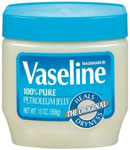
Vaseline petroleum jellyAlthough the popular theory seems to be that clogged follicles have their growth inhibited (hair being unable to grow because it is blocked), it is blatantly untrue. I do not believe petroleum jelly causes hair loss. The product you saw probably just had clever marketing and semantics so consumers will buy one hair conditioner product over another.

With respect to the bumps on your scalp, maybe it is pimples, and maybe you should have it checked out by your primary care doctor or dermatologist. I doubt it has much to do with balding, but I can’t tell something like that without an exam.

Does Creatine Really Cause Hair Loss?

Have you come across any studies which go on to show with considerable evidence that the bodybuilding supplement creatine can promote/speed up hair loss/mpb? There seems to be a lot of “broscience” when searching around, and I’d like to hear the thoughts of a professional.

Over the many years in this business, I have seen supplements that contain steroids (some labeled and some not labeled). I remember an article (didn’t save it) where the FDA caught some supplement company of putting steroids in with the Creatine, and not labeling it. They broke the law. Creatine, by itself, should not cause hair loss.


2018-11-14 07:35:44Does Creatine Really Cause Hair Loss?

Physical Activity Immediately Before a Hair Transplant Procedure

Hi Dr. Rassman:

I’m having a 3000-3500 graft strip procedure next Monday. I am an avid runner and long distance walker. I understand I should wait until the staples are removed to resume these activities. Is there any issue with running or walking for exercise in the days immediately before surgery?

Thanks

I don’t believe you can hurt anything by strenuous activities prior to your hair transplant surgery. After the procedure however, you should take it easy for at least a few days. You should completely avoid any activities that can increase the tension on the skin edges for several weeks after your hair transplant surgery. Running does not impact donor wounds, so I generally tell my patients that they can run a marathon after a week if they want. I gave that advice to a man last week and he told me that if his hair transplant allowed him to run a marathon, that was better than he could do prior to getting it. He was not a runner. Ha!

Better check with your doctor, because he/she might not agree with me.


2007-06-21 15:32:14Physical Activity Immediately Before a Hair Transplant Procedure