Dear Dr. Rassman
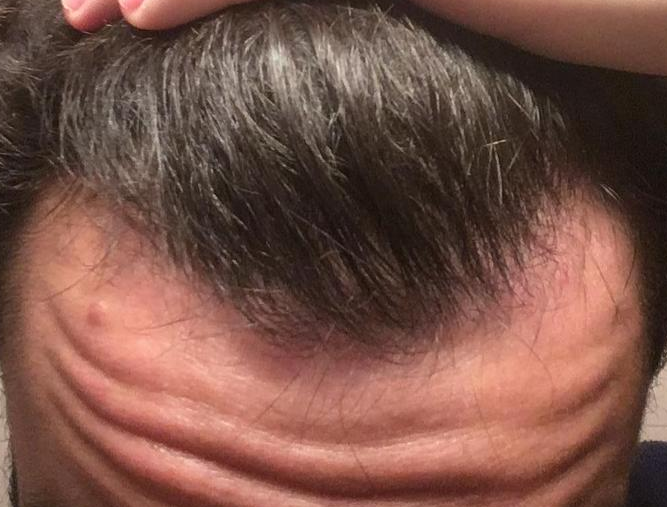
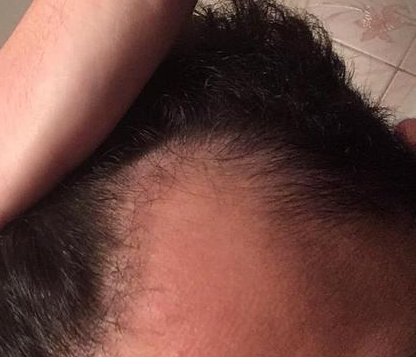
I’m a 54 years old male. I had a hair transplant operation on 30 June 2014 by FUT method followed by FUE method on 1st July to complete the transplantation. From the second day after operation I noticed that a big area in recipient part between crown and front of my head, the skin is so irritated (fig.1) and after 1 week it became completely black and was necrosed (fig.2).
Photos: Figure 1, Figure 2
I rang to my surgeon to consult on this issue. He said at your age this problem sometimes happens and I should wait until the skin being repaired and to speed up this procedure I should put warm towel on the necrosis area as well as making it oily by Vaseline to avoid dryness. I really don’t believe in the opinion of my doctor to relate this problem to my age, so I would highly appreciate if you let me know your opinion regarding the reason of this problem, is there any special treatment for such necrosis?
As the recovery procedure of the skin is so slow as shown in figs 3 and 4, I’m not sure that the transplanted follicles are not damaged. I thank you so much if receiving your valuable comments.
Photos: Figure 3, Figure 4
Sincerely yours
I am not clear on your history as you note a FUT (as in strip surgery) and fue (as in Follicular Unit Extraction Technique). There are some doctors who combined FUT and FUE (called FIT by one particular surgeon).
In my 23 years in this industry, we have performed hair restoration surgery in over 15,000 patients (with as many as 8 doctors working for the New Hair Institute at one time), so my experience is in the thousands of patients we have treated at NHI. Although I have never personally seen this complication in any of our patients, I have been aware of this complication in patients who have either consulted with me or I have heard about it through other doctors’ reports at medical meetings. At the recent meeting at the beginning of this month, one doctor presented 5 cases like this so your experience has been replicated at other clinics. This problem was more common in the 1993-1996 time frame, as doctors were increasing the number of grafts they were performing and not reducing the size of the punch or slit equipment. These doctors devascularized the scalp because their wound areas were too large or put too much epinephrine with the Xylocaine that negatively impacted the blood supply to the mid-scalp.
The central area of the scalp (where your problem is demonstrated) was the place where this complication has been seen most commonly, although I have seen patients referred to me where the finding was present in the donor wounds from FUT (strip) surgery. The least vascular area of the head is probably at that exact location because it reflects the end of the blood vessels that come from the side, back and front of the head. As you may know, balding produces an atrophic skin that is thin and not vascular with little infrastructure (fat) under the skin (where a normal scalp would be rich in blood supply, with many nerves per follicle, many hair follicles, considerable amounts of fat, etc..). The reason that the skin becomes atrophic in balding men is because the bald scalp does not need a rich blood supply, so the body withdraws the blood vessels in response to lack of demand. When a hair transplant is done, the demand of the new hair increases the blood supply and eventually the scalp is no longer atrophic and becomes rich in blood supply again.
I am certain that age is not an issue. Smoking may contribute to this problem. My oldest patients have been in their 80’s and we routinely operate on men in their 60s and 70s. I have done surgery on diabetics and in these people, I have not seen vascular problems either, but I often do not ‘dense pack’ these diabetic people for fear of such a complication. I personally had a hair transplant two year ago (at the age of 70) with no issue. I had an atrophic scalp resulting from 3 scalp reductions done in 1991-1992 that left my skin very, very thin and atrophic, yet I suffered no vascular effects from the transplant into my atrophic skin.
Some doctors believe that there is a risk for people who smoke, so if you are an active smoker, then this could be a contributing factor. If your surgeon used instruments that were larger than 18 gauge needles, then this could be a contributing factor. I have also seen necrosis when the doctor accidentally switched the routine medications used for anesthesia from a benign medication to a toxic medication; however, yours does not appear drug induced, because the necrosis would have been more immediate and more wide spread than your earlier pictures showed.
My educated guess is that there was a blood supply issue to the top of the scalp where blood supply is reduced in atrophic skin (something that you probably had based upon the photos you sent). How that happened is unclear. There are reports of necrosis in the donor area from FUE recently, and this is probably caused by taking the extracted hair follicles out too close to each other.
The treatment for this type of complication could be a problem. Usually, small areas of necrosis shed the dead skin and the wounds heal from the sides; however, large areas of necrosis puts you at risk for damage to the bones of the skull, so an experienced surgeon who knows of such risks should be consulted. Skin grafts may be necessary to protect the bone.
Please note that what I have stated here is NOT to be taken as a second medical opinion, but just an informational view from a well informed and experienced hair restoration surgeon. To evolve this into a formal second opinion, I would have to personally see you and examine you. If you would like a second medical opinion, please find and see a physician in person.